Want a new front for your Newcastle-under-Lyme premises? An aluminium frame gives you slim sightlines and a hard-wearing finish in any RAL colour, proportioned to the building rather than picked from a range.
Measuring the opening is the easy part of a survey in Newcastle-under-Lyme. We also look at the beam above, the pavement fall and any meters or drains nearby.
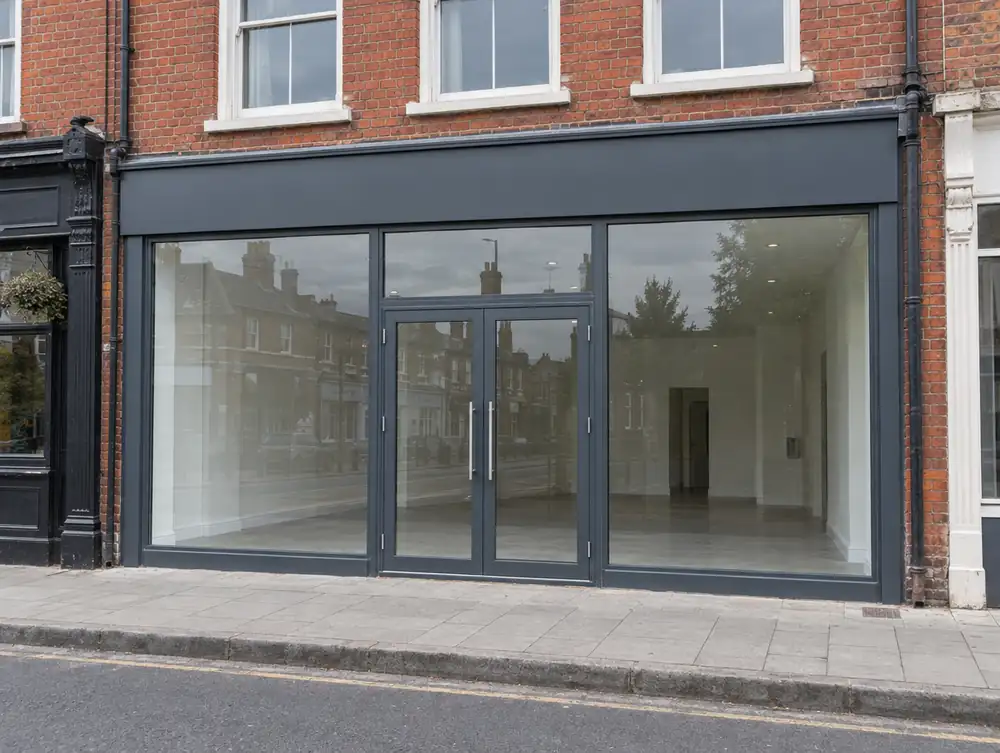
How do you design around the building when planning aluminium shopfronts in Newcastle-under-Lyme?
If your Newcastle-under-Lyme frontage faces south or west, the colour choice has a physical effect. Dark frames run hot in full sun and long runs of aluminium move, so we'd leave room for expansion at the fascia and look at solar control glass to protect stock.
Where a unit in Newcastle-under-Lyme can't afford a closed day, a night fit is worth pricing. Strip-out and frame go in over consecutive nights, with temporary boarding between shifts, so the shop opens each morning weathertight and secure.
Where the building has good brick or stone around the opening, set the frame back in the reveal so the masonry can be seen. On Newcastle-under-Lyme premises with a flat elevation, that deep reveal throws a shadow line that adds real depth in low sun.
What permissions should you check for aluminium shopfronts in Newcastle-under-Lyme?
England has no permitted development route for changing a shopfront. Part 7 Class A of the General Permitted Development Order 2015 excludes creating, altering or replacing one, and it allows no alterations at all on article 2(3) land. That leaves two outcomes for aluminium shopfronts at premises in the Newcastle-under-Lyme area: a planning application, or work that doesn't materially affect the external appearance.
Newcastle-under-Lyme applications for planning permission or advertisement consent are normally handled by Newcastle-under-Lyme Borough Council. Our survey includes a check of the position for your address.
What might aluminium shopfronts cost in Newcastle-under-Lyme?
The guide for aluminium shopfronts is £2,495 to £11,995 plus VAT for a typical 3 to 7 m frontage. Expect the lower end for simple work with clear access, and the upper end where detail, finish or awkward conditions add hours.
| Town | Newcastle-under-Lyme |
|---|---|
| Area | Staffordshire |
| Postcode districts | ST5 |
| Planning authority | Newcastle-under-Lyme Borough Council |
| Building approval | Building Regulations (Approved Documents) |
| Distance from Great Barr | About 35 miles |
| Survey | Free for new work |
Questions about aluminium shopfronts in Newcastle-under-Lyme
Can I keep trading while my Newcastle-under-Lyme shopfront is replaced?
Often, yes. The front can usually be replaced a section at a time, with temporary screens keeping the shop secure, and a closed-day or out-of-hours fit can be arranged if that suits you better.
Will an aluminium front make my Newcastle-under-Lyme shop warmer?
It can, though the glass matters more than the frame. A thermally broken section with double-glazed units loses less heat than single glazing, and a well-sealed door is often the change you notice most on a cold day.
Can you match a shopfront I like elsewhere in Staffordshire?
Usually, yes. Send the photo and address, and we'll work out the section, colour and proportions behind it, then adapt them to your Newcastle-under-Lyme opening.
Do I need planning permission to change a shopfront in the Newcastle-under-Lyme area?
Usually yes, if the work materially affects the building's external appearance. England's shop permitted development rights exclude creating, altering or replacing a shopfront, so there is no shortcut. A true like-for-like replacement usually needs no application, and the council confirms the position.
Does the Equality Act apply to a shop entrance in the Newcastle-under-Lyme area?
Yes. The Equality Act 2010 applies in England, as across Great Britain, and it requires reasonable steps to remove, alter or avoid physical features that disadvantage disabled people. The duty is anticipatory, so it looks at disabled people generally, and a new Services Code replaced the 2011 Code on 5 August 2026.