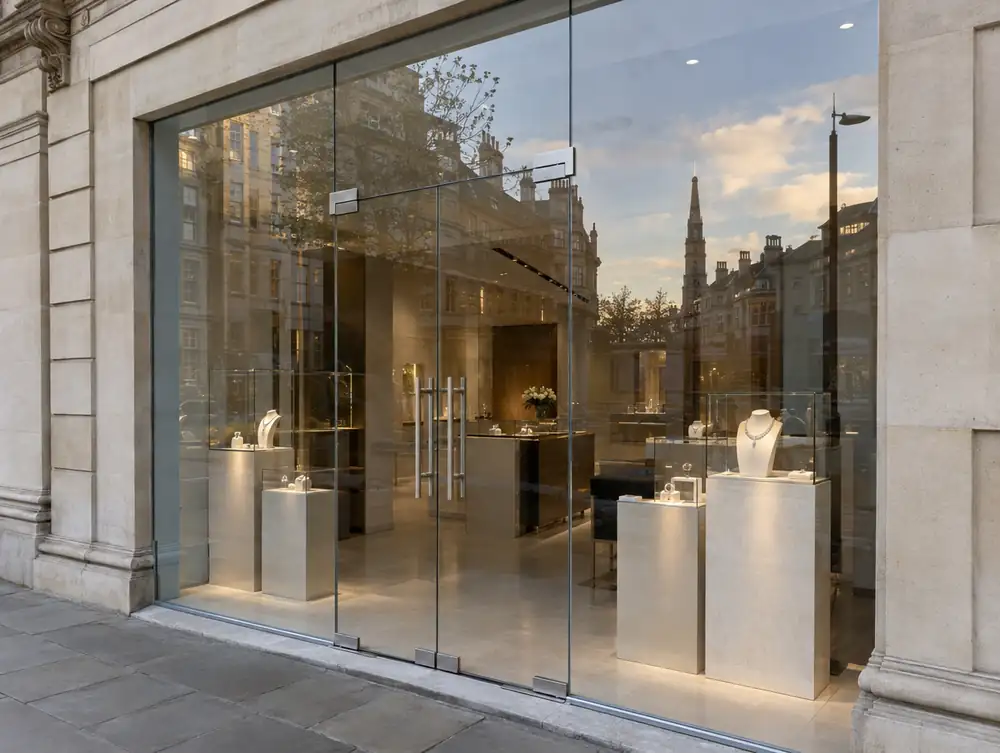
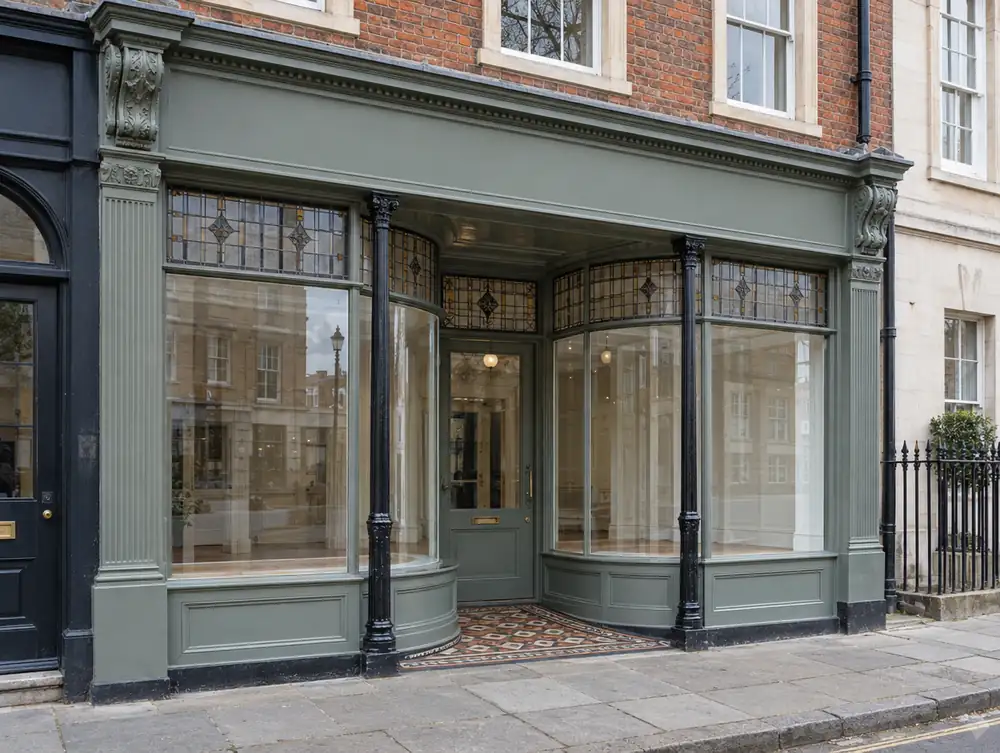
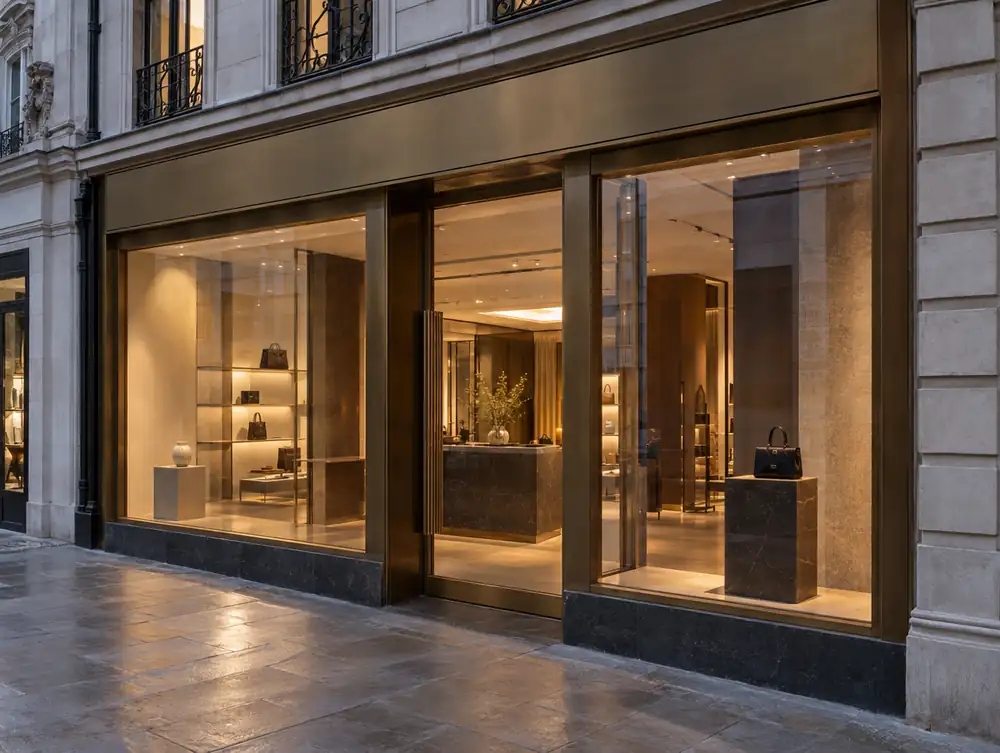
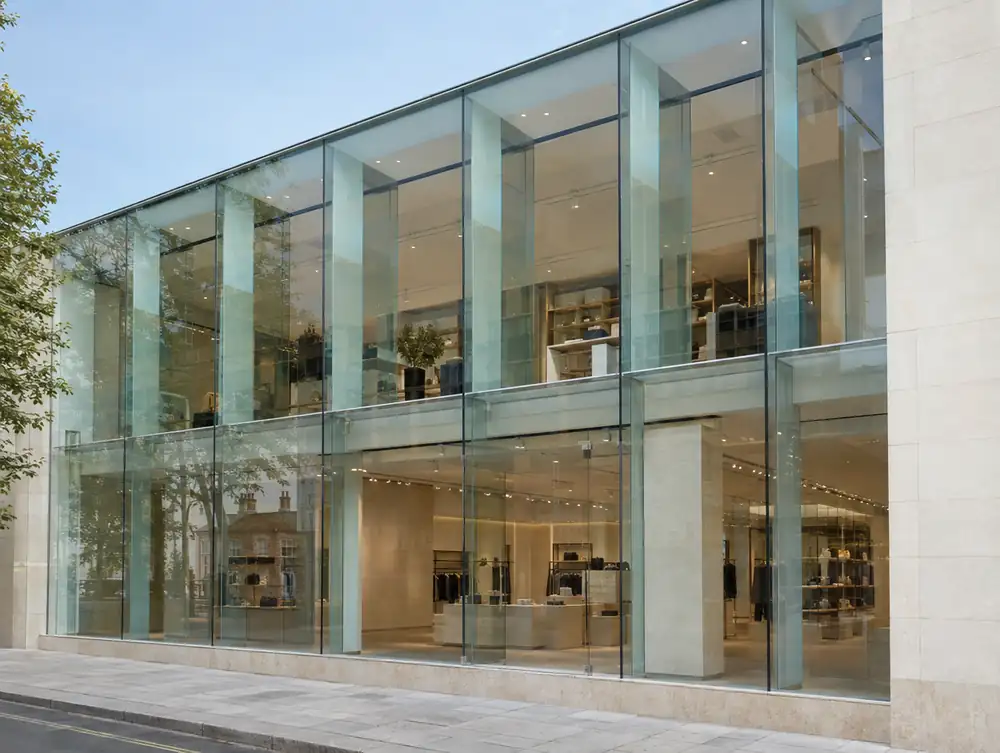
A curved glass shopfront uses panes bent to a set radius, in toughened or laminated glass, to wrap a corner, form a bay or draw people into a recessed lobby. It suits corner units, flagship stores, hotels and period buildings that already have a curve, where a faceted front would spoil the line.
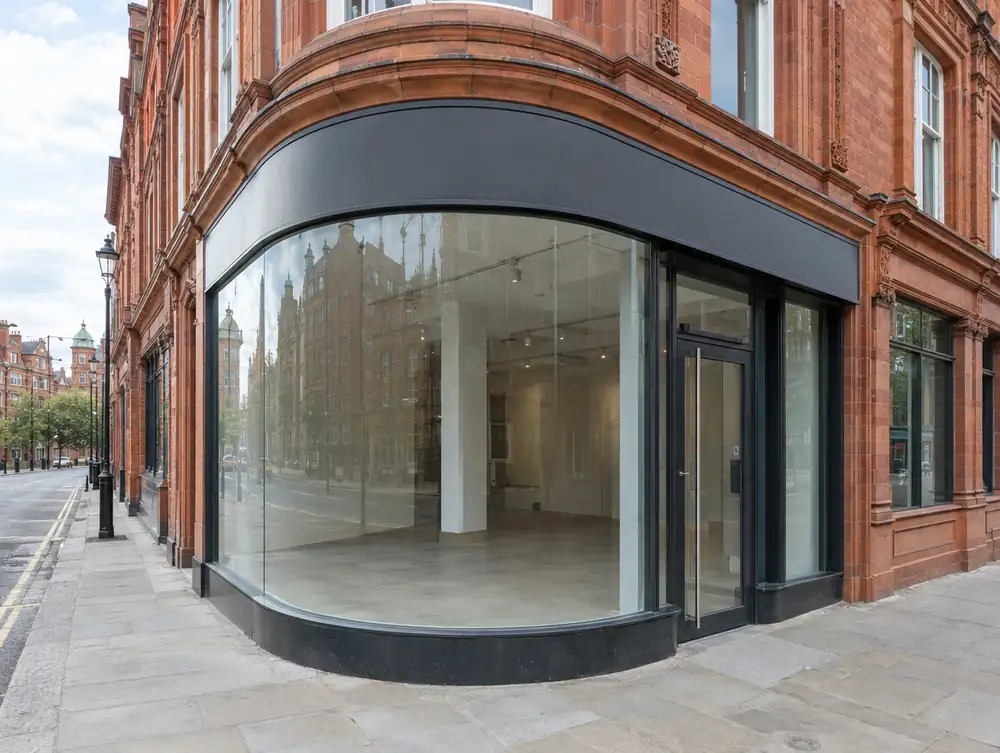
| Glass | Bent toughened or bent laminated panes, with build-ups set by the radius and pane size |
|---|---|
| Radius | Taken from the surveyed curve, with very tight radii limited to narrower panes |
| Framing | Roll-bent aluminium or bronze head and cill, or hidden channels for a frameless look |
| Joints | Silicone butt joints between panes, in clear or black |
| Template | Site template or laser survey at floor, mid-height and head |
| Typical lead time | Typically 8 to 14 weeks for glass after template approval, then 2 to 5 days on site |
| Designed to meet | BS EN 12600 impact classification and BS 6262-4 glazing practice, with glass certificates supplied where that applies |
| Comes with | Free measured survey, scale drawings, itemised quotation and a 10-year workmanship guarantee on its written terms |
When does curved glass earn its cost?
When the curve belongs to the building. A rounded brick corner, a period lobby or a bay already asks for it, and a faceted front there looks like a compromise. On a straight frontage with no reason for the bend, curved glass rarely pays for itself.
A good curve moves people. Round a corner, it leads the eye along the display without the hard stop of a post. In a recessed lobby, it pulls the pavement toward the door.
The stallriser and fascia have to follow the same arc as the glass. We set the head, cill and fascia from one centre point so the reveal stays constant round the bend. If the fascia is faceted while the glass is curved, the gap between them grows and shrinks, and everybody can see it.
How is curved glass made and measured?
Flat glass is heated and bent to a set radius, then toughened or laminated, so each pane is made for one curve and can't be altered afterwards. Bent glass also carries larger tolerances than flat, so the head and cill details need room to take up a few millimetres.
Measuring is the real skill. Old brick corners were built by eye and tend to drift from one radius to another, so a single measurement gives you an arc the building doesn't have. We template the real curve at floor, mid-height and head, then set the glass to the true average and lose the difference in the channel.
Where does curved glass go wrong?
Usually at the points where the curve meets something else. These are the faults we design out:
- Straight tails: many bending methods leave a short flat at the pane edge, so a butt joint can show a slight peak unless the supplier is told what you expect.
- Doors on the curve: a swing door can't hang from an arc. Keep the door on a straight section, or use a curved automatic sliding set.
- Head and floor out of line: if the cill curve and head curve don't share a centre, the pane twists when it is set in the channel.
- Handling: a curved pane won't sit on a normal A-frame, so it travels in a made crate and needs a planned route to the opening.
What does a curved pane cost to live with?
Daily upkeep is ordinary, and replacement is where the cost sits. Cleaning needs soft tools, since a straight squeegee can't follow a tight radius, and joints need the usual yearly look.
A broken pane is another matter. It means a made-to-order replacement at the original lead time, so plan how the opening would be protected for those weeks and check that your insurance covers it. Keeping the template and glass details on file saves real time, and a chain rolling out the same curve may want a spare pane in store.
Are there alternatives to curved glass?
Yes. A faceted run of narrow flat panes at small angles costs far less, and any pane can be replaced at normal lead times. Keep the facets to around 400 to 600mm wide, and from a distance the front reads as a soft curve, though close up the joints show. On a heritage corner, repairing an existing curved pane is often the better route than replacing it.
Which options can you choose from?
Bent toughened
Strong and clear, suited to frameless curves and larger radii. It breaks into small pieces like any toughened pane.
Bent laminated
Two bent plies bonded together, so a broken pane stays in the opening. Often the choice for display and period fronts.
Framed curve
Curved panes in a roll-bent metal head and cill, giving a crisp edge and a little more tolerance on site.
Frameless curve
Hidden channels and fine butt joints, so the glass seems to turn the corner by itself. It needs the tightest setting-out.
Faceted run
Narrow flat panes at slight angles, giving the feel of a curve at a lower price and with simple replacement.
Curved sliding door
An automatic door whose leaves follow the radius, keeping the arc unbroken at the entrance.
How much does it cost?
Guide price: £6,995 to £19,995 plus VAT for a typical frontage. This is a budget figure, and your free survey gives you the real one.
Work out a guide price or see all our prices.
Common questions
How much does a curved glass shopfront cost?
A curved glass shopfront costs £6,995 to £19,995 plus VAT for a typical frontage. The radius, pane height and glass build-up set the figure, and a tight bend or a curved door moves it up. Because every pane is made to a surveyed template, the quotation follows the measure-up.
How long does curved glass take?
Typically 8 to 14 weeks for the glass after the template is approved, then 2 to 5 days on site. That is longer than flat glass, so order well before any opening date. Allow for consent ahead of that where it applies.
Does a curved glass shopfront need planning permission?
Usually, if it changes the shape or look of the front. Replacing an existing curved pane like for like generally needs no application. On a listed building, an original curved pane is likely to be valued, so speak to the council before proposing to change it.
How do you clean curved glass?
Use clean water, a soft cloth and a flexible blade, because a straight squeegee won't follow a tight radius. Yearly checks of the joints and channels are enough for most fronts. Tell your window cleaner about the curve, as a heavy pole or rigid tool can catch an exposed edge.
Can curved glass be double-glazed?
Yes, but radius limits and lead times both tighten. Two curved panes have to match very closely to seal as a unit, so tight curves are often kept single-glazed. We'd check the options with the glass supplier once the radius is known.
What safety glass does a curved front need?
The same rules apply as for flat glass, and they differ by nation. England and Northern Ireland refer to BS EN 12600, Wales to BS 6206 and Scotland to BS 6262-4. We note the class on the drawing, and the certificate comes with the glass where that applies.
What happens if a curved pane breaks?
A new pane is made to the original template, typically at the same lead time as the first. Until then the opening has to be boarded or screened. Keep your template details safe, and check your insurance covers a made-to-order pane.