A canopy is a fixed projecting cover over a shopfront or entrance, and an awning is a fabric cover that retracts or folds away. They suit cafes, restaurants, food shops and any frontage that needs shade, shelter or more presence on the street.
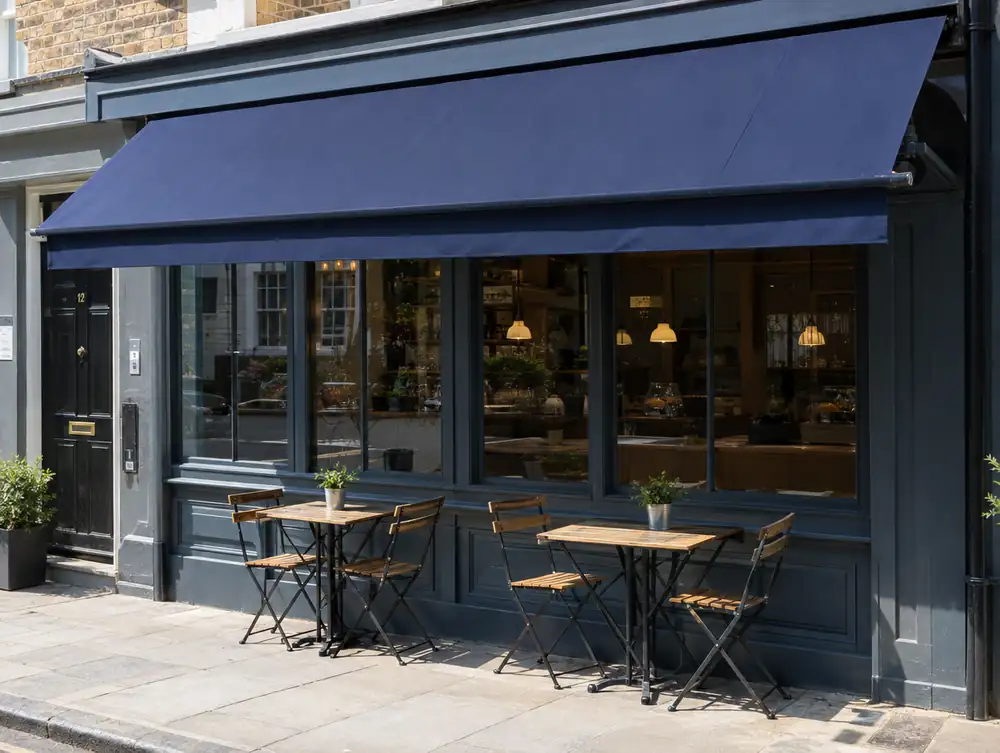
| Types | Traditional shop blind, folding arm awning, cassette awning, Dutch canopy, fixed steel or glass canopy |
|---|---|
| Fabric | Solution-dyed acrylic canvas around 300g/m², or PVC-coated polyester on fixed frames |
| Frames | Extruded aluminium arms and rollers, powder-coated steel, or stainless fittings on glass canopies |
| Typical projection | 1 to 3m for retractable awnings, and less where the pavement is narrow |
| Headroom | Designed around the 2300mm general clearance in Inclusive Mobility guidance, measured to the valance |
| Operation | Crank gear or tubular motor, with an optional wind sensor on motorised awnings |
| Typical lead time | Typically 3 to 6 weeks from signed drawings |
| Comes with | Measured survey, scale drawings, wall fixings designed for your structure, and a handover on safe use |
Should I choose a canopy or an awning?
Choose an awning if you want shade on sunny days and a clean frontage the rest of the time, and a fixed canopy if you want shelter all year. Cafes and food shops tend to need the first. Hotels, restaurants with queues and exposed entrances usually do better with the second.
Position is the design decision people miss. A retractable awning should disappear into a line the building already has, usually just below the fascia or in a recessed blind box. Fixed across the middle of the sign band, the box hides your name every time the awning goes in. Dutch canopies need more thought again, since their curved shape can tip a refined frontage towards the look of a takeaway.
How far can an awning project over the pavement?
Usually 1 to 3m, limited by headroom and the width of the pavement. We have found no statutory footway minimum, so we work from the Inclusive Mobility guidance of 2300mm generally, measured to the lowest part of the valance, and stop well short of the kerb.
A fixed structure over a public road is a further question. In England and Wales, section 177 of the Highways Act 1980 requires a licence for a structure over a highway, and that licence sets the headway. Northern Ireland uses Article 75 of the Roads (NI) Order 1993. In Scotland, ask the council how it treats a canopy over the footway.
Do canopies and awnings need planning permission?
Treat them as needing it unless your council says otherwise. We have found no specific permitted development class for canopies or awnings in any UK nation, so the question falls back on whether the appearance is materially affected, and a new canopy usually does that.
Printing your name brings a second question. In England and Wales an advertising awning or blind counts as an advertisement, so advertisement consent can apply as well. Listed buildings add listed building consent, and fixings into historic fabric need particular care.
Where do canopies and awnings go wrong?
Fixings fail first. A folding arm awning is a long lever, and a 5m wide cover in a gust puts a heavy pull on the top bolts. Anchoring into render, or into the outer leaf of a thin cavity wall, is how awnings end up on the pavement, so we find out what the wall is before drawing brackets.
Small errors show up later. If the mounting line is out by a few millimetres, the fabric tracks to one side and rolls up unevenly. Too shallow a pitch lets rain pond, and a bag of water will bend an arm in minutes. Most awnings want at least 15 degrees of fall.
Folding arm awnings are sun covers. Leaving one out in strong wind or heavy rain is the commonest cause of damage, which is why a wind sensor earns its cost on any motorised unit.
What do canopies and awnings cost to keep?
Plan on a yearly fabric clean and a spring service of the gears or motor. Acrylic canvas typically lasts 7 to 10 years before it fades or wears at the folds, and a sound frame can then take a new cover, which costs much less than a new awning.
Fixed canopies swap fabric care for gutters and glass. Clear the outlets twice a year, wash the glass as often as the shopfront, and repaint exposed steel when the finish starts to chalk. Always dry an awning out after rain, because rolled-up wet canvas grows mildew within days.
Which options can you choose from?
Traditional shop blind
A fabric blind on a timber or metal frame, folding into a box at the top of the shopfront. It suits period frontages and can often reuse an original blind box.
Folding arm awning
Sprung arms push out the fabric with no posts or side frames. It gives wide, clear shade, and it should come in when the wind picks up.
Cassette awning
A closed case protects the fabric and arms when retracted. It looks tidier on a modern frontage and adds years to the cover.
Dutch canopy
A curved fabric hood on folding ribs. It suits small entrances and windows, and the colour needs handling with restraint.
Fixed steel canopy
A steel frame with a fabric, metal or glazed top. It gives year-round shelter and needs structure behind it to match.
Glass canopy
Laminated glass on stainless or painted steel tie rods or brackets. It keeps daylight at the door and suits hotels and offices.
How much does it cost?
Guide price: £1,495 to £9,995 plus VAT per canopy or awning. This is a budget figure, and your free survey gives you the real one.
Work out a guide price or see all our prices.
Common questions
How much does a shop awning or canopy cost?
Canopies and awnings typically cost £1,495 to £9,995 plus VAT per canopy or awning. Width, projection, operation and the wall it fixes to make most of the difference. Fixed steel and glass canopies sit at the upper end of the range, and a small entrance blind sits near the lower end.
How long does an awning take to install?
Manufacture typically takes 3 to 6 weeks from signed drawings, and most awnings fit in a day or two. Fixed canopies can take longer on site, particularly if steel or glass needs lifting. Allow for any consent period first.
Do I need permission for a shop awning?
Often yes, because a new awning or canopy tends to affect the look of the building, and no specific permitted development class for them has been found in any UK nation. Printed names can add advertisement consent in England and Wales. Ask your council before you order.
How do I maintain a shop awning?
Brush off dirt regularly and wash the fabric with mild soapy water once a year. Have the arms, gears or motor serviced each spring, and let the cover dry before leaving it rolled for long. Replacement covers typically follow after 7 to 10 years.
Can an awning stay out in wind and rain?
No, not a folding arm awning. These are designed for sun and light showers, so retract them before wind builds or heavy rain arrives. Fixed canopies are designed for all weather, and a wind sensor can protect a motorised awning when nobody is around.
Can my name go on the awning?
Yes. Lettering usually sits on the valance, where it stays upright and readable when the awning is out. It can be printed, cut in or sewn. Keep the text short, because the valance is often only 200 to 300mm deep.
Can an awning be fixed to a rendered or cavity wall?
Yes, with the right fixing. We find out what sits behind the surface, then use long resin anchors into solid structure or a spreader plate across several bricks. A thin outer skin alone will not carry the load.