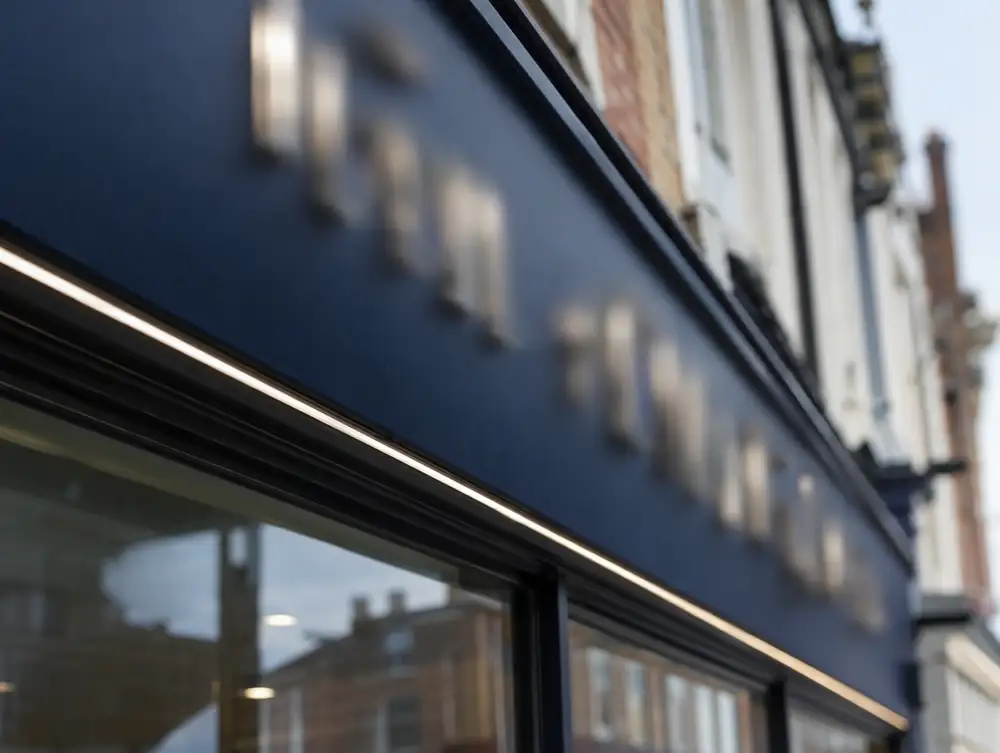
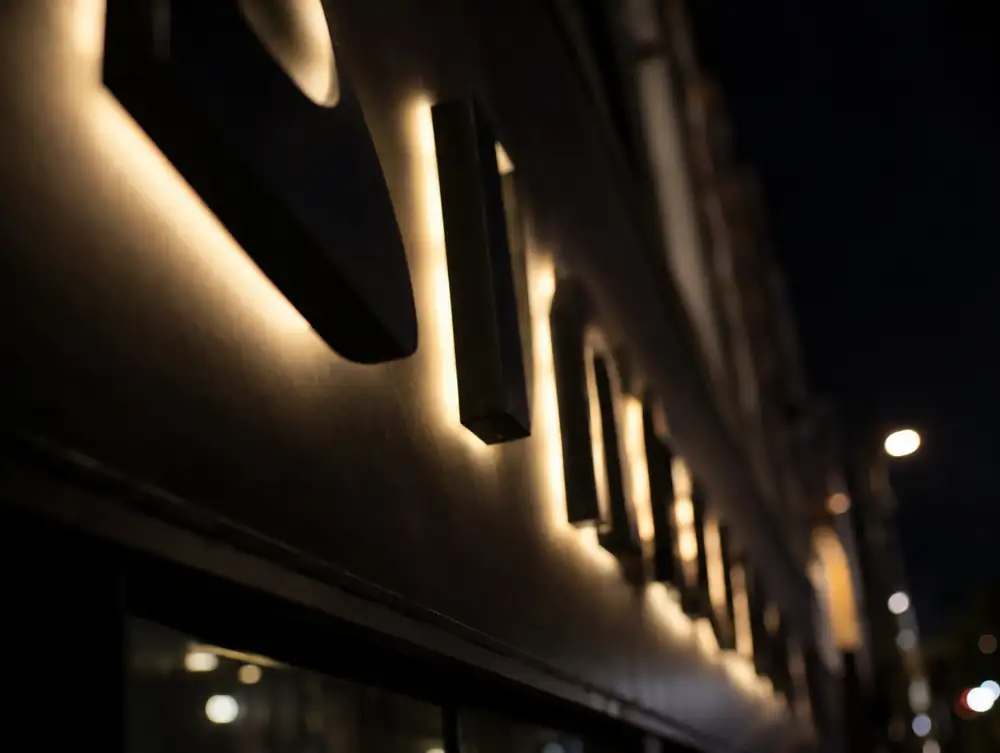
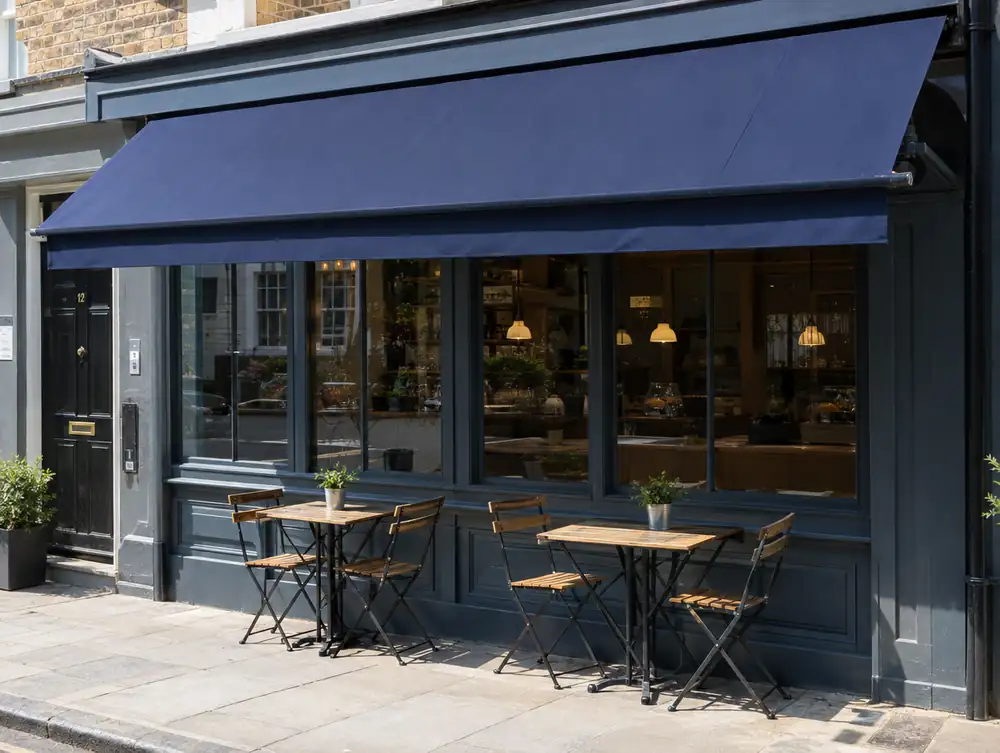
A projecting sign is fixed at right angles to the building, so people can read it as they walk along the pavement. It suits shops on long parades, first-floor businesses, pubs, cafes and any frontage that cannot be seen head-on until you reach the door.
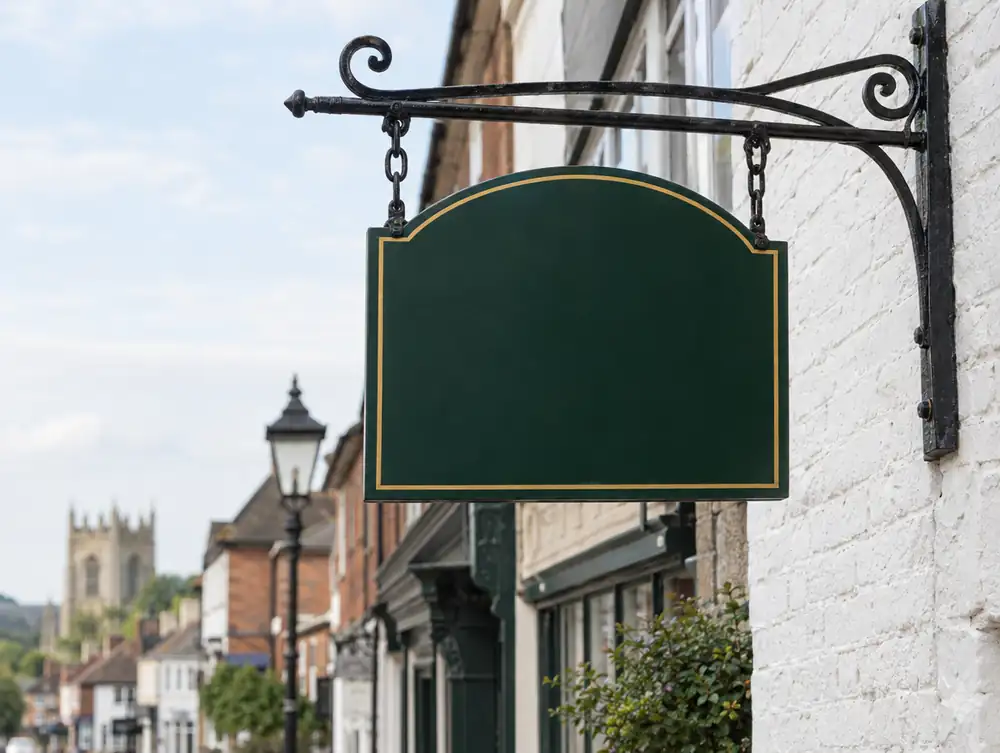
| Sign types | Hanging panel on a bracket, fixed blade sign, double-sided lightbox or cut-metal shape |
|---|---|
| Typical size | 500 to 900mm across, with faces in composite, painted hardwood or metal |
| Bracket | Powder-coated steel or aluminium, stainless steel, or traditional forged ironwork |
| Clearance | Set at around 2.3 to 2.5m above the pavement, and 2.5m where a lit-sign class applies |
| Fixing | Resin anchors and stainless threaded rod through the facing into solid masonry |
| Lighting | Internally lit box, trough light or small spotlights, where consent allows |
| Typical lead time | Typically 2 to 4 weeks from approved artwork, longer for forged ironwork |
| Comes with | Measured survey, scale drawing showing height and projection, fixing and making good |
Why have a projecting sign?
A projecting sign gives you a second audience: the people walking along the pavement who cannot see your fascia until they are level with it. On a long parade it can do more for footfall than a larger fascia ever will.
Keep the content simple. Someone reads it for a second or two at an angle, so a symbol or a short name works better than a phone number and a list of services. We usually set it at fascia level, centred on a pilaster or the party line, so it feels like part of the frontage and not an addition.
How big can a projecting sign be?
The limits depend on the nation and on whether the sign is lit. These are the figures for lit projecting signs under the deemed consent classes. Anything larger needs express consent, and your council confirms what applies.
- England: 0.75m² per face, 1m high, projecting 1m or two-thirds of the footway if less, and never over the carriageway.
- Wales: 0.75m² per face, 1m high, projecting 1m.
- Northern Ireland: 1m² per face, 1m high, projecting 1m or two-thirds of the footway.
- Scotland: the lit class has a 0.25m projection limit, so most lit projecting signs fall outside it.
How high should a projecting sign hang?
Keep the lowest edge at 2.5m or more wherever the building allows. Lit-sign classes require that height, and it comfortably clears the 2300mm general headroom and 2100mm for suspended signs given in the Inclusive Mobility guidance. Stay well back from the kerb line too, because high-sided vehicles sit closer to it than you might expect.
Highway powers sit behind this. Signs are named in section 152 of the Highways Act 1980, which lets the authority act on dangerous projections in England and Wales. Scotland has section 88 of the Roads (Scotland) Act 1984, and Northern Ireland has Article 55 of the Roads (NI) Order 1993.
Where do projecting signs go wrong?
A projecting sign is a lever. Wind on a 600 by 900mm panel at the end of a 1m bracket puts a real pull on the top fixing, and render will not hold it. We fix through the facing into solid masonry with resin anchors, angling the holes slightly so water runs out.
Hanging signs have their own weakness. The eyes and shackles rub together with every gust and wear thinner each year, unnoticed from the ground. We use stainless fittings with a sacrificial bush and draw the bracket with a hidden stop, so the panel cannot swing into the wall.
What does a projecting sign cost to maintain?
Very little, if you look at it once a year. Check the fixings, shackles and any seals from a ladder or platform, and wash the panel when the fascia is cleaned. Painted ironwork and timber typically need redecorating every 5 to 7 years, and a good coat of paint on the bracket will outlast several on the panel.
Which options can you choose from?
Painted hanging sign
A timber or composite panel hung from a bracket. It suits traditional frontages, pubs and cafes, and it can be repainted by hand.
Fixed blade sign
A slim rigid panel fixed directly to the wall. It suits modern frontages and has no moving parts to wear.
Double-sided lightbox
An illuminated box with a printed face on each side. It reads well at night, and it is the hardest of these to get through a council.
Cut-metal shape
A logo or symbol cut from aluminium or steel. It casts a sharp shadow and can read without any words at all.
Forged iron bracket
Traditional scrollwork made to your drawing. It suits period buildings, and the bracket can carry a replaceable panel.
How much does it cost?
Guide price: £395 to £1,295 plus VAT per sign. This is a budget figure, and your free survey gives you the real one.
Work out a guide price or see all our prices.
Common questions
How much does a projecting sign cost?
Projecting signs typically cost £395 to £1,295 plus VAT per sign. Lighting, forged ironwork and difficult access take a job towards the top of that range. The fixing into your wall and any making good are itemised in the quotation.
How long does a projecting sign take?
Manufacture typically takes 2 to 4 weeks from approved artwork, with forged ironwork taking longer. Fitting usually takes half a day, and any consent period comes first.
Does a projecting sign need consent?
Often, particularly if it is lit or in a sensitive location. The limits differ by nation, and Scotland's lit class has a 0.25m projection limit that rules out most lit projecting signs. Your council confirms the position, and displaying an advert without consent is a criminal offence.
How often should a projecting sign be checked?
Once a year is usually enough, ideally before the autumn winds. Look for movement in the bracket, wear on shackles and cracks around the fixings. A sign that has started to rock should be taken down until it is repaired.
Can a projecting sign go on a rendered wall?
Yes, as long as the fixings pass through the render into solid masonry. Render alone cannot carry the load, and a hollow patch will fail. We check by tapping and drilling a test hole at survey.
How far above the pavement must a projecting sign be?
Aim for 2.5m or more to the lowest edge. Lit-sign classes require it, and guidance gives 2100mm for suspended signs as a minimum working figure. We show the height on the scale drawing so everyone can check it.
Should a projecting sign be double-sided?
Almost always. People approach from both directions, and a blank back looks unfinished. Keep the same artwork on each face, unless a street name or a different message is genuinely useful.