What should your premises say from across the road? We open every conversation about projecting signs in Cumbria with that question, then treat sightlines and proportion as seriously as the budget.
Most frontages share something with someone, be that a door to the flats above, a meter cupboard or a pilaster on the boundary. We pick those up early on projecting signs in Cumbria, because they are far easier to design around than to discover on the day.
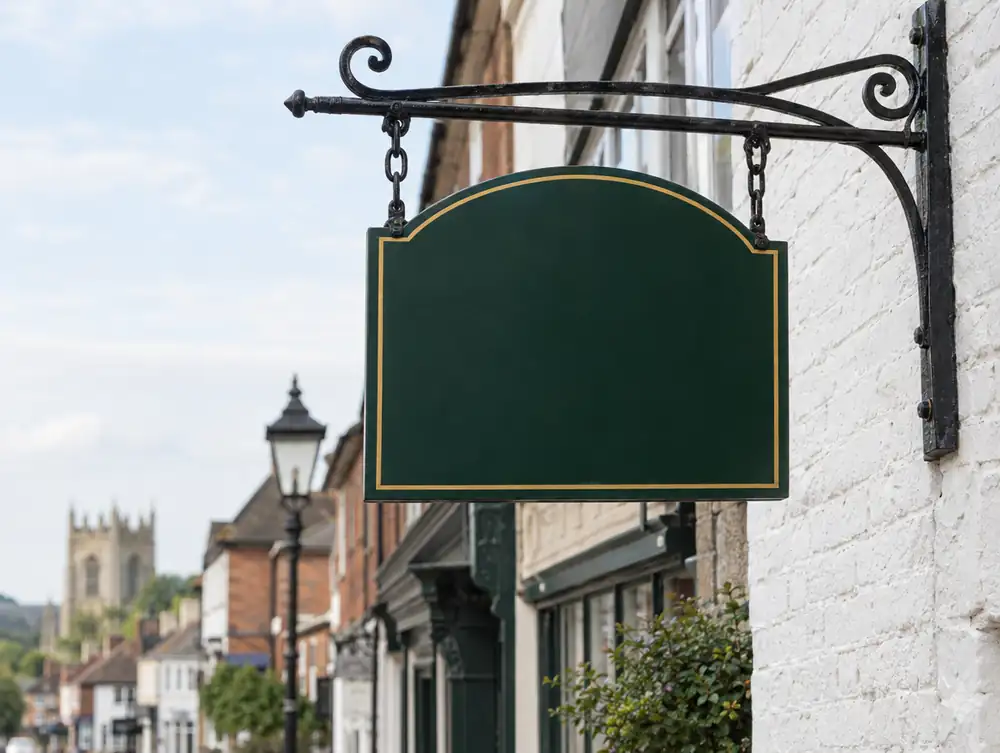
What should you look for from projecting signs in Cumbria?
Narrow pavements call for a smaller sign. If your premises in Cumbria open onto a tight footway, we keep the projection modest and the height generous, so the sign stays clear of people and vehicles.
Sightlines along the street decide the position. On premises across Cumbria we walk the pavement from both directions at survey, because a lamp post, tree or neighbouring sign can hide a sign from the side people arrive.
What consents apply to projecting signs in Cumbria?
A true like-for-like replacement usually needs no planning permission in England, because the external appearance isn't materially affected. New materials, a different glass line or altered proportions usually do count as material, so for projecting signs at premises in the Cumbria area, an application is then likely. The council confirms which side of that line a job falls on.
Lighting moves a sign out of Class 5 in England, because that class allows illumination only for medical-type notices. Class 4B then applies at premises in the Cumbria area: halo or character-only lighting, static, with the lowest part at least 2.5m up. Brightness is capped at 600 cd/m² on signs up to 10m² and 300 cd/m² above that, and anything outside these limits needs advertisement consent.
How much do projecting signs cost in Cumbria?
As a working budget, use £395 to £1,295 plus VAT per sign. Your place inside that range for projecting signs depends mostly on how much of the existing frontage can stay and how much has to be put right first.
| Area | Cumbria |
|---|---|
| Nation | England |
| Towns covered | 9 |
| Main town | Carlisle |
| Planning regime | England: TCPA 1990 and the 2007 Advertisement Regulations |
| Building approval | Building Regulations (Approved Documents) |
| Survey | Free for new work, from our Great Barr base |
Questions about projecting signs in Cumbria
What artwork works on a small hanging sign around Carlisle?
Bold, simple artwork works, with a logo or a short name. Fine lettering and long strap lines get lost at an angle, so we test the design at full size.
Can you fit a projecting sign to a stone or brick wall in Cumbria?
Yes. Hard stone and sound brick both take resin anchors well, and soft brick needs a longer, wider fixing. We drill into mortar joints or discreet positions where the wall needs protecting.
How long does fitting take on premises in Cumbria?
Usually about half a day from a ladder or tower, with a little longer if a cable has to be run for lighting. The shop can normally stay open while we work.
Does a new shopfront in the Cumbria area need Building Regulations approval?
Assume yes until building control says otherwise. England has no like-for-like exemption, though registered installers can self-certify replacement windows and doors in non-dwellings. That route doesn't cover structural glass, curtain walling or revolving doors.
Do I need planning permission to change a shopfront in the Cumbria area?
Usually yes, if the work materially affects the building's external appearance. England's shop permitted development rights exclude creating, altering or replacing a shopfront, so there is no shortcut. A true like-for-like replacement usually needs no application, and the council confirms the position.