Planning and consents is the service of preparing the drawings, statements and forms a council needs to decide on a change to your frontage. It suits anyone changing a shopfront, sign, shutter or canopy, particularly on a listed building or in a conservation area, and the decision always rests with the council.
| Applications covered | Planning permission, advertisement consent and listed building consent, plus conservation area consent where it applies |
|---|---|
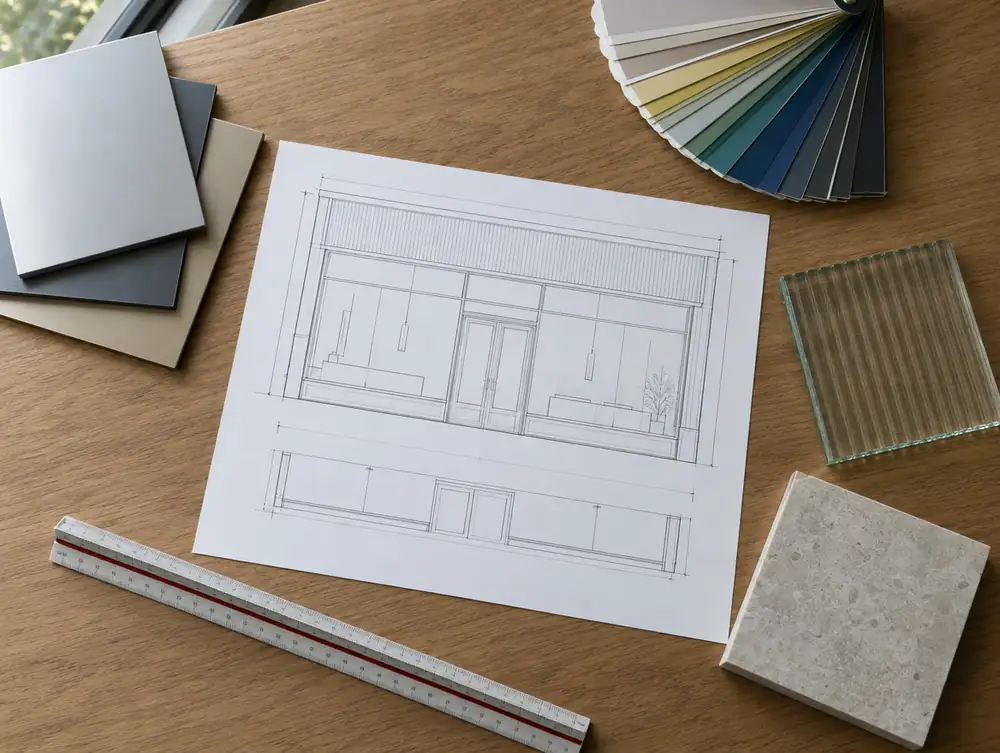
| Drawings | Location plan, existing and proposed elevations, plan and section, with key details |
| Supporting notes | Design and heritage notes where the council asks for them, with a materials and lighting schedule |
| Who decides | Your council or planning authority. In Wales, planning authorities and Welsh Ministers share control of listed building consent |
| Official fee | Set by each nation and paid to the council on top of our fee, with dated figures shown below |
| Typical decision time | Typically 4 to 8 weeks, and longer for listed buildings and sensitive sites |
| Building approval | A separate step: Approved Documents in England and Wales, building warrants in Scotland, Building Control and Technical Booklets in Northern Ireland |
| Comes with | Measured survey, scale drawings, submission of the application and replies to the officer's questions |
Do I need planning permission to change my shopfront?
Usually yes, if the work materially affects the appearance of the premises. We found no permitted development route for changing a shopfront in any UK nation. England and Wales exclude creating, altering or replacing a shop front from the rights for shops, Scotland excludes work that alters or extends beyond the existing front, and no route has been found in Northern Ireland.
A true like-for-like replacement usually doesn't need permission, because the appearance stays the same. The word true matters here. A slimmer frame, a different colour or a new door position can all tip it over the line, so ask your council before you order.
Which consents might a frontage need?
One job can need several consents, each with its own decision. Work through this list before fixing a programme.
- Planning permission covers changes that materially affect the appearance.
- Advertisement consent covers signs, under separate regulations in each nation, and displaying an advert without it is a criminal offence.
- Listed building consent is decided by the local planning authority in England, by planning authorities and Welsh Ministers in Wales, by the planning authority in Scotland and by councils in Northern Ireland.
- Conservation area consent covers demolition in Wales, Scotland and Northern Ireland. England ended it in 2013 and uses planning permission.
- Building approval is separate from planning, and it follows the system of your nation.
What does a council charge for a shopfront application?
No fee schedule names shopfronts, so these are the closest categories, and your council confirms the actual fee. Our charge for preparing it is typically £395 to £1,295 plus VAT per application, plus the council's fee.
- England, from 1 April 2026: £309 for an alteration, and £174 for adverts on business premises.
- Wales, from 1 December 2025: £383 for an alteration with no added floor space up to 40m², and £248 for adverts on business premises.
- Scotland, from 1 April 2026: £371 for an alteration under Category 4, and £371 for adverts.
- Northern Ireland, from 1 April 2025, the latest schedule found: £220 for an alteration under Category 5, and £231 for adverts.
- Listed building consent carries no fee in England.
How long does a decision take?
Typically 4 to 8 weeks for a straightforward application, and longer on listed buildings. Heritage bodies may be involved: Historic England is notified of certain works, Historic Environment Scotland is consulted on some applications, and the Historic Environment Division is a statutory consultee in Northern Ireland.
Don't order anything until the decision is in hand. A sign or frame made too early can be wasted money, and it leaves no room for amendments the officer may ask for.
Where do shopfront applications go wrong?
Thin drawings cause more trouble than bad ideas. An officer reads a section through the fascia and reveal far more closely than a glossy visual, so we draw how deep the glass sits and what the fascia is made of. If the existing elevation is 50mm out against the real building, confidence in the rest goes with it.
Leaving items out is the other classic error. A shutter box, a lit sign or a canopy added after approval can reopen the whole question, so we put everything on one set of drawings. Keep an eye on conditions too. Consent can fix a colour, a material or lighting hours, and those become a commitment you carry when the frontage is next repainted.
Which options can you choose from?
Planning application
Drawings and forms for a change to the frontage. It is the starting point for most new shopfronts and external shutters.
Advertisement consent
An application for a sign that falls outside the deemed limits. Lit signs and sensitive locations are the usual reasons.
Listed building consent
Drawings and heritage notes for work to a listed building. It often runs alongside a planning application.
Early enquiry
A short drawing and note to test the idea, where your council offers pre-application advice. It can save a wasted full application.
Design and application package
Design service and application handled together. The drawings are prepared with the officer's questions in mind from the start.
How much does it cost?
Guide price: £395 to £1,295 plus VAT per application, plus the council's fee. This is a budget figure, and your free survey gives you the real one.
Work out a guide price or see all our prices.
Common questions
How much does a planning application for a shopfront cost?
Our fee is typically £395 to £1,295 plus VAT per application, plus the council's fee. The council's fee is set nationally, and it varies by nation and category, so your council confirms it. Listed buildings usually need extra notes, which takes the fee towards the top of the range.
How long does planning take for a shopfront?
Typically 4 to 8 weeks from submission for a straightforward case, with drawing time before that. Listed buildings and conservation areas usually take longer. Your programme should not depend on an exact date.
Can you guarantee my application will be approved?
No. We prepare the drawings and application, and the council decides. What we can do is present the proposal clearly and tell you honestly where we expect resistance.
Does a like-for-like replacement need permission?
Usually not for planning, because the appearance is not materially affected. Building regulations can still apply, since England and Wales have no like-for-like exemption for that purpose. A listed building is different again, so ask first.
Do the rules differ between councils?
Yes. The four nations have different systems, and individual councils publish their own design guidance. Wales passed a new Planning (Wales) Act in 2026, but most of it still awaits a commencement order, so the current rules apply for now.
Should the tenant or the landlord apply?
Agree this with your landlord first, because the lease usually controls alterations. The council's forms deal with ownership, and it can tell you what it needs. We prepare the application for whichever of you applies.
Does consent affect how I maintain my shopfront?
It can. Conditions may fix a colour, material or lighting hours, so check them before repainting or changing a sign. On a listed building, like-for-like repair may not need consent, but ask your council before you start.