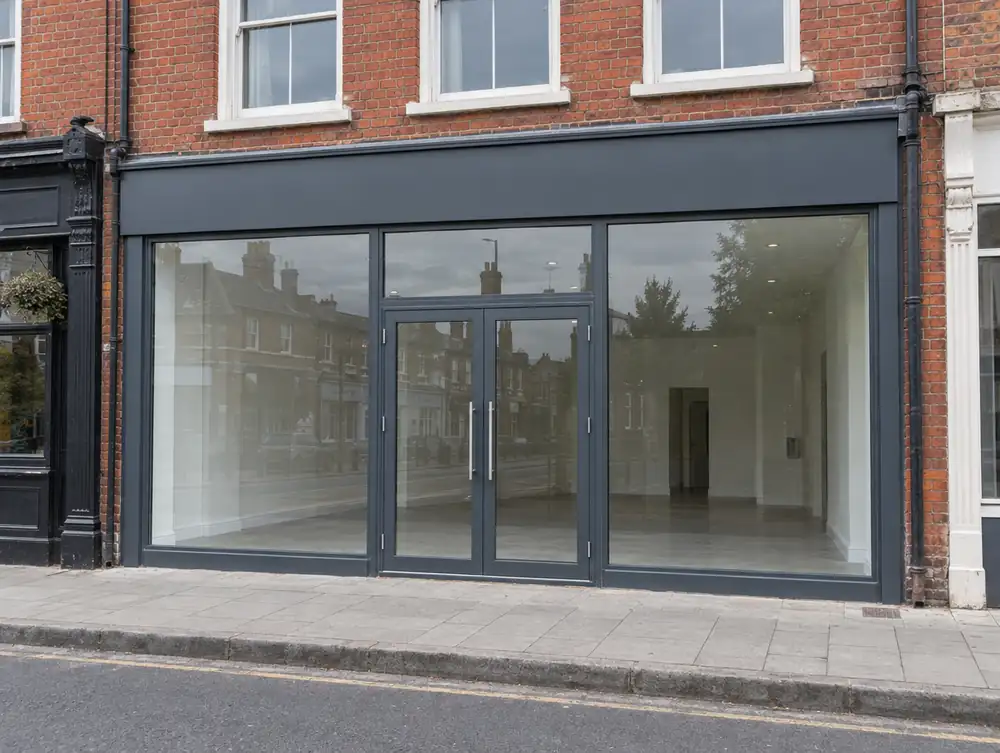
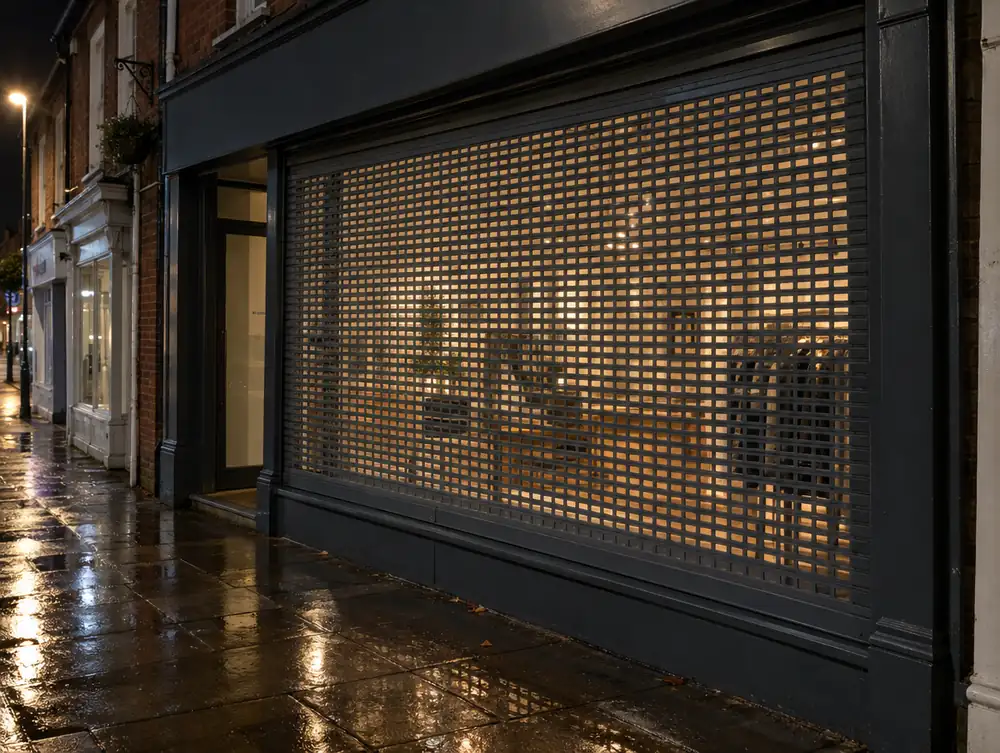
A perforated roller shutter is a steel or aluminium curtain punched with small holes, so light and the shop display stay visible when it is closed. It suits shops, jewellers, pharmacies and showrooms that need out-of-hours protection without leaving a blank wall on the street.
| Curtain | Roll-formed aluminium or galvanised steel laths around 75mm high, powder coated to a RAL colour |
|---|---|
| Perforation | Micro-perforated laths or larger punched holes, with typically 20 to 30% open area |
| Box | Usually 200 to 300mm square depending on height, housed behind the fascia or inside the shop |
| Guides | Aluminium or steel channels, typically 60 to 100mm deep, fixed to solid structure |
| Operation | Tubular or external motor, key switch or remote, with a manual override |
| Standards | Designed to meet BS EN 13241:2003+A2:2016, with LPS 1175 or BS EN 1627:2021 rated products available where the risk calls for them |
| Typical lead time | Typically 3 to 5 weeks from signed drawings, plus any consent period |
| Comes with | Measured survey, scale drawings, installation and commissioning, with the certificate supplied with the product where that applies |
Do external roller shutters need planning permission?
Usually yes, and they are one of the items planners resist most often. In England and Wales, installing or replacing a shutter on a shopfront is expressly outside the permitted development rules for shops. Scotland and Northern Ireland do not name them in the same way, so the question there is likely to turn on whether the appearance is materially affected, and a new external shutter generally does that.
Councils worry about what a closed frontage does to a street after hours. Perforation helps that argument, but it does not settle it, and a conservation area or listed building makes it harder. We prepare the drawings and application if you want to try, and we will tell you plainly if an internal shutter looks more realistic. The council decides.
Should the shutter go inside or outside the glass?
Inside, in most cases. An internal shutter keeps the frontage looking the same by day and by night, and it usually makes for a far easier conversation with the council. It does have limits, so weigh these honestly.
- Internal shutters protect the stock, not the glass, so a broken pane still has to be replaced. Laminated glass closes much of that gap.
- They need ceiling space for the box and a clear line behind the window, which may cost some display depth.
- External shutters do protect the glass, and they suit premises where the risk is high and the council will accept them.
- An external box needs designing into the fascia, or it will sit on the front of the building for good.
How see-through is a perforated shutter?
Expect a veiled view. With 20 to 30% open area, a lit display reads as a soft image from the pavement, and the effect depends heavily on what is happening behind it.
Two things make a big difference. Leave low-level lighting on in the display overnight, or the shutter will read as grey metal. Choose a darker finish too, because pale laths reflect street light into your eye and hide what lies behind, while dark ones almost fall away.
Where do shutter installations go wrong?
Planning the box too late is the usual mistake. A 250mm box added after the shopfront is finished lands on the outside of the fascia or across the top of the glass, so we draw it with the frontage from the start.
Guides are the next weak point, because they often land on a stallriser or a thin aluminium frame. An attacker works on the bottom corners first, so the fixings at low level matter most. Check with your insurer before you order as well, since some policies name a shutter type or rating. Finally, a shutter must never close across an escape route while people are inside, and a manual override should be reachable if the power fails.
What does a roller shutter cost to run?
Power use is negligible, so the running cost is mainly servicing. Budget for one planned service a year at £145 plus VAT per shutter, which covers the curtain, guides, limits and safety edge.
Perforated laths collect dirt faster than solid ones, so wash the curtain as often as the shopfront. Motors typically last 7 to 10 years in daily use, and a shutter that starts to slow, tilt or strain should be looked at before it stops halfway down at closing time.
Which options can you choose from?
Internal perforated shutter
Fitted behind the glass, with the box in the ceiling line. The frontage keeps its daytime look, and the display stays visible at night.
External shutter in a hidden box
The box sits behind the fascia and the guides are colour matched. It protects the glass as well, and consent is the main hurdle.
Micro-perforated aluminium
Fine holes across a light curtain. It gives a smooth look from a distance, and it is the natural choice for an internal shutter.
Punched steel
Larger holes in a heavier galvanised curtain. It lets more light through and resists more force, with a more industrial look.
Open roller grille
An open lattice of links in place of laths. It is the most transparent option, and it suits internal use in malls and arcades.
Rated security shutter
A shutter tested to LPS 1175 or BS EN 1627 for higher-risk premises. Ask your insurer which rating they want before specifying one.
How much does it cost?
Guide price: £1,695 to £4,495 plus VAT per shutter. This is a budget figure, and your free survey gives you the real one.
Work out a guide price or see all our prices.
Common questions
How much does a perforated roller shutter cost?
Perforated shutters typically cost £1,695 to £4,495 plus VAT per shutter. Width, motor type, box position and any security rating set the final figure. The quotation shows each item, and nothing is ordered until you accept it.
How long does a roller shutter take to fit?
Manufacture typically takes 3 to 5 weeks from signed drawings, and most shutters are fitted in a day. Consent for an external shutter comes first and can add a further 4 to 8 weeks, typically. Fitting can be arranged out of hours to protect trading.
Do perforated shutters need planning permission?
External ones usually do, and councils often resist them even when perforated. In England and Wales they are expressly outside the permitted development rules for shops, and elsewhere a new external shutter generally affects the appearance. An internal shutter behind the glass usually avoids the question, but ask your council to confirm.
How often should a shutter be serviced?
Once a year for most shops, and more often if it runs many times a day. Keep the guides clean, and never force a shutter that has jammed. A yearly service typically costs £145 plus VAT per shutter and catches most faults early.
Can people see my display through a perforated shutter?
Yes, as a soft view, not a clear one. It works well with a dark curtain and a lit display behind it. If the interior goes dark at night, the shutter will read as a plain metal surface.
Will a perforated shutter satisfy my insurer?
It depends on your policy and your stock. Some insurers name a particular rating or a solid curtain for higher-risk goods, so ask before you order. We can supply the product's test information for them to review.
What happens to the shutter in a power cut?
A manual override lets you raise or lower it by hand, using a crank or chain. We position it so it can be reached from inside. Ask for a demonstration at handover, so everyone who closes up knows how it works.