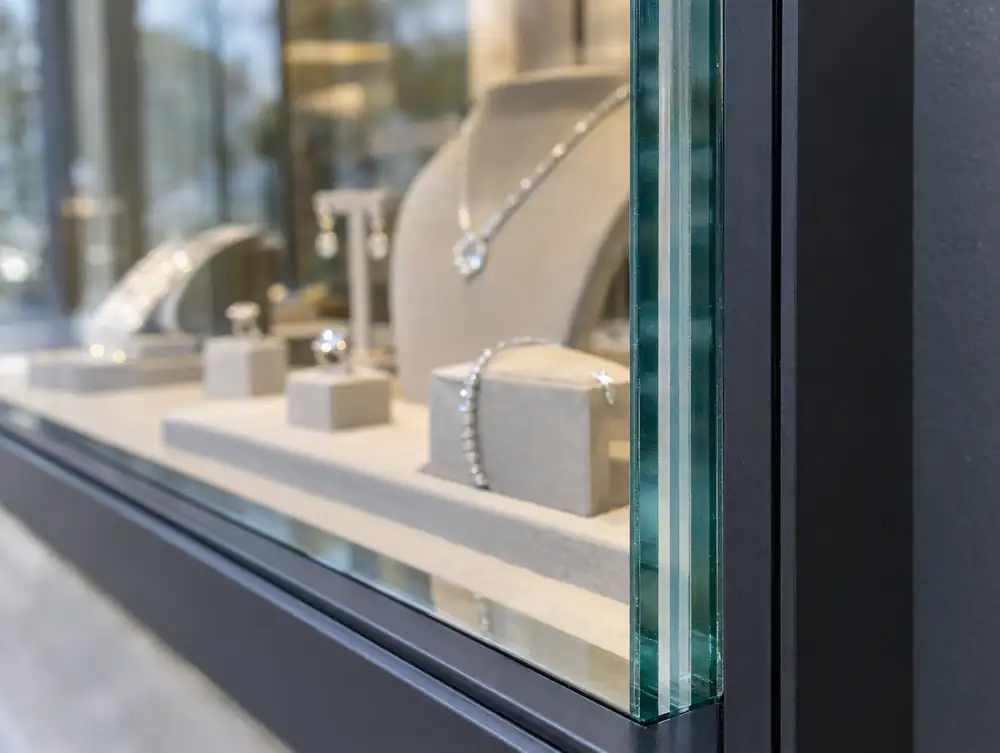
Security glazing is laminated glass with tough interlayers, usually set in a stronger frame, that resists manual attack and stays in place when broken. It suits jewellers, pharmacies, phone shops, banks and any premises where delay and deterrence matter and a shutter would spoil the frontage.
| Glass | Laminated panes, commonly 8.8 to 13.5mm, or thicker multi-ply build-ups for higher classes |
|---|---|
| Interlayer | PVB, typically 0.76 to 1.52mm, with multiple layers on heavier build-ups |
| Classification | BS EN 356:2000 for resistance to manual attack, where P6B is one of the higher classes |
| Impact safety | BS EN 12600:2002 pendulum classification, with the certificate supplied with the product where that applies |
| Frames | Deep rebates with internal beads and security glazing tape or silicone |
| Tested sets | PAS 24:2022, LPS 1175 Issue 8.2 or BS EN 1627:2021 doorsets and screens, where the risk calls for them |
| Typical lead time | Typically 1 to 3 weeks for standard laminates, longer for multi-ply or shaped panes |
| Comes with | Measured survey, glass schedule, removal of the old glass and a check of the frame |
Is laminated glass burglar proof?
No, and no glass is. Laminated glass buys time. An attacker can crack it, but the interlayer holds the pane together, so getting through becomes slow, noisy and visible. That delay, combined with an alarm, good lighting and stock kept out of easy reach, is what protects a shop.
A thicker laminate means more delay, not immunity. Be wary of anyone who talks about glass as if it ends the risk, and ask what it was tested against and for how long.
Is laminated glass better than toughened for security?
Yes. Toughened glass is several times stronger against a blow, but once it breaks the whole pane collapses into small pieces and leaves an open hole. Laminated glass cracks where it is hit and stays in the frame.
Both can be safety glass in the right classification, so the choice depends on the job. A toughened laminated pane gives you the strength of one with the retention of the other, and it costs more. On a shopfront, the laminate usually goes wherever stock sits behind the glass.
What do BS EN 356, PAS 24 and LPS 1175 mean?
They test different things, so ask which one your risk and your insurer actually need.
- BS EN 356:2000 classifies glass by its resistance to manual attack, and it is a test of the pane alone.
- PAS 24:2022 covers enhanced security for doorsets and windows as complete units.
- LPS 1175 Issue 8.2 is the LPCB intruder resistance standard, and ratings such as B3 combine a tool category with delay minutes.
- BS EN 1627:2021 sets burglar resistance classes for doorsets, windows, curtain walling, grilles and shutters.
Where does security glazing go wrong?
The frame is usually the weak point. A heavy laminate in a shallow rebate can be pushed out whole, and external beads can be unclipped in seconds. We keep beads on the inside, give the pane proper edge cover and tie it to the frame with security tape or silicone.
Weight is the other trap. Historic England warns that heavier glass can affect a shop front's structure, and the same goes for any old timber or slim aluminium frame. Then there is water. Laminate edges left standing wet will start to cloud, so the rebate has to drain. Doors deserve the same attention, because a rated pane beside a weak lock simply moves the attack a metre to the left.
What does security glazing cost over its life?
Almost nothing beyond normal cleaning. The interlayer also cuts most ultraviolet light, which slows fading of stock in the window, and it adds some sound reduction on a noisy road.
The real cost comes after an attack. A cracked pane usually stays secure, so you can trade behind it until the new glass arrives, without boarding the frontage. Keep your glass schedule to hand, as a known size and build-up shortens the wait. Check the excess on your glass cover too, since heavy laminates cost more to replace.
Which options can you choose from?
Standard laminate
Two panes bonded with PVB, commonly 8.8 to 11.5mm. It suits most shops as a first upgrade from toughened or float glass.
Multi-ply laminate
Several layers of glass and interlayer, tested to the higher BS EN 356 classes. It suits jewellers and high-value stock, and it needs a stronger frame.
Toughened laminated
Two toughened panes with an interlayer, which gives strength and retention together. It suits larger frameless panes and doors.
Laminated sealed units
A double-glazed unit with a laminated pane inside, outside or both. Heat performance and security improve together, at a higher weight.
Applied security film
A film bonded to existing glass that holds the shards together. Treat it as a stop-gap, because it depends on the pane and frame already in place.
How much does it cost?
Guide price: £195 to £495 plus VAT per m² of glass. This is a budget figure, and your free survey gives you the real one.
Work out a guide price or see all our prices.
Common questions
How much does security glazing cost?
Security glass typically costs £195 to £495 plus VAT per m² of glass, before any frame changes. Thicker multi-ply panes cost more, and so do large sizes that need extra hands or lifting gear. An itemised quotation separates glass, frame work and access.
How long does it take to fit security glass?
Standard laminates typically take 1 to 3 weeks to arrive after survey, and multi-ply or shaped panes take longer. Most shopfronts can be reglazed in a day. Out-of-hours work can be arranged to keep disruption down.
Do I need consent to change to security glass?
Usually not for planning if the frontage looks the same, because the test is whether the appearance is materially affected. Building regulations are a separate question, so ask your council whether the change is notifiable. On a listed building, ask before you touch anything, as heavier glass can affect the structure and consent may be needed.
Is laminated glass legally required on a shopfront?
Not as such. The rules ask that glass in critical locations breaks safely, and laminated or toughened glass can both meet that, depending on classification. Security laminate is a choice driven by your risk and your insurer.
How much more is laminated glass than toughened?
Laminated glass usually costs noticeably more per m² than toughened of a similar thickness, and the gap widens for thick multi-ply panes. Frame changes can add more than the glass itself. A measured survey shows which panes justify the upgrade.
What should I do after a break-in?
Call the police, then your insurer, and photograph the damage before anything is moved. Cracked laminate usually holds well enough to stay secure in the short term. Our repair call-outs are charged, at £165 plus VAT for attendance and the first hour, and new glass is then ordered to your schedule.
How do I maintain security glass?
Clean it as you would any shop window, using non-abrasive products. Check the beads, seals and drainage once a year. Report any clouding along the edge, as it can mean water is reaching the interlayer.