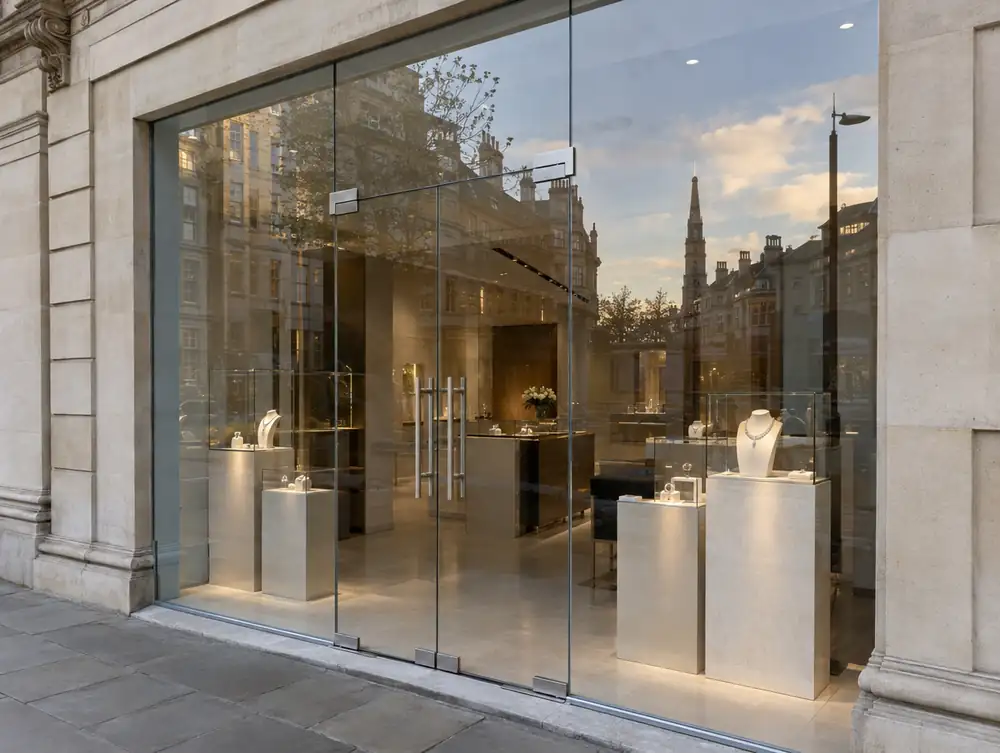
A frameless glass shopfront is a run of toughened glass panes held in discreet channels at the head and floor, joined edge to edge with fine silicone joints and no visible mullions. It suits fashion, beauty, jewellery and hospitality brands that want the interior to do the selling, in premises with a stiff structure overhead.
| Glass | 10mm or 12mm toughened as standard, low-iron glass for a whiter edge, toughened laminated where a broken pane must stay in place |
|---|---|
| Joints | Clear or black silicone butt joints, typically 6 to 8mm wide |
| Fixing | Recessed head and floor channels, clamps where the floor can't be cut, glass fins on tall or wide panes |
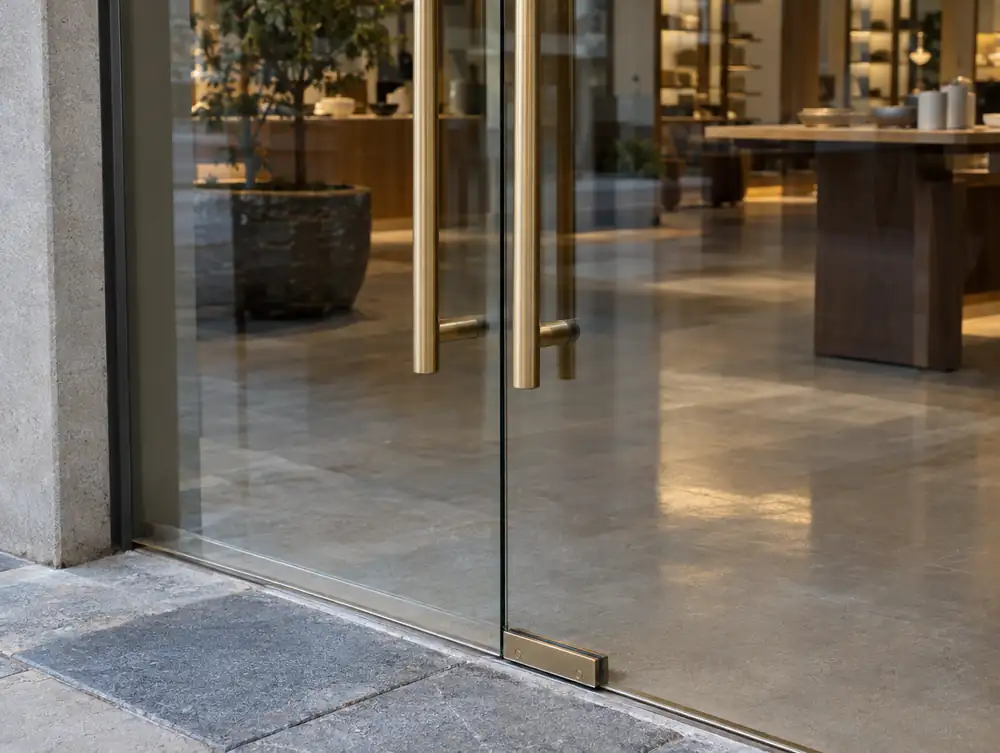
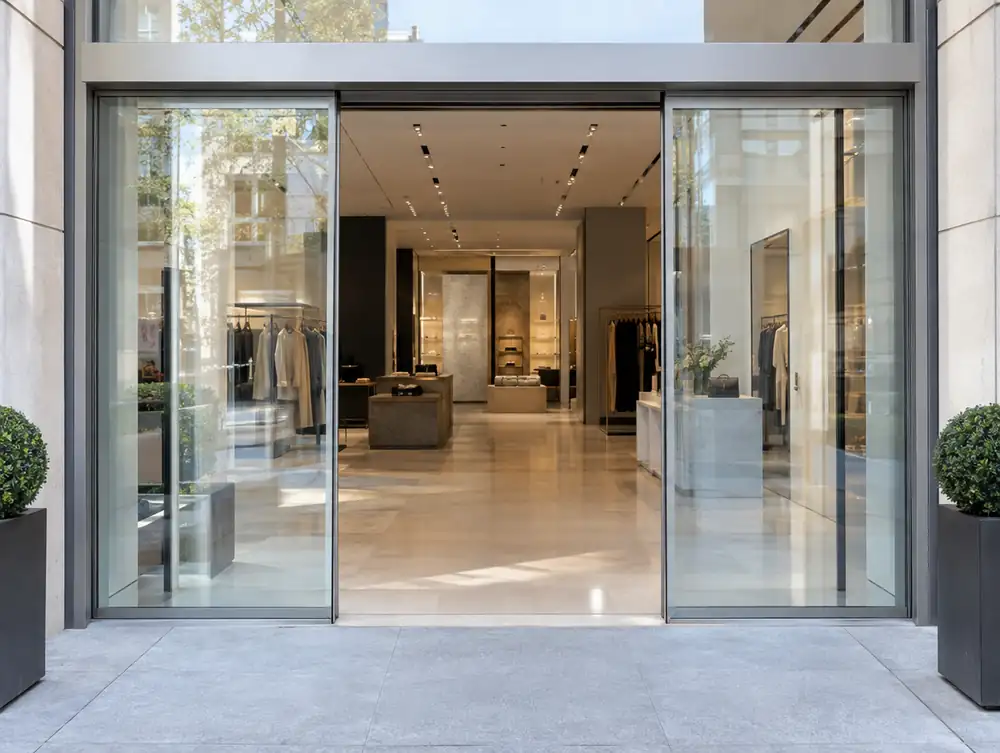
| Doors | Frameless leaves on floor springs and patch fittings, or a power-operated sliding set |
| Edges and trims | Polished glass edges, with head and floor trims in brushed stainless steel, anodised or powder-coated metal |
| Typical lead time | Typically 2 to 4 weeks for the glass after the final check measure, then 1 to 3 days on site |
| Designed to meet | BS EN 12600 impact classification and BS 6262-4 glazing practice, with the certificate supplied with the glass where that applies |
| Comes with | Free measured survey, signed-off scale drawings, one contract for glass and doors, and a 10-year workmanship guarantee on the quotation's written terms |
How do you design a frameless front so it looks right?
Start with the joints, because they become the only lines on the elevation. We space them to answer the piers or windows above, so the glass keeps a rhythm, and we hold pane widths even where the door position allows.
A frameless front has no natural stallriser, and that is the part most people forget. The glass needs a base, so the floor finish, threshold and any low plinth are drawn with the same care as the panes. Leave them to chance and the bottom edge turns into a dirt line.
- Fascia: deep enough to hide the head channel and door gear, typically around 250mm, and no deeper.
- Plinth: a low band of stone or metal protects the glass from mops and kicks and gives a light front some weight.
- Reveals: run the glass into a slot in the side piers, so no cut edge or sealant line shows.
- Low-iron glass: removes the green cast of thick glass, which matters against white interiors and pale stock.
Where does frameless glass go wrong?
Usually in the measuring, because toughened glass can't be cut or drilled once it has been made. Every hole and notch is fixed before the pane is toughened. We open up the old front at key points for a final check measure, so the glass is ordered to the true opening while you keep trading, and the channels take up what remains.
Structure comes next. A 12mm pane weighs 30kg per square metre, so a 3m by 2.5m panel is 225kg that needs a lifting plan and a clear pavement. With no frame to absorb movement, any sag in the beam above ends up pressing on the top edge of the glass.
One oddity is worth hearing before you order. Microscopic nickel sulphide inclusions can, very rarely, shatter a toughened pane with no impact at all, sometimes years later. Heat-soak testing reduces the risk and is worth specifying for large panes over a doorway.
Why does toughened glass look rippled at some angles?
That ripple is roller wave, a faint distortion left as hot glass travels over rollers in the toughening furnace. It is normal, and it shows most in low evening sun or in the reflection of a straight lamp post.
You can't remove it, but you can manage it. Asking the glass supplier to run the wave the same way on every pane makes the reflections line up across the front, and few clients know to ask. Polarised sunglasses also reveal faint patterning, known as anisotropy, which is another normal result of toughening.
Is frameless glass secure and warm enough for a shop?
It is as secure as you specify, and it will always be thermally weak. Toughened glass is hard to break but fails all at once, so jewellers and high-value retailers usually move to toughened laminated panes or an internal shutter behind the glass. BS EN 356 classifies glass by its resistance to manual attack, which is the figure to ask an insurer about.
Heat loss needs an honest conversation. A single-glazed wall of glass with no thermal break will lose more heat than a framed double-glazed front, so plan for an air curtain or a lobby if comfort at the door matters.
What does a frameless shopfront cost to keep looking good?
Cleaning is the main cost, since clear glass shows every mark. Budget for a window cleaner weekly or fortnightly on a street frontage, using clean water and soft tools, because razor scrapers can leave permanent fine scratches on toughened surfaces. Silicone joints need a yearly look and an occasional re-run once they pick up pollution, and floor channels must stay clear of grit so water can drain.
Which options can you choose from?
Butt-jointed toughened
Panes joined with clear silicone and held in head and floor channels. The classic frameless look, and the simplest to maintain.
Low-iron glass
A whiter glass without the green edge tint. It costs more, and it shows colours truly behind the pane.
Toughened laminated
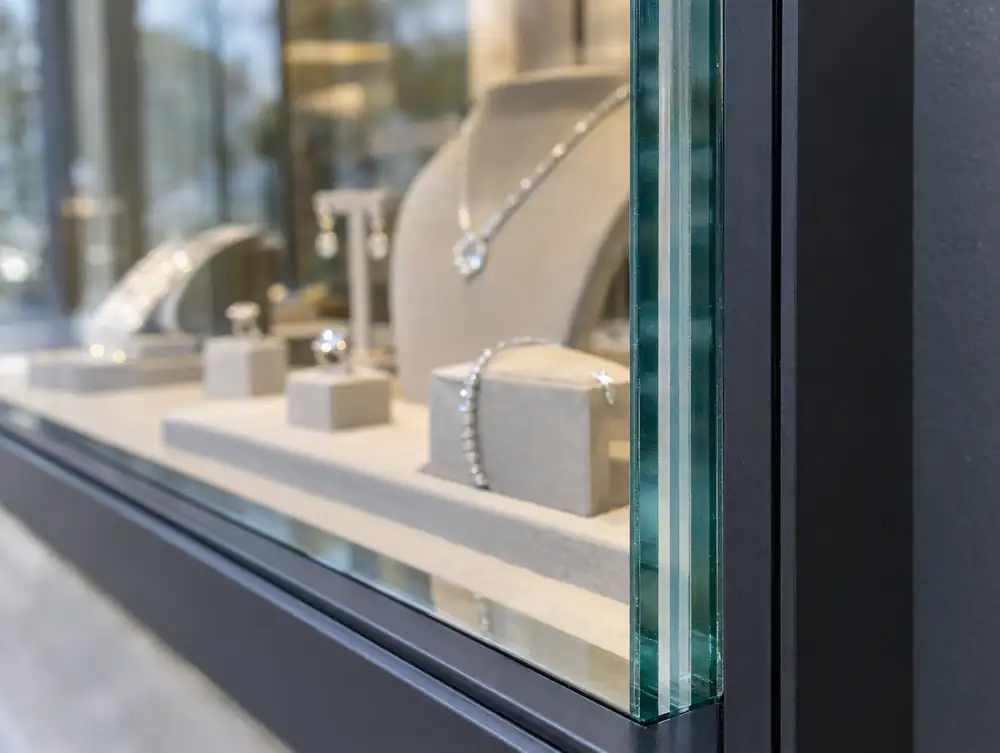
Two toughened plies bonded by an interlayer, so a broken pane stays in the opening. The usual route for jewellers and late-night sites.
Glass fins
Slim glass blades set behind the joints to brace tall or wide panes, for fronts too big to rely on channels alone.
Black silicone joints
A darker joint that reads as a deliberate line against a dark interior or fascia, and hides pollution better than clear.
Clamped floor fixing
Discreet metal clamps for sites where a cellar or services stop us cutting a channel into the floor.
How much does it cost?
Guide price: £4,995 to £15,995 plus VAT for a typical frontage. This is a budget figure, and your free survey gives you the real one.
Work out a guide price or see all our prices.
Common questions
How much does a frameless glass shopfront cost?
A frameless glass shopfront costs £4,995 to £15,995 plus VAT for a typical frontage. Pane height, glass type and the doors set the figure, and low-iron or laminated glass adds to it. The surveyed price is itemised, so you can see what each choice adds.
How does frameless compare with an aluminium frame?
Frameless gives a clearer view and a more open shop, while aluminium offers stronger security options, better insulation and a lower price at the same width. A frameless front also needs a stiffer head and a floor that can take a channel. Plenty of good fronts mix the two, using slim framing at the edges and clear glass at the centre.
How long does a frameless glass shopfront take?
Typically 2 to 4 weeks for the glass after the final check measure, then 1 to 3 days on site for a straightforward run. Fins, laminated panes and awkward access lengthen that. Where consent is needed, allow 4 to 8 weeks before the glass is ordered.
Do frameless shopfronts need planning permission?
In most cases, yes, because taking out the frames and stallriser materially changes how the building looks. No nation offers a permitted development route for this work, and a council may resist losing a stallriser on an older building. Talk to the council early and expect to apply.
How do you clean and maintain frameless glass?
Weekly or fortnightly cleaning with clean water and soft tools keeps it right, and razor scrapers should be kept well away. Silicone joints and door gear need checking once a year. Keep floor channels free of grit so that water can get away.
Is a frameless shopfront safe if someone walks into it?
Yes, provided the glass is the right safety class and carries visible markings. Manifestation between 850 and 1000mm and between 1400 and 1600mm applies in all four nations, and it can be designed as a logo or pattern. The safe-breakage reference differs by nation, so the drawing names the class for your address.
What happens if a frameless pane breaks?
The opening is made safe and a new pane is made to the original drawing, which typically takes 2 to 4 weeks. Keep your glass schedule, and check that your insurance covers both the glass and the lifting. A toughened laminated pane stays in the opening after a break, which is why high-value retailers choose it.