Frameless glass gives the clearest view into a shop and suits modern units with stiff structure, while a framed shopfront insulates better, copes with crooked openings and costs less to repair. Prices start from £4,995 plus VAT for frameless and from £2,495 plus VAT for framed aluminium. On a protected building, or under a beam that moves, frameless is usually the wrong choice.
What is the difference between frameless and framed glass shopfronts?
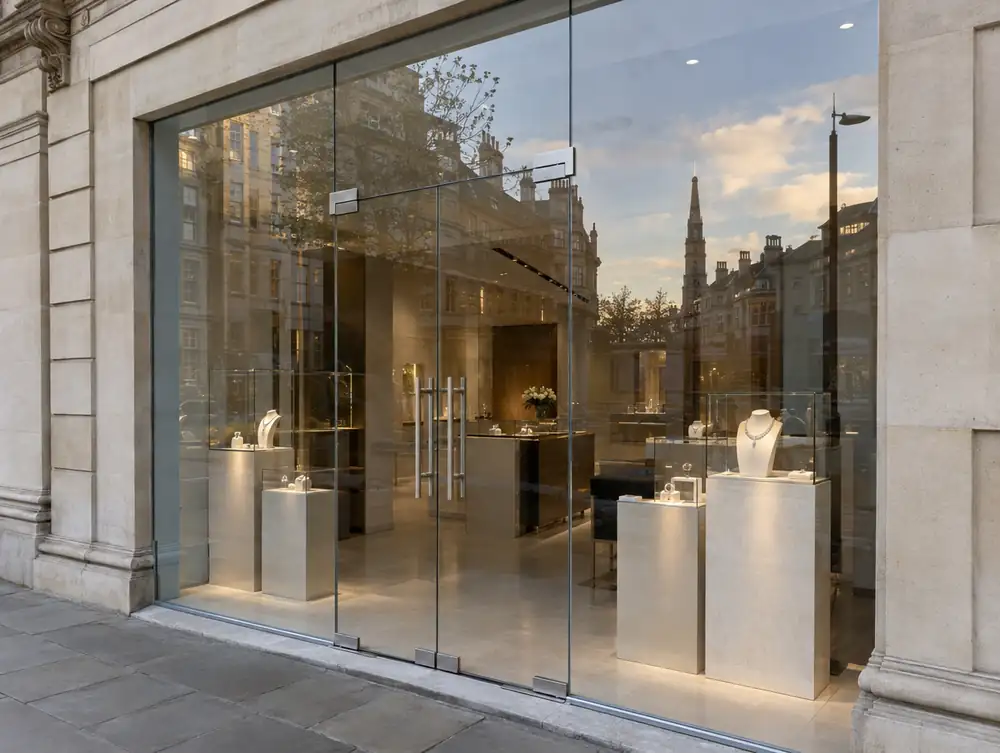
A frameless shopfront holds toughened glass in slim channels at head and floor, with panes joined edge to edge, whereas a framed shopfront sets each pane inside aluminium or timber sections. One reads as a sheet of glass and the other as a drawn frame with glass in it.
Neither is a higher grade than the other. Frameless puts the money into glass and fixings, and framed puts it into the section, the finish and the detail at each junction. Choosing between them starts with the building, since the structure above the opening often settles the question.
| Factor | Frameless | Framed aluminium |
|---|---|---|
| Look | Unbroken glass, minimal lines | Drawn frame, visible mullions |
| Usual glazing | Single toughened or laminated | Single or double-glazed |
| Heat loss | Higher, unless units are used | Lower with broken sections |
| Tolerance | Very little | Packers and beads absorb it |
| Pane change | Large, made to order | Smaller, easier to lift |
| Guide price | £4,995 to £15,995 plus VAT for a typical frontage | £2,495 to £11,995 plus VAT for a typical 3 to 7 m frontage |
What are the advantages of frameless glass?
Frameless gives the widest unbroken view into a shop, and that is its whole case. For a jeweller, a fashion boutique or a gallery, the interior becomes the frontage, and the eye goes straight to what is on display.
Daylight travels further into the unit with nothing interrupting it. After dark the effect is stronger still, since a well-lit interior behind clear glass reads like a stage set from the street. Low-iron glass takes out the green cast you would otherwise see at the polished edges, and that small upgrade is often what separates a good frameless front from an ordinary one.
The door can speak the same language, too. A frameless door with a slim top rail or patch fittings keeps the glass line running across the entrance, which a framed door interrupts. On a narrow unit, losing even two 50mm frames can make the shop feel noticeably wider from the pavement.
When is frameless glass the wrong choice?
Frameless is usually wrong where the structure moves, the opening is badly out of true, or the building is protected. Glass has no forgiveness in it, and the head detail has to allow for any deflection in the beam above, otherwise the load finds its way into the pane.
Toughened glass also can't be cut or drilled once it has been toughened, so every edge and hole is final. A 5mm mistake on survey doesn't get trimmed on site. It gets remade, and your opening waits behind a board until it arrives.
- Old timber beams or long steels that deflect under load
- Listed buildings and many conservation areas
- Units where heat loss is a serious running cost
- High-risk sites relying on toughened glass alone
- Floors with no depth for a channel or floor spring
When is a framed shopfront the better buy?
A framed shopfront is the better buy when you need double glazing, simple pane changes, or a budget that leaves room for a proper door and sign. Two slim mullions on a 6m frontage cut the largest pane by two thirds, and that shows up in lifting gear, delivery and the replacement cost if a pane ever breaks.
Frames also absorb reality. Old buildings are never square, and a framed system hides a 15mm run-out in its packers and beads, where frameless would show it as a tapering joint. Standard door sets, closers and locks all fit a frame without special gear.
Framing can still be the wrong answer. On a small unit, chunky sections eat a real share of the width, and on an all-glass brand they fight the idea behind the design. Poorly set-out mullions are worse than none, particularly if they land in front of a column, cut through a logo or ignore the windows above.
Can frameless glass be secure and energy efficient?
It can, though the look and the price both change. Toughened laminated glass stays in place when broken, which plain toughened does not, because the interlayer holds the pieces together. That interlayer shows as a line at the polished edge, so ask to see a sample before you sign off the detail.
Double-glazed frameless units exist, but the spacer bar becomes visible at every joint and the weight of each pane climbs sharply. Many designers accept single glass at the display and put their energy effort into the door, a lobby and the airtightness around the opening.
England's Approved Document L Volume 2 lists no maximum U-value for display windows, although its pedestrian door and high-usage entrance figures still apply. Our energy guide sets those figures out, and building control confirms how they apply to your job.
Why is frameless glass harder to install?
Frameless is harder because the tolerance is tiny and everything depends on the head and floor details. The floor channel has to be dead level along its length, which usually means cutting into the screed, and a floor spring needs a pit that may have to be cored through a slab with services in it.
Toughened glass carries a slight roller wave from the furnace, so a careful installer keeps it running the same way on every pane. Get that wrong and reflections break at each joint, which you will see every sunny morning. Check the pane edges and the setting blocks too, because a chip at the edge is where a sheet fails later, sometimes weeks after the fitters have gone. Glass should never bear directly on metal at any point.
Paperwork differs as well. In England and Wales, the registered-installer route for replacement windows and doors in non-dwellings excludes structural glass, so assume building control may need to be involved where the glass is doing structural work.
Common questions
How thick is the glass in a frameless shopfront?
Most frameless fronts use 12mm toughened, with thicker glass on tall or wide panes. The height, the fixing detail and any laminate decide the final make-up, so it is set at drawing stage.
How long does a frameless shopfront take?
Glass can only be ordered after a final measure, because it can't be altered once toughened. Fabrication typically runs 2 to 4 weeks, with 1 to 5 days on site, and these are typical ranges rather than promises.
What happens if a frameless pane breaks?
Toughened glass drops into small dice, so the opening is boarded until a new pane has been made to the exact size. Nothing comes off a shelf, which is why many owners keep the pane schedule safe.
Can a frameless front have a roller shutter?
Yes, though with no frame to fix to, the guide channels need solid piers or reveals either side. The box has to go behind the fascia or inside the shop, so the shutter should be drawn at the same time as the glass.