An automatic sliding door is a powered entrance whose leaves slide apart when a sensor detects someone approaching, then close behind them. It suits pharmacies, supermarkets, showrooms, clinics and any busy shop that needs hands-free access without a door swinging into the pavement or the sales floor.
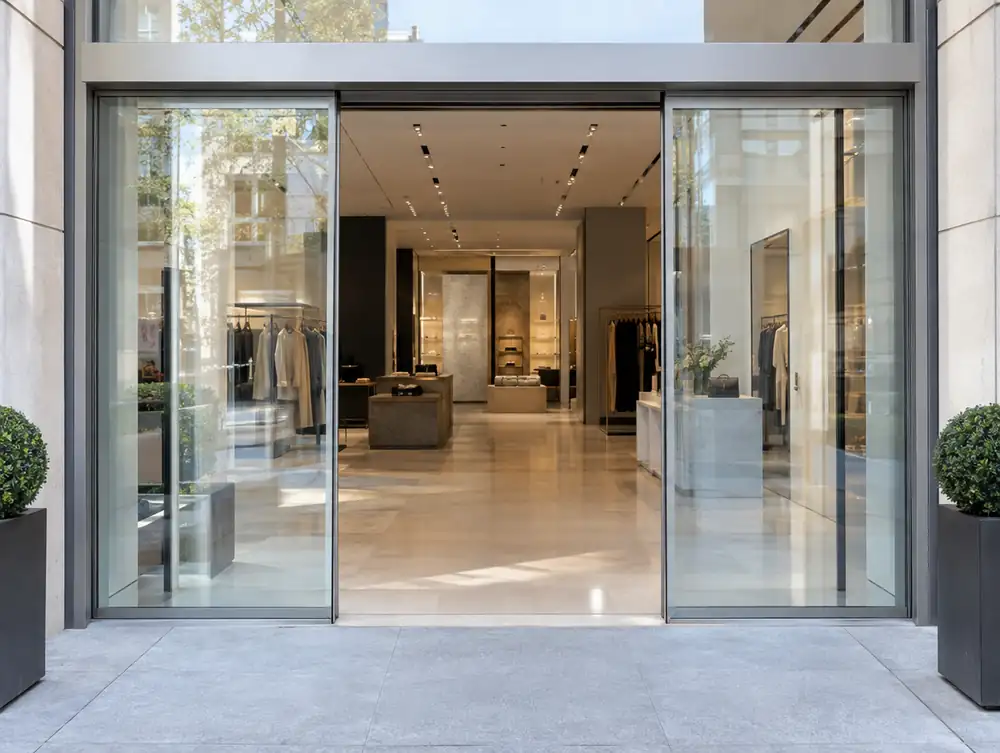
| Door type | Bi-parting, single-slide or telescopic leaves, framed or frameless |
|---|---|
| Clear opening | Around 1000mm to 2000mm or more, set by the frontage and the parked leaves |
| Operator | Head-mounted drive, typically 100 to 150mm deep, with battery back-up |
| Glass | 10mm toughened or laminated safety glass in slim framed leaves |
| Sensors | Radar or infrared activation with presence safety sensors, adjusted on site |
| Typical lead time | Typically 3 to 6 weeks after sign-off, then 1 to 3 days on site |
| Designed to meet | BS EN 16005:2023 for safety in use, BS 7036-0:2014 for the risk assessment and BS EN 12600 for the glass |
| Comes with | Free site survey, scale drawings, itemised quotation and a 10-year workmanship guarantee on its written terms |
Which automatic door suits a shop entrance?
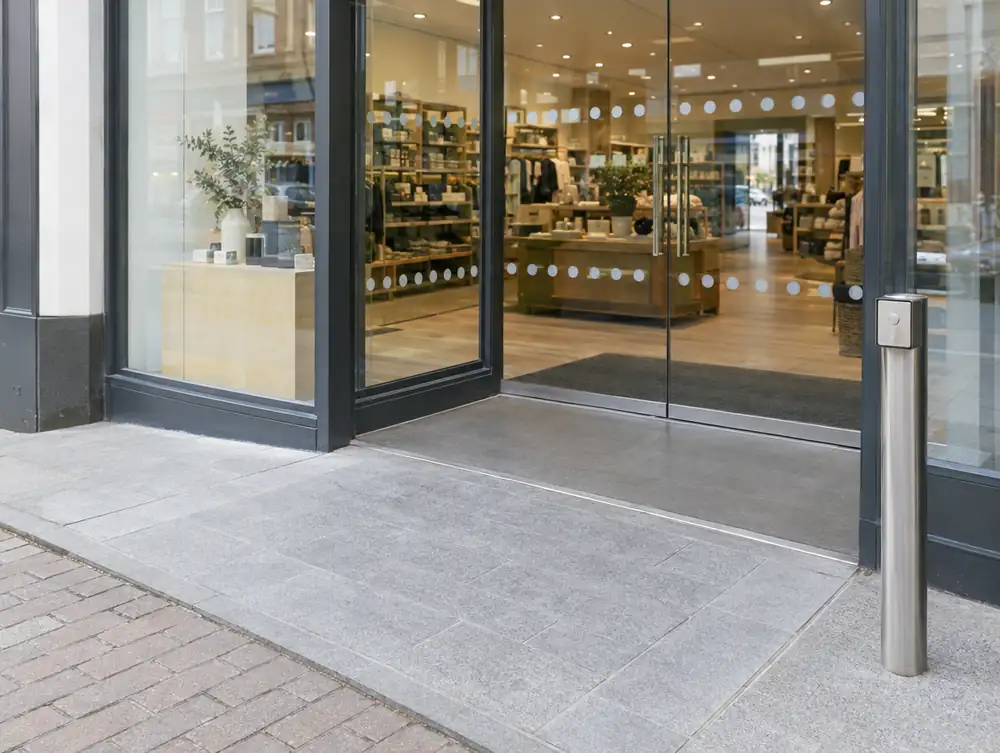
A bi-parting door suits most shops, because the leaves split to each side and give the widest opening for the space. Where a side wall stops one leaf, a single-slide set works, and a telescopic set stacks two or more leaves to one side, squeezing more opening out of a narrow front.
Parked leaves need somewhere to go. A 2m clear opening takes about 4m of straight frontage once both leaves are open, so on a narrow shop the door decides the layout of the whole elevation.
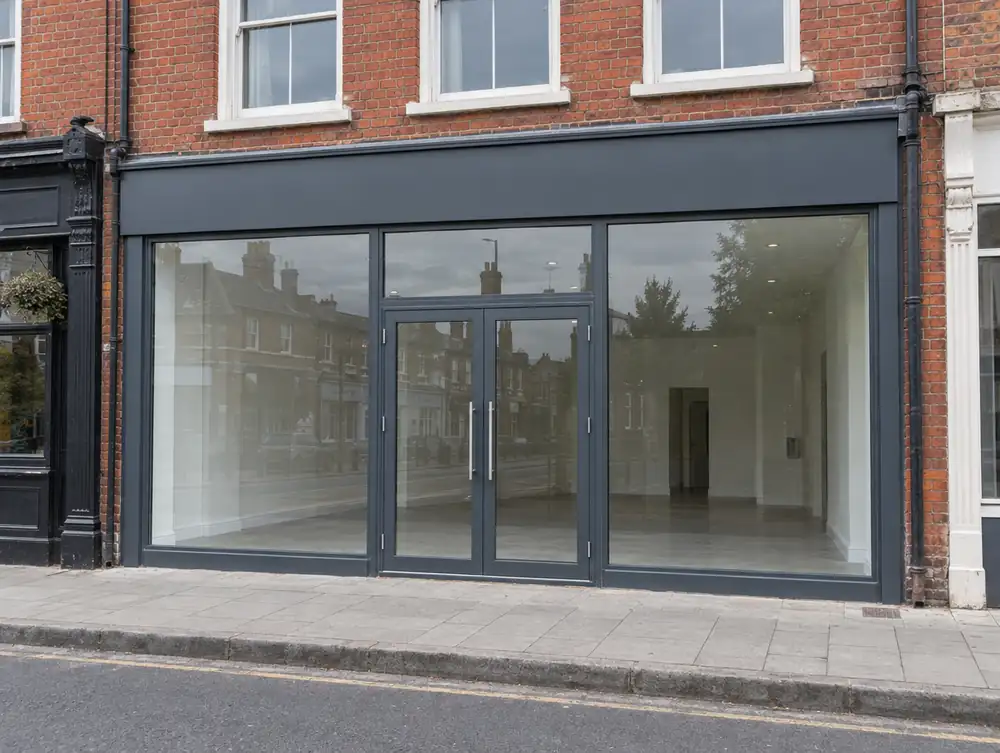
The operator is the other design problem. A drive 100 to 150mm deep has to live somewhere, so we bury it behind the fascia or in a bulkhead. Side screens then line up with the leaves and the stallriser stops at a clean pier, so the entrance reads as part of the front and not as a box added to it.
What standards apply to automatic shop doors?
BS EN 16005:2023 covers the safety in use of power-operated pedestrian doors, and BS 7036-0:2014 covers the risk assessment behind them. The rest depends on where you are.
- England: Approved Document K says powered doors must not trap people and must open on power failure.
- Scotland: on an escape route, automatic doors need BS 7036 design and fail-safe conditions.
- All four nations: fire law rules out sliding doors on a dedicated fire exit, so a slider can't be your only way out.
- Clear width: 1000mm for a new public door in England, Wales and Northern Ireland, and 800mm in Scotland.
Where do automatic doors go wrong?
In the sensor field, far more often than the motor. A radar set up as if for a quiet lobby will see everyone walking along the pavement, so the door opens all day, heat pours out and the drive wears early. We narrow the field and angle it to read direction, so passers-by are ignored and people heading for the door are not.
Wind comes next. Tall leaves on an exposed front act like sails, pushing against the drive until the safety system reverses, and the door looks faulty on every blustery day. A lobby, a deeper recess or a stronger drive solves it, and it is far easier to deal with before the door is ordered.
Floors cause the rest. Bottom guides fill with grit, and bright sun on a polished floor can confuse an infrared sensor into thinking someone is standing there.
What does an automatic door cost to run?
Two services a year and an occasional battery are the usual costs. The electricity is small beside the heat lost through needless openings, which is why sensor set-up and a night mode pay for themselves. Belts, rollers and bottom guides wear with use, so a door on a busy street gets through them sooner.
Staff can help by checking each morning that the door opens fully, closes smoothly and stops when someone stands in the opening. If the door keeps a shop warm only by being closed, an air curtain is worth pricing. England's Approved Document L gives 3.0 W/m²K for high-usage entrance doors, so ask building control how yours will be treated.
Which options can you choose from?
Bi-parting framed
Two slim aluminium-framed leaves opening from the centre. The everyday choice, in any RAL colour.
Bi-parting frameless
All-glass leaves with minimal rails, for a lighter look that matches a frameless front.
Single-slide
One leaf sliding to one side, for openings hard against a wall or a pier.
Telescopic
Two or more leaves stacking together, giving a wider opening on a narrow front.
Curved sliding
Leaves that follow a radius, for a corner or lobby where the door has to keep the line of the glass.
Breakout leaves
Leaves that can be pushed open by hand, used where the design and fire strategy call for them.
How much does it cost?
Guide price: £3,895 to £11,995 plus VAT per entrance. This is a budget figure, and your free survey gives you the real one.
Work out a guide price or see all our prices.
Common questions
How much do automatic sliding doors cost?
An automatic sliding door costs £3,895 to £11,995 plus VAT per entrance. Size, leaf type and any surrounding glazed screen decide the figure, and very low prices seen elsewhere may leave that screen out. Your itemised quotation shows the door, screen and electrical work separately.
How long do automatic doors take to install?
Typically 3 to 6 weeks to order after sign-off, then 1 to 3 days on site. A closed day or out-of-hours fit can be arranged. Allow more time if a mains supply or new steel is needed at the head.
Do automatic doors need planning permission?
Sometimes. A door set that materially changes the look of the front usually needs an application, while a like-for-like swap behind the same fascia usually won't. Building approval is a separate question, so ask the council or building control about both.
How often should automatic doors be serviced?
Twice a year is the usual pattern, with more visits on a very busy entrance. Staff should also carry out a quick daily check of opening, closing and stopping. Keep a log of each visit, as it helps with any later fault.
What happens to automatic doors in a power cut?
In England, Approved Document K expects powered doors to open on power failure, and battery back-up handles that on most sets. Scottish guidance asks for fail-safe conditions on escape routes. We confirm the behaviour with you at design stage, because it affects how the shop is secured.
Can an automatic sliding door be used as a fire exit?
Not as a dedicated fire exit, as fire law in all four nations rules out sliding doors there. An entrance door on a general escape route is a different question, and it depends on the fire strategy. Ask whoever holds the fire duties to confirm it: the responsible person in England and Wales, or the dutyholders in Scotland and Northern Ireland.
Can you automate our existing shop door?
Often, if the frame and opening can take it. A swing door can usually be fitted with an operator, while changing to a slider means checking the head, side space and parked leaves. We'd look at both options at the free survey.