Few businesses can shut for a week, so any time on site for automatic sliding doors in the Scottish Borders is planned around the hours you trade. Closed-day or out-of-hours installation can be arranged.
Most frontages share something with someone, be that a door to the flats above, a meter cupboard or a pilaster on the boundary. We pick those up early on automatic sliding doors in the Scottish Borders, because they are far easier to design around than to discover on the day.
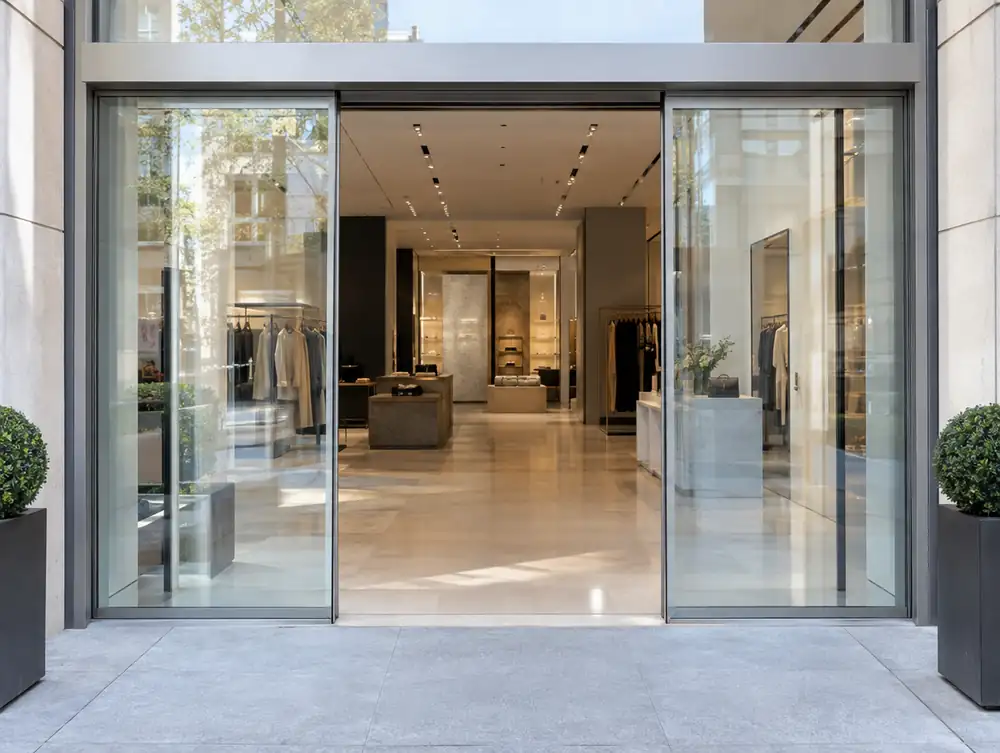
What should you look for from automatic sliding doors in the Scottish Borders?
Exposure shapes the door. If your entrance in the Scottish Borders faces the prevailing wind, we'd look at a lobby, a stronger drive or a deeper recess, so that tall leaves don't fight the weather.
Street-facing doors need tuning to the pavement. For premises across the Scottish Borders, we set the sensor field on the real footfall, because a shop on a narrow pavement sees far more false openings than one set back from the path.
What consents apply to automatic sliding doors in the Scottish Borders?
Section 26 of the Town and Country Planning (Scotland) Act 1997 sets the test: work that doesn't materially affect the external appearance isn't development. For automatic sliding doors at premises in the Scottish Borders area, anything that does needs planning permission, and a true like-for-like replacement usually doesn't. The council confirms how that applies to each site.
How much do automatic sliding doors cost in the Scottish Borders?
We would budget £3,895 to £11,995 plus VAT per entrance. Scope sets most of the figure, so a clear brief at the start does more for the budget than any later change of detail.
| Area | Scottish Borders |
|---|---|
| Nation | Scotland |
| Towns covered | 2 |
| Main town | Galashiels |
| Planning regime | Scotland: 1997 Planning Act and the 1984 Advertisement Regulations |
| Building approval | Building warrant (Technical Handbook) |
| Survey | Free for new work, from our Great Barr base |
Does Scottish Borders Council publish shopfront guidance?
Yes, Supplementary Planning Guidance on Shop Fronts and Shop Signs (2011). It tells applicants what the council expects from new and altered shopfronts. A few of the things it asks for:
- Roller shutters are opposed on listed buildings and sensitive conservation area frontages, and elsewhere should be recessed and preferably open grille.
- Signs in conservation areas should not be internally illuminated, and reasonable external lighting is often acceptable.
- Each enterprise may have one projecting sign, with its bottom edge at least 2.25m above ground and 0.5m in from the kerb.
Questions about automatic sliding doors in the Scottish Borders
Can a door in the Scottish Borders be set up to ignore people walking past?
Yes, in most cases. The sensor field can be narrowed and angled so it reads direction, which cuts false openings on a street-facing door.
Do you fit automatic sliding doors across the Scottish Borders?
Yes. We travel from Great Barr to survey the entrance, then fit and set up the door with a vetted team.
Who services automatic doors once they are fitted in the Scottish Borders?
Any competent door engineer can, and we'd recommend two visits a year. We'll talk you through the options at handover, so it doesn't get forgotten.
Does the Equality Act cover a shop entrance in the Scottish Borders area?
Yes. The Equality Act 2010 applies in Scotland as part of Great Britain, and its anticipatory duty expects reasonable steps to remove, alter or avoid physical features that disadvantage disabled people generally. BS 8300-2:2018 is the current British Standard for accessible buildings.
Do I need planning permission to alter a shopfront in the Scottish Borders area?
Usually yes, if the work materially affects the external appearance. Class 9A, Scotland's shop permitted development right, doesn't cover work that alters or extends beyond the existing front. A true like-for-like replacement usually needs no permission, and the council confirms the position.