From Galashiels to the furthest corner of the Scottish Borders, the sequence for heritage shopfronts stays the same: survey, drawings, written price, then work on site. We travel from Great Barr in Birmingham and use vetted teams working under S&K Glazing.
Finishes behave differently at full size. Any sample we show you for heritage shopfronts is better judged at the premises in daylight, since a colour that looks quiet on a desk can read much louder across a whole elevation.
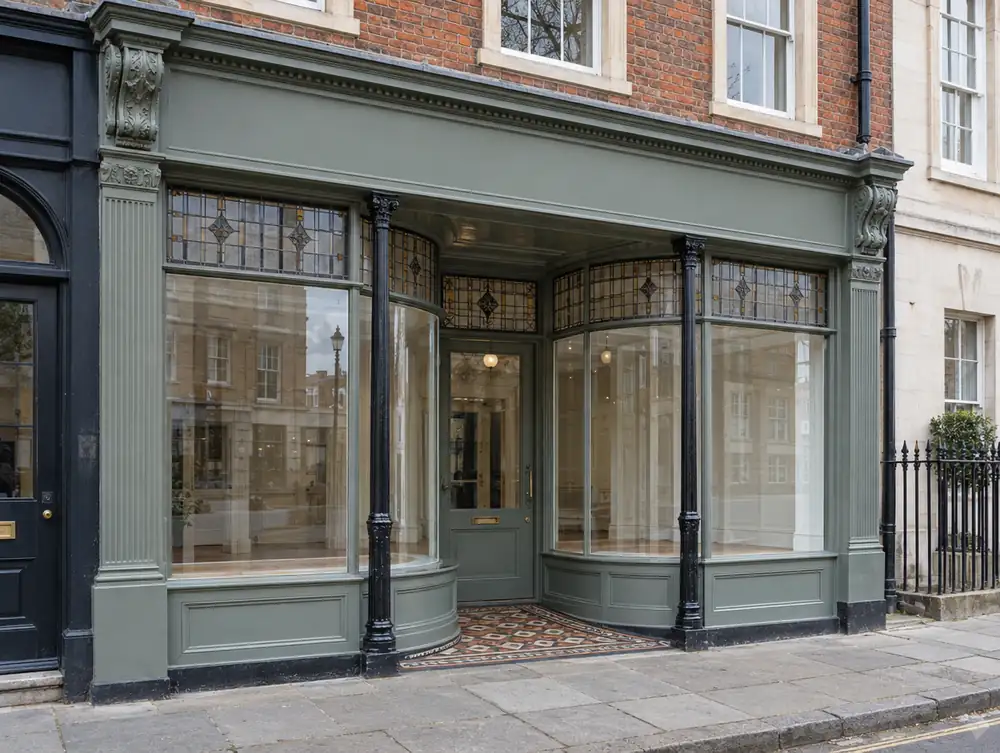
What should you look for from heritage shopfronts in the Scottish Borders?
Stone, brick and tile weather differently from one place to another. For a period front in Galashiels or elsewhere in the Scottish Borders, we match new work to the existing materials by eye and by sample, so repairs sit quietly beside the original.
A period front still has to work as a modern shop. For premises in the Scottish Borders, we look at how door gear, lighting, alarm contacts and a cleaner threshold can be added without any of it showing from the street.
What consents apply to heritage shopfronts in the Scottish Borders?
Scottish guidance says like-for-like windows need no permission, and a true like-for-like frontage replacement usually follows the same logic. Class 7A covers altering or replacing an existing window, but it doesn't mention shopfronts, so ask before relying on it for a display window. For heritage shopfronts at premises in the Scottish Borders area, a material effect on the external appearance means planning permission, and the council confirms the position.
How much do heritage shopfronts cost in the Scottish Borders?
A sensible starting budget is £8,495 to £24,995 plus VAT for a typical frontage. What shifts the figure is whatever can't be seen yet, such as the condition behind the old frontage or the services running through it.
| Area | Scottish Borders |
|---|---|
| Nation | Scotland |
| Towns covered | 2 |
| Main town | Galashiels |
| Planning regime | Scotland: 1997 Planning Act and the 1984 Advertisement Regulations |
| Building approval | Building warrant (Technical Handbook) |
| Survey | Free for new work, from our Great Barr base |
Does Scottish Borders Council publish shopfront guidance?
Yes, Supplementary Planning Guidance on Shop Fronts and Shop Signs (2011). It tells applicants what the council expects from new and altered shopfronts. A few of the things it asks for:
- Roller shutters are opposed on listed buildings and sensitive conservation area frontages, and elsewhere should be recessed and preferably open grille.
- Signs in conservation areas should not be internally illuminated, and reasonable external lighting is often acceptable.
- Each enterprise may have one projecting sign, with its bottom edge at least 2.25m above ground and 0.5m in from the kerb.
Questions about heritage shopfronts in the Scottish Borders
How long does period joinery take for premises in the Scottish Borders?
Typically 8 to 14 weeks to make, then 1 to 3 weeks on site. Repairs in place can take less, depending on what the survey finds.
Can you match old glass at premises in the Scottish Borders?
Often. Reclaimed or drawn glass with a slight ripple can be sourced for small panes, and leaded lights can be repaired to the same pattern.
Can period features be saved during a refit in Galashiels?
Yes, if they are recorded and protected early. We'd mark what stays on the drawing, then box in tiles, brackets or glass before any strip-out.
Do I need planning permission to alter a shopfront in the Scottish Borders area?
Usually yes, if the work materially affects the external appearance. Class 9A, Scotland's shop permitted development right, doesn't cover work that alters or extends beyond the existing front. A true like-for-like replacement usually needs no permission, and the council confirms the position.
Does a shop sign in the Scottish Borders area need advertisement consent?
Not always. Scotland's 1984 Regulations let an unlit sign within Class IV(1) go up without an application, and Class VI does the same for a lit sign with each character lit from within. Class VI isn't available in conservation areas, and one council says lit signs always need express consent, so ask first.