What should your premises say from across the road? We open every conversation about projecting signs in the Scottish Borders with that question, then treat sightlines and proportion as seriously as the budget.
Most frontages share something with someone, be that a door to the flats above, a meter cupboard or a pilaster on the boundary. We pick those up early on projecting signs in the Scottish Borders, because they are far easier to design around than to discover on the day.
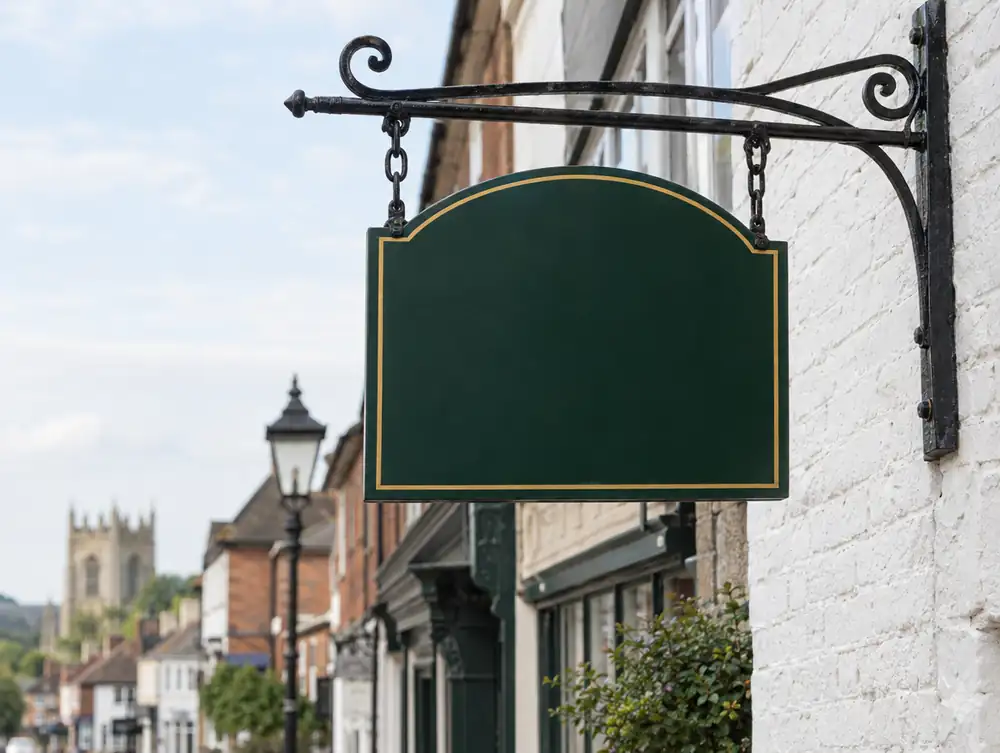
How should you approach projecting signs in the Scottish Borders?
Narrow pavements call for a smaller sign. If your premises in the Scottish Borders open onto a tight footway, we keep the projection modest and the height generous, so the sign stays clear of people and vehicles.
Wall construction matters more than the sign itself. Around Galashiels we check what sits behind the paint or render, since a bracket that looks secure on a hollow surface can work loose within a season.
What consents apply to projecting signs in the Scottish Borders?
Scottish guidance says like-for-like windows need no permission, and a true like-for-like frontage replacement usually follows the same logic. Class 7A covers altering or replacing an existing window, but it doesn't mention shopfronts, so ask before relying on it for a display window. For projecting signs at premises in the Scottish Borders area, a material effect on the external appearance means planning permission, and the council confirms the position.
Class VI is the class for lit signs in Scotland, and it is tightly drawn: each character lit from within, the sign at least 2.5m up, no more than 0.25m of projection, and static lighting. One Scottish council says illuminated signs always need express consent, which doesn't match Class VI, so ask the council for the Scottish Borders area before ordering.
How much do projecting signs cost in the Scottish Borders?
As a working budget, use £395 to £1,295 plus VAT per sign. Your place inside that range for projecting signs depends mostly on how much of the existing frontage can stay and how much has to be put right first.
| Area | Scottish Borders |
|---|---|
| Nation | Scotland |
| Towns covered | 2 |
| Main town | Galashiels |
| Planning regime | Scotland: 1997 Planning Act and the 1984 Advertisement Regulations |
| Building approval | Building warrant (Technical Handbook) |
| Survey | Free for new work, from our Great Barr base |
Does Scottish Borders Council publish shopfront guidance?
Yes, Supplementary Planning Guidance on Shop Fronts and Shop Signs (2011). It tells applicants what the council expects from new and altered shopfronts. A few of the things it asks for:
- Roller shutters are opposed on listed buildings and sensitive conservation area frontages, and elsewhere should be recessed and preferably open grille.
- Signs in conservation areas should not be internally illuminated, and reasonable external lighting is often acceptable.
- Each enterprise may have one projecting sign, with its bottom edge at least 2.25m above ground and 0.5m in from the kerb.
Questions about projecting signs in the Scottish Borders
How long does fitting take on premises in the Scottish Borders?
Usually about half a day from a ladder or tower, with a little longer if a cable has to be run for lighting. The shop can normally stay open while we work.
Can you fit a projecting sign to a stone or brick wall in the Scottish Borders?
Yes. Hard stone and sound brick both take resin anchors well, and soft brick needs a longer, wider fixing. We drill into mortar joints or discreet positions where the wall needs protecting.
Is a hanging sign better than a fixed one for premises around Galashiels?
It depends on the building and the exposure. Hanging signs suit traditional frontages and give a bit of movement, while fixed signs need less upkeep. On a windy elevation we usually suggest fixed.
Which way must a fire exit door open on a shop in the Scottish Borders area?
In the direction of escape. Regulation 13(2) of the Fire Safety (Scotland) Regulations 2006 also rules out sliding and revolving doors on a dedicated fire exit and says fire exit doors can't be locked against immediate use. Duties sit with dutyholders under Part 3 of the Fire (Scotland) Act 2005, meaning the employer and any person with control of the premises.
Do I need a building warrant for a shopfront in the Scottish Borders area?
Usually yes in Scotland, if the work alters a wall or structure. Schedule 3 of the Building (Scotland) Regulations 2004 lists some work that needs no warrant, such as replacing a door or window with its frame, but the standards still apply. Shopfronts aren't named there, so ask the council before relying on it.