Our quotation for timber shopfronts in the Scottish Borders is written, itemised and valid for 90 days. Nothing is ordered until you accept it, which gives you time to take it to a landlord, a partner or a board.
Your frontage is read alongside its neighbours, so we note the fascia line, stallriser height and pilasters on either side before drawing timber shopfronts for the Scottish Borders premises. Matching those lines or breaking them on purpose can both work, whereas doing it by accident never does.
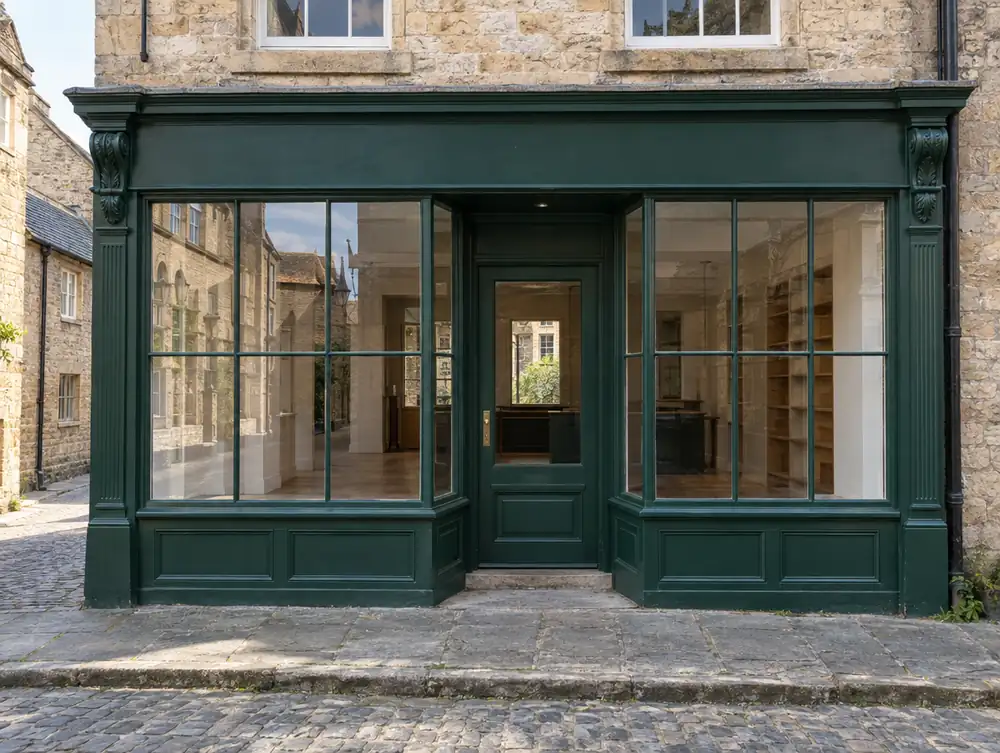
What makes timber shopfronts work well for premises in the Scottish Borders?
Weather decides how timber is detailed across the Scottish Borders, more than fashion does. On an exposed frontage we'd raise pilasters on plinth blocks, steepen the cills and choose a more stable timber, while a sheltered one gives more freedom with mouldings.
A timber front has to sit comfortably with what's around it. If your premises in the Scottish Borders share a terrace, we draw the mouldings at a scale that suits the neighbours, so the new work looks settled from the day it goes in.
What consents apply to timber shopfronts in the Scottish Borders?
Class 9A, Scotland's shop permitted development right, gives no route for a shopfront change. It covers Class 1A premises, but not work that alters or extends beyond the existing front, and it doesn't apply in conservation areas, National Parks or World Heritage Sites. For timber shopfronts at premises in the Scottish Borders area, that generally means a planning application unless the external appearance isn't materially affected.
How much do timber shopfronts cost in the Scottish Borders?
Guide price: £3,995 to £13,995 plus VAT for a typical frontage. Materials, finish and the amount of drawing and coordination involved all move it, and your itemised quotation shows where the money goes on timber shopfronts.
| Area | Scottish Borders |
|---|---|
| Nation | Scotland |
| Towns covered | 2 |
| Main town | Galashiels |
| Planning regime | Scotland: 1997 Planning Act and the 1984 Advertisement Regulations |
| Building approval | Building warrant (Technical Handbook) |
| Survey | Free for new work, from our Great Barr base |
Does Scottish Borders Council publish shopfront guidance?
Yes, Supplementary Planning Guidance on Shop Fronts and Shop Signs (2011). It tells applicants what the council expects from new and altered shopfronts. A few of the things it asks for:
- Roller shutters are opposed on listed buildings and sensitive conservation area frontages, and elsewhere should be recessed and preferably open grille.
- Signs in conservation areas should not be internally illuminated, and reasonable external lighting is often acceptable.
- Each enterprise may have one projecting sign, with its bottom edge at least 2.25m above ground and 0.5m in from the kerb.
Questions about timber shopfronts in the Scottish Borders
Do you make timber shopfronts for premises in the Scottish Borders?
Yes. Each front is drawn and made to a measured survey, and we travel from Great Barr to fit it, with one named contact throughout.
Can you match other timber shopfronts in Galashiels?
Yes, if we can see and measure the original. Mouldings can be copied from a surviving piece, and paint colours can be matched from a sample.
How far ahead should we plan a timber front in the Scottish Borders?
Allow typically 4 to 8 weeks for making after sign-off, then around a week on site. A winter fit needs extra margin for paint drying.
Does a shop sign in the Scottish Borders area need advertisement consent?
Not always. Scotland's 1984 Regulations let an unlit sign within Class IV(1) go up without an application, and Class VI does the same for a lit sign with each character lit from within. Class VI isn't available in conservation areas, and one council says lit signs always need express consent, so ask first.
Do I need a building warrant for a shopfront in the Scottish Borders area?
Usually yes in Scotland, if the work alters a wall or structure. Schedule 3 of the Building (Scotland) Regulations 2004 lists some work that needs no warrant, such as replacing a door or window with its frame, but the standards still apply. Shopfronts aren't named there, so ask the council before relying on it.