Our quotation for automatic sliding doors in Greater Manchester is written, itemised and valid for 90 days. Nothing is ordered until you accept it, which gives you time to take it to a landlord, a partner or a board.
Finishes behave differently at full size. Any sample we show you for automatic sliding doors is better judged at the premises in daylight, since a colour that looks quiet on a desk can read much louder across a whole elevation.
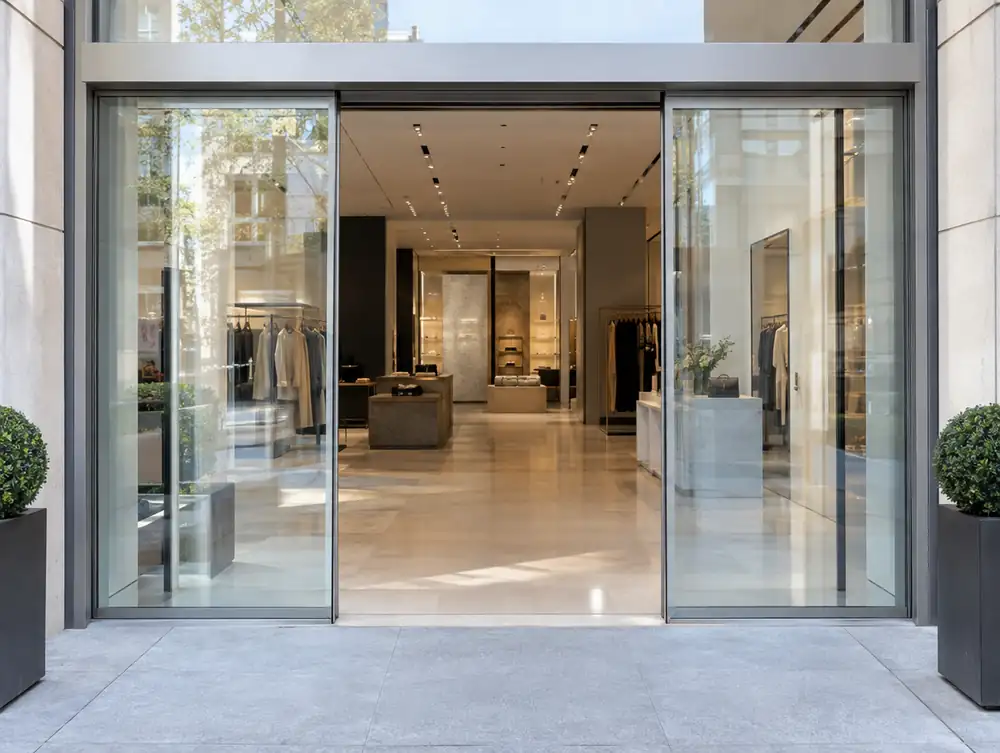
Where do you start with automatic sliding doors in Greater Manchester?
Servicing should be thought about at the start. For premises in Greater Manchester, we'd place the operator cover and isolator where an engineer can reach them from a short ladder, with no need to disturb the fascia.
Exposure shapes the door. If your entrance in Greater Manchester faces the prevailing wind, we'd look at a lobby, a stronger drive or a deeper recess, so that tall leaves don't fight the weather.
What consents apply to automatic sliding doors in Greater Manchester?
England has no permitted development route for changing a shopfront. Part 7 Class A of the General Permitted Development Order 2015 excludes creating, altering or replacing one, and it allows no alterations at all on article 2(3) land. That leaves two outcomes for automatic sliding doors at premises in the Greater Manchester area: a planning application, or work that doesn't materially affect the external appearance.
How much do automatic sliding doors cost in Greater Manchester?
Guide price: £3,895 to £11,995 plus VAT per entrance. Materials, finish and the amount of drawing and coordination involved all move it, and your itemised quotation shows where the money goes on automatic sliding doors.
| Area | Greater Manchester |
|---|---|
| Nation | England |
| Towns covered | 69 |
| Main town | Manchester |
| Planning regime | England: TCPA 1990 and the 2007 Advertisement Regulations |
| Building approval | Building Regulations (Approved Documents) |
| Survey | Free for new work, from our Great Barr base |
Does Manchester City Council publish shopfront guidance?
Yes, Shopfront and Signage Design Guide. It tells applicants what the council expects from new and altered shopfronts. A few of the things it asks for:
- External shutters are generally not permitted, and any exceptional case must be at least 50% transparent, sit within the shopfront frame and hide its box behind the fascia.
- Internally lit lightbox signage is not permitted for new signs, and external lighting such as discreet spotlights is preferred.
- New signage is limited to one fascia or internal hanging sign per elevation, with a maximum depth of 30mm.
Questions about automatic sliding doors in Greater Manchester
Can premises in Manchester keep trading during installation?
Often, yes. A side entrance or a closed period outside trading hours usually covers the main stage, and the door can be set up soon after.
Do you fit automatic sliding doors across Greater Manchester?
Yes. We travel from Great Barr to survey the entrance, then fit and set up the door with a vetted team.
Will an automatic door work in an exposed part of Greater Manchester?
Usually, with the right drive and some shelter. Wind pressure on tall leaves is the main thing to design for, so we look at a recess or lobby first.
Do I need planning permission to change a shopfront in the Greater Manchester area?
Usually yes, if the work materially affects the building's external appearance. England's shop permitted development rights exclude creating, altering or replacing a shopfront, so there is no shortcut. A true like-for-like replacement usually needs no application, and the council confirms the position.
Does a shop sign in the Greater Manchester area need advertisement consent?
Not always. In England, an unlit sign within Class 5 of the 2007 Advertisement Regulations generally needs no application, and neither does a lit sign within Class 4B. Anything outside those classes needs consent, and Class 4B isn't available in conservation areas, so check before ordering.