Few businesses can shut for a week, so any time on site for frameless glass shopfronts in Greater Manchester is planned around the hours you trade. Closed-day or out-of-hours installation can be arranged.
Your frontage is read alongside its neighbours, so we note the fascia line, stallriser height and pilasters on either side before drawing frameless glass shopfronts for Greater Manchester premises. Matching those lines or breaking them on purpose can both work, whereas doing it by accident never does.
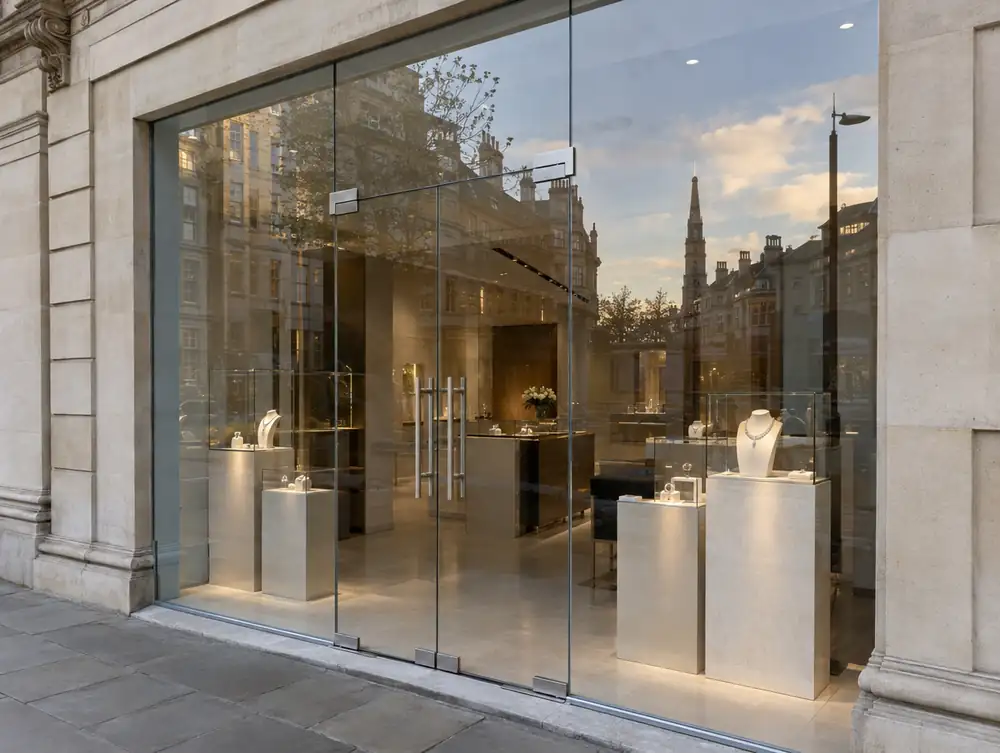
What should you look for from frameless glass shopfronts in Greater Manchester?
If your premises in Greater Manchester sit on a slope, a frameless front has nowhere to hide the fall. We'd step the floor channel behind a low plinth, or set the joints so each pane takes one level, rather than leaving a wedge of silicone at the pavement.
Frameless glass stands or falls on the structure above it, so the first job at any address in Greater Manchester is finding out what holds the building up. Once the fascia is opened, we can say plainly whether the head is stiff enough or needs a new steel.
What consents apply to frameless glass shopfronts in Greater Manchester?
For frameless glass shopfronts at premises in the Greater Manchester area, the deciding question in England is whether the building work materially affects the external appearance. If it does, planning permission is needed, while a true like-for-like replacement usually needs none. The council confirms the position for each site.
How much do frameless glass shopfronts cost in Greater Manchester?
We would budget £4,995 to £15,995 plus VAT for a typical frontage. Scope sets most of the figure, so a clear brief at the start does more for the budget than any later change of detail.
| Area | Greater Manchester |
|---|---|
| Nation | England |
| Towns covered | 69 |
| Main town | Manchester |
| Planning regime | England: TCPA 1990 and the 2007 Advertisement Regulations |
| Building approval | Building Regulations (Approved Documents) |
| Survey | Free for new work, from our Great Barr base |
Does Manchester City Council publish shopfront guidance?
Yes, Shopfront and Signage Design Guide. It tells applicants what the council expects from new and altered shopfronts. A few of the things it asks for:
- External shutters are generally not permitted, and any exceptional case must be at least 50% transparent, sit within the shopfront frame and hide its box behind the fascia.
- Internally lit lightbox signage is not permitted for new signs, and external lighting such as discreet spotlights is preferred.
- New signage is limited to one fascia or internal hanging sign per elevation, with a maximum depth of 30mm.
Questions about frameless glass shopfronts in Greater Manchester
How are heavy panes handled at premises in Manchester?
With vacuum lifters and a glazing crew sized to the pane, and a mechanical lifter on the larger sheets. Delivery and lifting are planned around your street before the order is placed.
Do you need to close the shop to fit frameless glass in Greater Manchester?
Usually for part of the job. The old front has to come out before the new panes go in, so a closed day or an out-of-hours fit tends to be the tidiest answer.
Can a frameless front in Greater Manchester still have a shutter?
Yes, and an internal shutter usually suits it better than an external one because the glass stays on show. We'd draw the box behind the fascia from the start.
Do roller shutters need planning permission in the Greater Manchester area?
Usually yes. Installing or replacing a security grill or shutter on a shopfront is expressly outside England's shop permitted development rights, so the only way to avoid an application is work that doesn't materially affect the appearance. Ask the council before ordering.
Does the Equality Act apply to a shop entrance in the Greater Manchester area?
Yes. The Equality Act 2010 applies in England, as across Great Britain, and it requires reasonable steps to remove, alter or avoid physical features that disadvantage disabled people. The duty is anticipatory, so it looks at disabled people generally, and a new Services Code replaced the 2011 Code on 5 August 2026.