Survey, supply and set-up of automatic sliding doors for Manchester premises all run under one contract, arranged from Great Barr. The usual pattern is 3 to 6 weeks to order after sign-off, then typically 1 to 3 days on site.
Your survey is where the price gets real, because widths, heights, levels and access are all taken on site in Manchester.
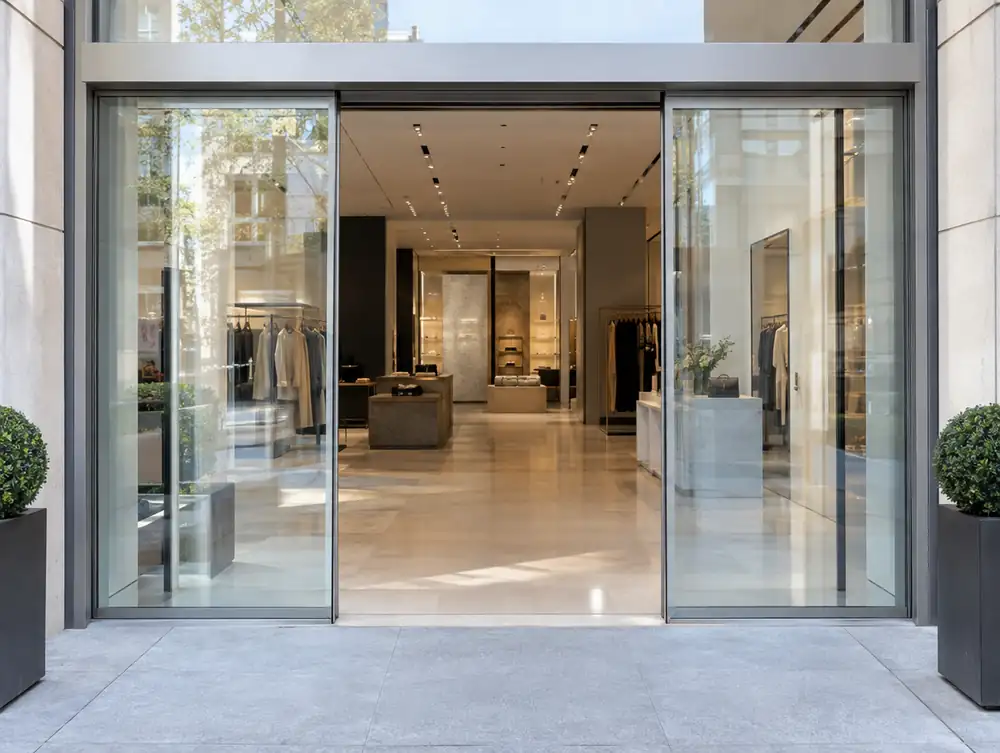
How do you design around the building when planning automatic sliding doors in Manchester?
A corner unit in Manchester can often move its entrance to the angle, where two directions of footfall meet. We'd look at a curved or canted door set, and check the wind on both streets before fixing the position.
Automatic doors suit a night fit in Manchester, because most of the work is at the head and the opening stays usable in stages. We'd fit the track and leaves out of hours, then commission the door before you open.
Where units share one long run of fascia, breaking the height makes you stand out for the wrong reason. If that describes your Manchester parade, keep the line and win attention with lettering, lighting and what's in the window.
What might automatic sliding doors cost in Manchester?
Until the survey is done, plan on £3,895 to £11,995 plus VAT per entrance. Unusual sizes, fine detail and phased working push the figure up, while a simple brief and clear access keep it toward the lower end.
What permissions should you check for automatic sliding doors in Manchester?
Security grilles and shutters are named in England's rules: installing or replacing one on a shopfront sits outside the shop permitted development rights. The frontage itself is treated the same way, so for automatic sliding doors at premises in the Manchester area, building work that materially affects the appearance needs planning permission. Confirm the position with the council before anything is ordered.
We confirm the position at survey, because a boundary or a special designation can change who handles the file, but applications from Manchester premises normally go to Manchester City Council.
| Town | Manchester |
|---|---|
| Area | Greater Manchester |
| Postcode districts | M1, M2, M4, M60 |
| Planning authority | Manchester City Council |
| Building approval | Building Regulations (Approved Documents) |
| Distance from Great Barr | About 66 miles |
| Survey | Free for new work |
Does Manchester City Council publish shopfront guidance?
Yes, Shopfront and Signage Design Guide. It tells applicants what the council expects from new and altered shopfronts. A few of the things it asks for:
- External shutters are generally not permitted, and any exceptional case must be at least 50% transparent, sit within the shopfront frame and hide its box behind the fascia.
- Internally lit lightbox signage is not permitted for new signs, and external lighting such as discreet spotlights is preferred.
- New signage is limited to one fascia or internal hanging sign per elevation, with a maximum depth of 30mm.
Questions about automatic sliding doors in Manchester
Can you match the door to my existing front in Greater Manchester?
Yes. Frames come in any RAL colour, and we'd line up the leaves with your existing mullions so the door doesn't look like an add-on.
What do I need to arrange for a door in Manchester?
Usually just a power supply near the head, and we'll tell you exactly what at survey. We can bring that into the one contract if you'd rather not chase an electrician.
How noisy would an automatic door be at my Manchester shop?
A healthy door is very quiet, and you'd normally hear only a soft hum. Noise usually means worn rollers or grit in the guide, which a service will put right.
Does a shop sign in the Manchester area need advertisement consent?
Not always. In England, an unlit sign within Class 5 of the 2007 Advertisement Regulations generally needs no application, and neither does a lit sign within Class 4B. Anything outside those classes needs consent, and Class 4B isn't available in conservation areas, so check before ordering.
Do I need listed building consent for a shopfront in the Manchester area?
Usually yes, if the building is listed. In England the local planning authority decides, and Historic England is notified of Grade I and II* works and specified Grade II works. Like-for-like repair may not need consent, so ask the council before work starts.