Swinging doors can be a daily nuisance for staff carrying stock through a shop in Edinburgh. A sliding set clears the opening with no effort, and keeps the floor space around the door usable.
Please have keys to any meter cupboards and shutter housings to hand when we survey in Edinburgh, because what sits behind them can change the drawing.
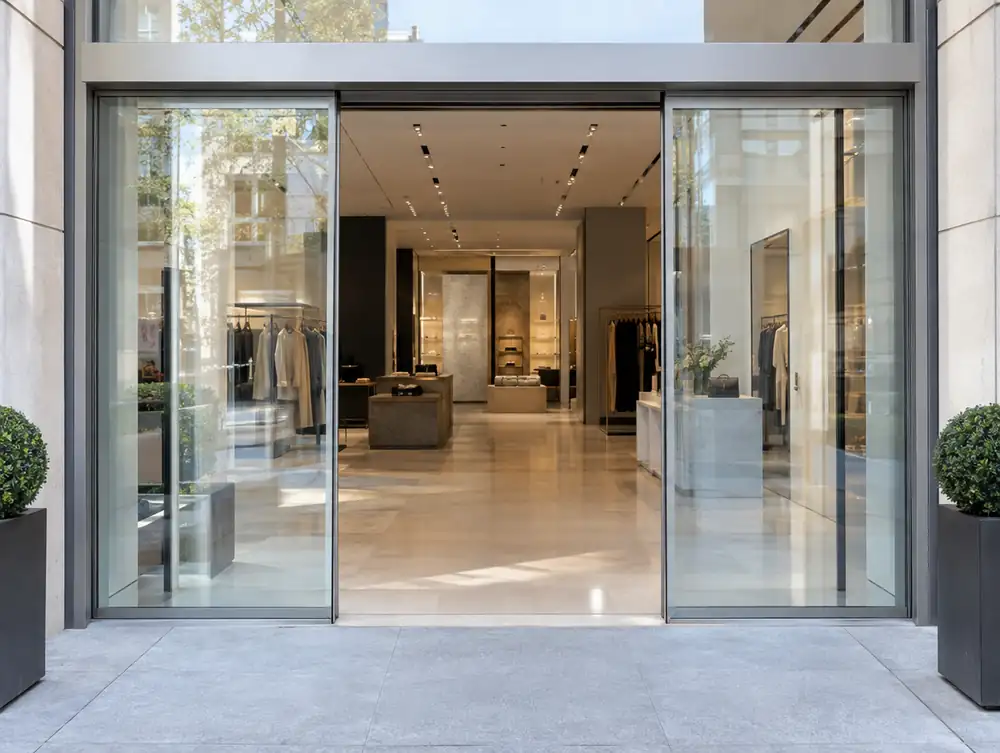
How would we approach automatic sliding doors for your Edinburgh premises?
In a parade in Edinburgh with a narrow pavement, the sensor set-up is the first job. We'd angle the radar so people walking past don't trigger the door, and keep the leaves in line with the neighbouring frontage.
On a narrow Edinburgh frontage, parked leaves can leave too little opening. We'd look at a telescopic or single-slide set, and consider moving the door to one side to free up the display.
If the pavement falls across your frontage, let the stallriser take up the slope and keep the glass line dead level. The eye reads the long horizontal, so Edinburgh premises on a slope look settled once that line is true.
What consents could affect automatic sliding doors in Edinburgh?
Scottish guidance says like-for-like windows need no permission, and a true like-for-like frontage replacement usually follows the same logic. Class 7A covers altering or replacing an existing window, but it doesn't mention shopfronts, so ask before relying on it for a display window. For automatic sliding doors at premises in the Edinburgh area, a material effect on the external appearance means planning permission, and the council confirms the position.
For Edinburgh, the usual route for planning and advert applications is through City of Edinburgh Council, and we confirm that when we visit.
What should you budget for automatic sliding doors in Edinburgh?
As a working budget, use £3,895 to £11,995 plus VAT per entrance. Your place inside that range for automatic sliding doors depends mostly on how much of the existing frontage can stay and how much has to be put right first.
| Town | Edinburgh |
|---|---|
| Area | Edinburgh and the Lothians |
| Postcode districts | EH1, EH2, EH3, EH8 |
| Planning authority | City of Edinburgh Council |
| Building approval | Building warrant (Technical Handbook) |
| Distance from Great Barr | About 241 miles |
| Survey | Free for new work |
Does The City of Edinburgh Council publish shopfront guidance?
Yes, Guidance for Businesses (2024). It tells applicants what the council expects from new and altered shopfronts. A few of the things it asks for:
- Fascias should not exceed one-fifth of the overall frontage height, and applied fascia boards are normally unacceptable.
- Individual lettering should not exceed two-thirds of the fascia depth, up to a maximum of 450mm.
- Solid roller shutters are unacceptable, externally mounted shutters will not be considered acceptable, and toughened glass is the most appropriate security method.
Questions about automatic sliding doors in Edinburgh
How noisy would an automatic door be at my Edinburgh shop?
A healthy door is very quiet, and you'd normally hear only a soft hum. Noise usually means worn rollers or grit in the guide, which a service will put right.
Will the door keep opening for passers-by in Edinburgh?
Not if it is set up properly. We narrow the sensor field on site and test it against real footfall, so only people heading for the door trigger it.
Who installs automatic doors in Edinburgh?
Vetted door teams working under S&K Glazing handle the fit and set-up, travelling from Great Barr. Your agreement is with S&K Glazing Limited, and one person stays your point of call.
Do I need a building warrant for a shopfront in the Edinburgh area?
Usually yes in Scotland, if the work alters a wall or structure. Schedule 3 of the Building (Scotland) Regulations 2004 lists some work that needs no warrant, such as replacing a door or window with its frame, but the standards still apply. Shopfronts aren't named there, so ask the council before relying on it.
Does a shop sign in the Edinburgh area need advertisement consent?
Not always. Scotland's 1984 Regulations let an unlit sign within Class IV(1) go up without an application, and Class VI does the same for a lit sign with each character lit from within. Class VI isn't available in conservation areas, and one council says lit signs always need express consent, so ask first.