Restaurants, salons and boutiques each ask something different of a frontage. We design around how people will use your Edinburgh premises, from the door to the display.
It helps if you can be there when we visit Edinburgh, since five minutes walking the frontage together answers more than a long email.
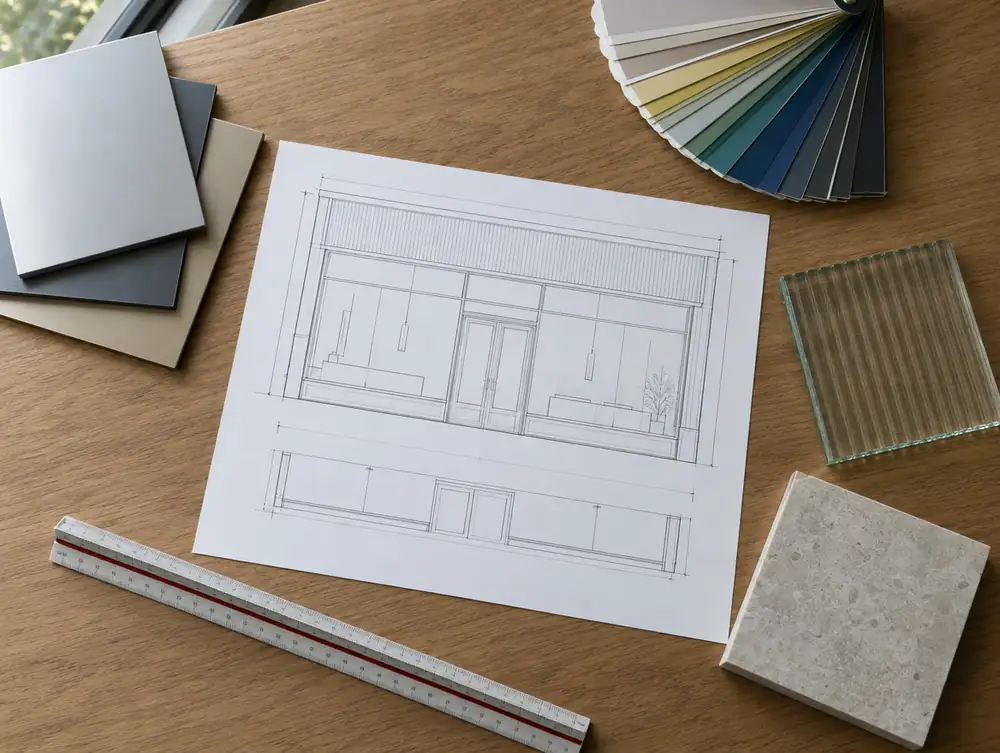
What goes into getting shopfront design right in Edinburgh?
Where the building above has strong vertical lines, we carry them down through pilasters and mullions. If it is plain, the shopfront can take a calmer, wider treatment.
If you trade after dark, we add an evening view to the drawings. Interior light, the sign and any shade change how the frontage reads, so we would sooner show you than describe it.
On a north-facing frontage the glass stays free of glare, but the interior can look dim from the street, so lighting needs to sit closer to the window. If your Edinburgh premises face south, the problem flips to reflections by day and fading stock.
How much could shopfront design in Edinburgh cost you?
As a working budget, use £495 to £2,495 plus VAT per frontage. Your place inside that range for shopfront design depends mostly on how much of the existing frontage can stay and how much has to be put right first.
Which applications might shopfront design in Edinburgh involve?
Scottish guidance says like-for-like windows need no permission, and a true like-for-like frontage replacement usually follows the same logic. Class 7A covers altering or replacing an existing window, but it doesn't mention shopfronts, so ask before relying on it for a display window. For shopfront work at premises in the Edinburgh area, a material effect on the external appearance means planning permission, and the council confirms the position.
Expect planning and advert applications here to go to City of Edinburgh Council in the normal way. We check what that means for your building when we survey it in Edinburgh.
| Town | Edinburgh |
|---|---|
| Area | Edinburgh and the Lothians |
| Postcode districts | EH1, EH2, EH3, EH8 |
| Planning authority | City of Edinburgh Council |
| Building approval | Building warrant (Technical Handbook) |
| Distance from Great Barr | About 241 miles |
| Survey | Free for new work |
Does The City of Edinburgh Council publish shopfront guidance?
Yes, Guidance for Businesses (2024). It tells applicants what the council expects from new and altered shopfronts. A few of the things it asks for:
- Fascias should not exceed one-fifth of the overall frontage height, and applied fascia boards are normally unacceptable.
- Individual lettering should not exceed two-thirds of the fascia depth, up to a maximum of 450mm.
- Solid roller shutters are unacceptable, externally mounted shutters will not be considered acceptable, and toughened glass is the most appropriate security method.
Questions about shopfront design in Edinburgh
Can you show the design to my landlord in Edinburgh and the Lothians?
Yes. The drawings and visuals are prepared so a landlord or agent can review them easily. We can answer their questions directly if that helps.
Can a design for Edinburgh premises follow my brand guidelines?
Yes. Send them over with your logo files, and we apply them to your elevation. Where a rule does not fit the building, we explain why and suggest an adjustment.
Do I need a design service for a simple Edinburgh shopfront?
Not always. Every job gets a measured survey and scale drawings anyway. The design service adds options, visuals and a full specification, which pay off when the look matters most.
Does the Equality Act cover a shop entrance in the Edinburgh area?
Yes. The Equality Act 2010 applies in Scotland as part of Great Britain, and its anticipatory duty expects reasonable steps to remove, alter or avoid physical features that disadvantage disabled people generally. BS 8300-2:2018 is the current British Standard for accessible buildings.
Do I need listed building consent for a shopfront in the Edinburgh area?
Almost certainly, if the building is listed and windows or doors are changing, according to Historic Environment Scotland. The planning authority decides, and Historic Environment Scotland is consulted on some applications. Scottish Ministers are notified if it objects.