Seen a frontage you admire? Bring the picture to our first talk about automatic sliding doors in Tyne and Wear, and we will work out what makes it succeed, from fascia depth to glass line, and what that means for your building.
Most frontages share something with someone, be that a door to the flats above, a meter cupboard or a pilaster on the boundary. We pick those up early on automatic sliding doors in Tyne and Wear, because they are far easier to design around than to discover on the day.
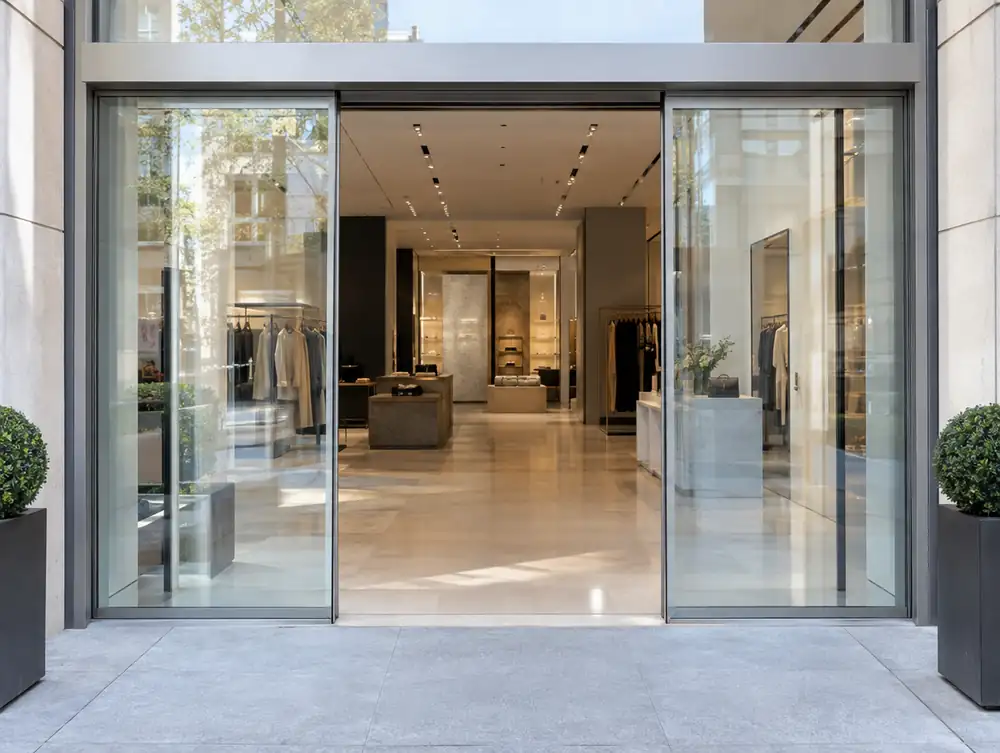
How do we handle automatic sliding doors for premises in Tyne and Wear?
A unit in Newcastle upon Tyne may trade into the evening while a clinic elsewhere in Tyne and Wear keeps office hours. We set the door's modes to match, including one-way, exit-only and locked settings, so nobody has to think about it daily.
Exposure shapes the door. If your entrance in Tyne and Wear faces the prevailing wind, we'd look at a lobby, a stronger drive or a deeper recess, so that tall leaves don't fight the weather.
What consents apply to automatic sliding doors in Tyne and Wear?
Security grilles and shutters are named in England's rules: installing or replacing one on a shopfront sits outside the shop permitted development rights. The frontage itself is treated the same way, so for automatic sliding doors at premises in the Tyne and Wear area, building work that materially affects the appearance needs planning permission. Confirm the position with the council before anything is ordered.
How much do automatic sliding doors cost in Tyne and Wear?
Until the survey is done, plan on £3,895 to £11,995 plus VAT per entrance. Unusual sizes, fine detail and phased working push the figure up, while a simple brief and clear access keep it toward the lower end.
| Area | Tyne and Wear |
|---|---|
| Nation | England |
| Towns covered | 20 |
| Main town | Newcastle upon Tyne |
| Planning regime | England: TCPA 1990 and the 2007 Advertisement Regulations |
| Building approval | Building Regulations (Approved Documents) |
| Survey | Free for new work, from our Great Barr base |
Does Newcastle City Council publish shopfront guidance?
Yes, Shopfronts in the historic environment (2011). It tells applicants what the council expects from new and altered shopfronts. A few of the things it asks for:
- Fascias should generally take up no more than 20% of the shopfront height, with lettering no more than two-thirds of the fascia height.
- Solid external roller shutters are treated as harmful to appearance, with internal lattice grilles offered as a good alternative.
- No shopfront sign should be internally lit, and whole plastic fascias are not acceptable.
Questions about automatic sliding doors in Tyne and Wear
Who services automatic doors once they are fitted in Tyne and Wear?
Any competent door engineer can, and we'd recommend two visits a year. We'll talk you through the options at handover, so it doesn't get forgotten.
How long does an automatic door take for a site in Tyne and Wear?
Doors are typically ready 3 to 6 weeks after sign-off, and fitting typically takes 1 to 3 days. Electrical work needs booking in with the fit.
Can premises in Newcastle upon Tyne keep trading during installation?
Often, yes. A side entrance or a closed period outside trading hours usually covers the main stage, and the door can be set up soon after.
What rules apply to a fire exit door through a shopfront in the Tyne and Wear area?
It must open in the direction of escape and can't be locked against immediate use, and a dedicated fire exit can't be a sliding or revolving door. In England that comes from article 14(2) of the Regulatory Reform (Fire Safety) Order 2005, and the duty sits with the responsible person, normally the employer or whoever controls the premises for a business, otherwise the owner. An outward door can clash with section 153 of the Highways Act 1980 where it opens onto the footway, so raise it early.
Do roller shutters need planning permission in the Tyne and Wear area?
Usually yes. Installing or replacing a security grill or shutter on a shopfront is expressly outside England's shop permitted development rights, so the only way to avoid an application is work that doesn't materially affect the appearance. Ask the council before ordering.