Our fee for planning and consent support in Tyne and Wear is written and itemised before any work starts, which gives you time to take it to a landlord, a partner or a board.
What sits behind the existing fascia often decides the job. Old beams, abandoned cable runs and earlier frames are common finds, which is why our visit to Tyne and Wear premises looks past the surface before anything is drawn or priced for planning and consent support.
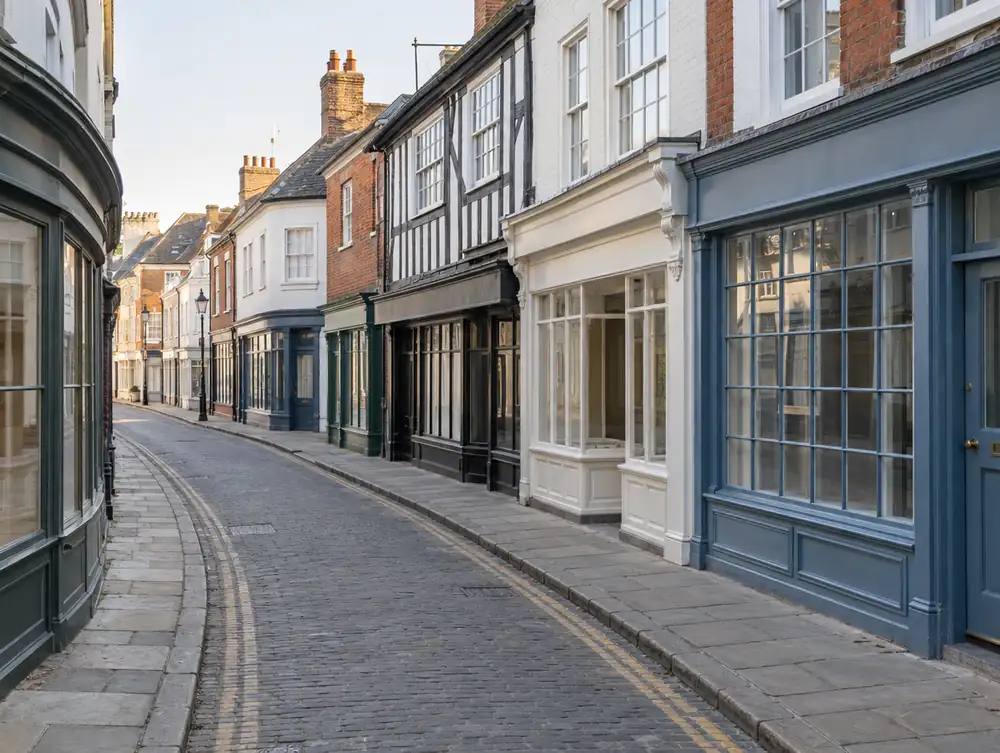
What should you look for from planning and consent support in Tyne and Wear?
One set of drawings should answer every question. For a frontage near Newcastle upon Tyne we put signs, lighting, shutters and canopies on the same elevations, so nothing surfaces later as a surprise.
Older buildings need more evidence. If your premises in Tyne and Wear have surviving features, we photograph and draw them before the design is fixed, so the submission shows what will be kept.
What consents apply to shopfront work in Tyne and Wear?
For shopfront work at premises in the Tyne and Wear area, the deciding question in England is whether the building work materially affects the external appearance. If it does, planning permission is needed, while a true like-for-like replacement usually needs none. The council confirms the position for each site.
How much does planning and consent support cost in Tyne and Wear?
Allow £395 to £1,295 plus VAT per application, plus the council's fee. Size and specification set most of that figure for planning and consent support, and the rest depends on what the survey finds on site.
| Area | Tyne and Wear |
|---|---|
| Nation | England |
| Towns covered | 20 |
| Main town | Newcastle upon Tyne |
| Planning regime | England: TCPA 1990 and the 2007 Advertisement Regulations |
| Building approval | Building Regulations (Approved Documents) |
| Survey | Free for new work, from our Great Barr base |
Does Newcastle City Council publish shopfront guidance?
Yes, Shopfronts in the historic environment (2011). It tells applicants what the council expects from new and altered shopfronts. A few of the things it asks for:
- Fascias should generally take up no more than 20% of the shopfront height, with lettering no more than two-thirds of the fascia height.
- Solid external roller shutters are treated as harmful to appearance, with internal lattice grilles offered as a good alternative.
- No shopfront sign should be internally lit, and whole plastic fascias are not acceptable.
Questions about planning and consent support in Tyne and Wear
Do you prepare applications for premises across Tyne and Wear?
Yes. We measure, draw and prepare the application, then submit it and answer the officer's questions. The decision itself is never ours to make, and we will always be plain about that.
Can you take over an application already started for premises around Newcastle upon Tyne?
Often, yes. Send us the drawings and any correspondence, and we will check them against a measured survey. If the officer has raised points, we would deal with those first.
What photographs help with an application near Newcastle upon Tyne?
Straight-on views of the frontage, views along the street in both directions and close-ups of any older details. We take photographs at survey, and yours can add useful history.
Do roller shutters need planning permission in the Tyne and Wear area?
Usually yes. Installing or replacing a security grill or shutter on a shopfront is expressly outside England's shop permitted development rights, so the only way to avoid an application is work that doesn't materially affect the appearance. Ask the council before ordering.
What rules apply to a fire exit door through a shopfront in the Tyne and Wear area?
It must open in the direction of escape and can't be locked against immediate use, and a dedicated fire exit can't be a sliding or revolving door. In England that comes from article 14(2) of the Regulatory Reform (Fire Safety) Order 2005, and the duty sits with the responsible person, normally the employer or whoever controls the premises for a business, otherwise the owner. An outward door can clash with section 153 of the Highways Act 1980 where it opens onto the footway, so raise it early.