Few businesses can shut for a week, so any time on site for shopfront refurbishment in Tyne and Wear is planned around the hours you trade. Closed-day or out-of-hours installation can be arranged.
If you're a tenant, your landlord will probably want to see what is proposed. The scale drawings we produce for shopfront refurbishment are clear enough to send straight on, which saves a round of explaining.
What should you look for from shopfront refurbishment in Tyne and Wear?
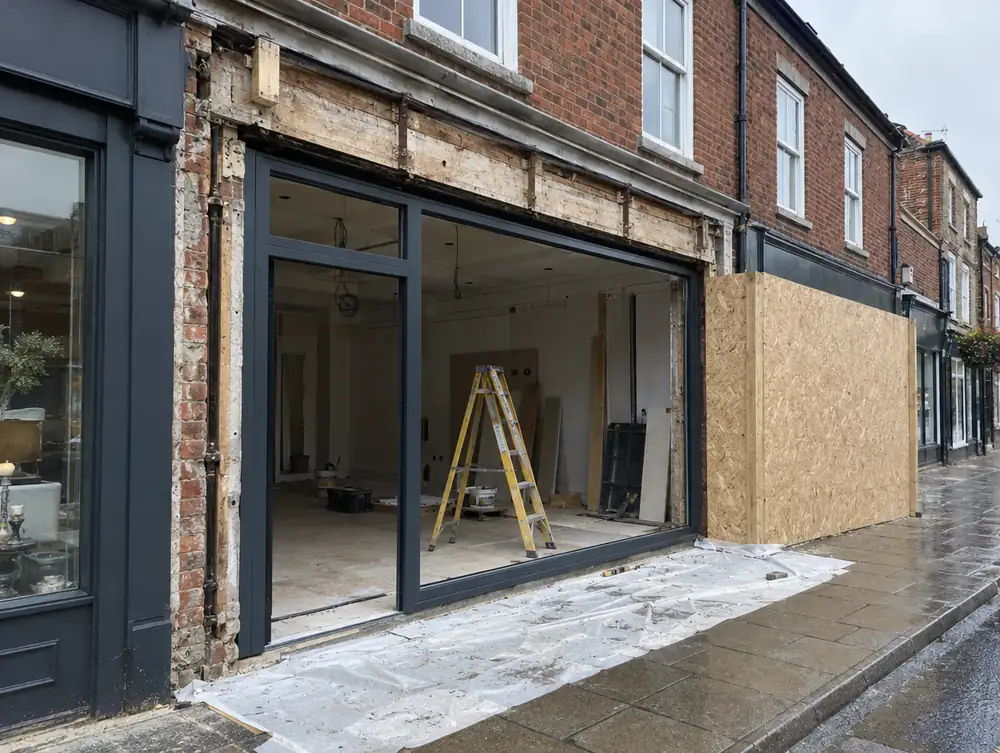
Hidden layers are common on frontages that have changed hands. If your premises in Tyne and Wear have had several tenants, we expect old panels, fixings and cables, and we allow for clearing them properly.
Landlords with several units can refresh them in sequence. If you own premises across Tyne and Wear, we would draw one palette and one sign zone, then carry them out as each unit falls vacant.
What consents apply to shopfront refurbishment in Tyne and Wear?
For shopfront refurbishment at premises in the Tyne and Wear area, the deciding question in England is whether the building work materially affects the external appearance. If it does, planning permission is needed, while a true like-for-like replacement usually needs none. The council confirms the position for each site.
How much does shopfront refurbishment cost in Tyne and Wear?
We would budget £1,995 to £8,995 plus VAT depending on what is kept. Scope sets most of the figure, so a clear brief at the start does more for the budget than any later change of detail.
| Area | Tyne and Wear |
|---|---|
| Nation | England |
| Towns covered | 20 |
| Main town | Newcastle upon Tyne |
| Planning regime | England: TCPA 1990 and the 2007 Advertisement Regulations |
| Building approval | Building Regulations (Approved Documents) |
| Survey | Free for new work, from our Great Barr base |
Does Newcastle City Council publish shopfront guidance?
Yes, Shopfronts in the historic environment (2011). It tells applicants what the council expects from new and altered shopfronts. A few of the things it asks for:
- Fascias should generally take up no more than 20% of the shopfront height, with lettering no more than two-thirds of the fascia height.
- Solid external roller shutters are treated as harmful to appearance, with internal lattice grilles offered as a good alternative.
- No shopfront sign should be internally lit, and whole plastic fascias are not acceptable.
Questions about shopfront refurbishment in Tyne and Wear
Can you budget a refurbishment in Tyne and Wear from a photograph?
Only roughly, and we would not call it a price. Every figure comes from a measure-up, because the condition behind the paint is what sets the cost.
Can a refurbishment run alongside a new tenant's fit-out in Tyne and Wear?
Yes, and that is often the ideal moment, as the frontage can be opened up without disturbing trade. We coordinate dates with your shopfitter through one named contact.
Do you repair original tile or joinery in Tyne and Wear?
Yes, where it can be saved. Tile can be cleaned and repaired with matched pieces, and joinery can be spliced with new hardwood. We show you the options at survey.
Does a new shopfront in the Tyne and Wear area need Building Regulations approval?
Assume yes until building control says otherwise. England has no like-for-like exemption, though registered installers can self-certify replacement windows and doors in non-dwellings. That route doesn't cover structural glass, curtain walling or revolving doors.
Do roller shutters need planning permission in the Tyne and Wear area?
Usually yes. Installing or replacing a security grill or shutter on a shopfront is expressly outside England's shop permitted development rights, so the only way to avoid an application is work that doesn't materially affect the appearance. Ask the council before ordering.