Paint, glass, signs and door gear usually age long before the frame does. We look at each part of your Gosforth shopfront on its merits, then put forward a scope that makes sense.
Expect us to measure the opening, photograph the existing front and check how materials will reach it on the day, at a time you have agreed.
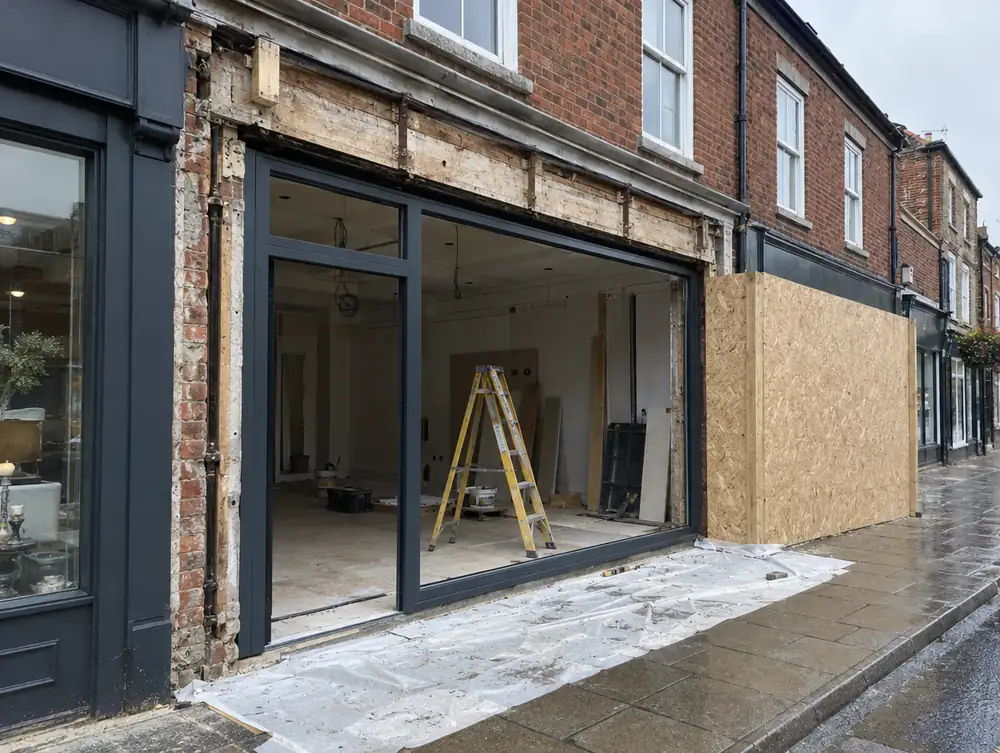
What should you think about before commissioning shopfront refurbishment in Gosforth?
If later panels cover the original fascia, we lift a corner at survey. Surviving cornices, pilasters or tile can change the whole plan, and they cost nothing to keep.
If your Gosforth shopfront is aluminium and the frame is sound, a recoat can change the whole look. We check for corrosion and old sealant first, because paint will not hide either for long.
Where the footway outside your Gosforth premises is narrow, a recessed entrance earns its keep. It gives people a dry place to pause out of the walkway, and it adds a longer run of display glass either side of the door.
Who approves shopfront refurbishment in Gosforth?
A true like-for-like replacement usually needs no planning permission in England, because the external appearance isn't materially affected. New materials, a different glass line or altered proportions usually do count as material, so for shopfront refurbishment at premises in the Gosforth area, an application is then likely. The council confirms which side of that line a job falls on.
For Gosforth, the usual route for planning and advert applications is through Newcastle City Council, and we confirm that when we visit.
What is a realistic budget for shopfront refurbishment in Gosforth?
A sensible starting budget is £1,995 to £8,995 plus VAT depending on what is kept. What shifts the figure is whatever can't be seen yet, such as the condition behind the old frontage or the services running through it.
| Town | Gosforth |
|---|---|
| Area | Tyne and Wear |
| Postcode districts | NE1, NE2, NE3, NE7 |
| Planning authority | Newcastle City Council |
| Building approval | Building Regulations (Approved Documents) |
| Distance from Great Barr | About 170 miles |
| Survey | Free for new work |
Does Newcastle City Council publish shopfront guidance?
Yes, Shopfronts in the historic environment (2011). It tells applicants what the council expects from new and altered shopfronts. A few of the things it asks for:
- Fascias should generally take up no more than 20% of the shopfront height, with lettering no more than two-thirds of the fascia height.
- Solid external roller shutters are treated as harmful to appearance, with internal lattice grilles offered as a good alternative.
- No shopfront sign should be internally lit, and whole plastic fascias are not acceptable.
Questions about shopfront refurbishment in Gosforth
Can you refurbish just the sign and door on my Gosforth frontage?
Yes. A new sign and door gear can make a big difference on their own. We would look at how they sit with the frame and suggest a colour to tie them together.
Can my Gosforth shopfront be refurbished without closing?
Usually, yes. Work is split into stages around your trading hours, and closed-day or out-of-hours work can be arranged for anything that affects the door.
Can a refurbishment make my Gosforth premises easier to enter?
Often, yes. Lighter door closers, better handles and a lower threshold can all be added without replacing the frontage. We check the door width and the step at survey.
What rules apply to a fire exit door through a shopfront in the Gosforth area?
It must open in the direction of escape and can't be locked against immediate use, and a dedicated fire exit can't be a sliding or revolving door. In England that comes from article 14(2) of the Regulatory Reform (Fire Safety) Order 2005, and the duty sits with the responsible person, normally the employer or whoever controls the premises for a business, otherwise the owner. An outward door can clash with section 153 of the Highways Act 1980 where it opens onto the footway, so raise it early.
Does a new shopfront in the Gosforth area need Building Regulations approval?
Assume yes until building control says otherwise. England has no like-for-like exemption, though registered installers can self-certify replacement windows and doors in non-dwellings. That route doesn't cover structural glass, curtain walling or revolving doors.