What should your premises say from across the road? We open every conversation about shopfront design in Tyne and Wear with that question, then treat proportion as seriously as the budget.
Your frontage is read alongside its neighbours, so we note the fascia line, stallriser height and pilasters on either side before drawing shopfront design for Tyne and Wear premises. Matching those lines or breaking them on purpose can both work, whereas doing it by accident never does.
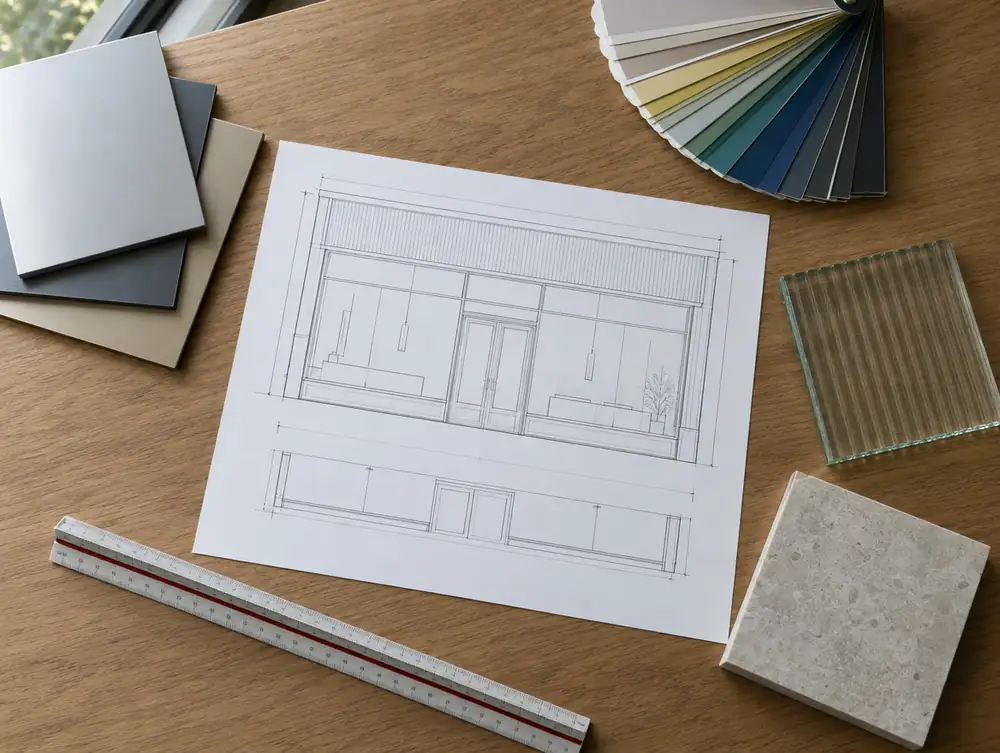
What makes shopfront design work well for premises in Tyne and Wear?
Context comes first. For premises across Tyne and Wear we draw the neighbouring frontages on the elevation, so your design is judged on the street and not on a white page.
Older buildings often hide their finest details. If your unit in Tyne and Wear has been altered, we look behind later panels at survey, as a surviving cornice or pilaster can give the design its starting point.
What consents apply to shopfront work in Tyne and Wear?
England has no permitted development route for changing a shopfront. Part 7 Class A of the General Permitted Development Order 2015 excludes creating, altering or replacing one, and it allows no alterations at all on article 2(3) land. That leaves two outcomes for shopfront work at premises in the Tyne and Wear area: a planning application, or work that doesn't materially affect the external appearance.
How much does shopfront design cost in Tyne and Wear?
Guide price: £495 to £2,495 plus VAT per frontage. Materials, finish and the amount of drawing and coordination involved all move it, and your itemised quotation shows where the money goes on shopfront design.
| Area | Tyne and Wear |
|---|---|
| Nation | England |
| Towns covered | 20 |
| Main town | Newcastle upon Tyne |
| Planning regime | England: TCPA 1990 and the 2007 Advertisement Regulations |
| Building approval | Building Regulations (Approved Documents) |
| Survey | Free for new work, from our Great Barr base |
Does Newcastle City Council publish shopfront guidance?
Yes, Shopfronts in the historic environment (2011). It tells applicants what the council expects from new and altered shopfronts. A few of the things it asks for:
- Fascias should generally take up no more than 20% of the shopfront height, with lettering no more than two-thirds of the fascia height.
- Solid external roller shutters are treated as harmful to appearance, with internal lattice grilles offered as a good alternative.
- No shopfront sign should be internally lit, and whole plastic fascias are not acceptable.
Questions about shopfront design in Tyne and Wear
Do you only design for jobs you build in Tyne and Wear?
No, design is priced as its own item. Tell us how your project is arranged, and we will suggest the most useful scope.
Can the design cover a sign and lighting too?
Yes, and it should. The sign, lamps and interior light all affect the frontage, so we draw them together for premises around Newcastle upon Tyne and everywhere else we work.
Can you draw my premises in Tyne and Wear before I commit to the lease?
Yes. A survey and concept drawing can show what the frontage could become and give a budget for it, which is useful while terms are still open.
Does a shop sign in the Tyne and Wear area need advertisement consent?
Not always. In England, an unlit sign within Class 5 of the 2007 Advertisement Regulations generally needs no application, and neither does a lit sign within Class 4B. Anything outside those classes needs consent, and Class 4B isn't available in conservation areas, so check before ordering.
Do I need listed building consent for a shopfront in the Tyne and Wear area?
Usually yes, if the building is listed. In England the local planning authority decides, and Historic England is notified of Grade I and II* works and specified Grade II works. Like-for-like repair may not need consent, so ask the council before work starts.