Shopfront design for Newcastle upon Tyne premises starts with a measure-up, because good proportion depends on the real building. We draw the frontage to scale, with the sign, glass and door resolved together.
Expect us to measure the opening, photograph the existing front and check how materials will reach it on the day, at a time you have agreed.
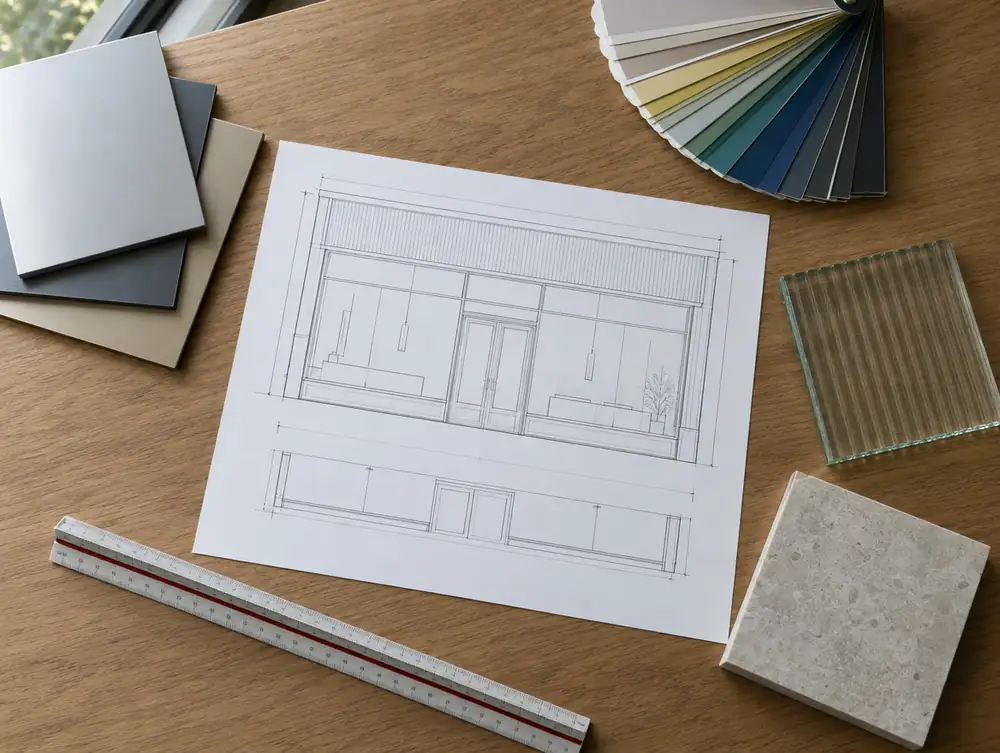
What goes into getting shopfront design right in Newcastle upon Tyne?
Should several trades be involved in your fit-out, we coordinate the frontage with the shopfitter's drawings. Ceiling lines, display depths and shutter boxes then agree with each other before work starts.
Where an existing shopfront has good bones, the design may keep the frame and change only the glass, fascia and colour. We would show that option next to a new frontage, with the cost of each.
On a north-facing frontage the glass stays free of glare, but the interior can look dim from the street, so lighting needs to sit closer to the window. If your Newcastle upon Tyne premises face south, the problem flips to reflections by day and fading stock.
Which applications might shopfront design in Newcastle upon Tyne involve?
For shopfront work at premises in the Newcastle upon Tyne area, the deciding question in England is whether the building work materially affects the external appearance. If it does, planning permission is needed, while a true like-for-like replacement usually needs none. The council confirms the position for each site.
Planning and advert applications for Newcastle upon Tyne premises normally go to Newcastle City Council. We check the position for your address at survey.
How much could shopfront design in Newcastle upon Tyne cost you?
As a working budget, use £495 to £2,495 plus VAT per frontage. Your place inside that range for shopfront design depends mostly on how much of the existing frontage can stay and how much has to be put right first.
| Town | Newcastle upon Tyne |
|---|---|
| Area | Tyne and Wear |
| Postcode districts | NE1, NE2, NE4, NE99 |
| Planning authority | Newcastle City Council |
| Building approval | Building Regulations (Approved Documents) |
| Distance from Great Barr | About 168 miles |
| Survey | Free for new work |
Does Newcastle City Council publish shopfront guidance?
Yes, Shopfronts in the historic environment (2011). It tells applicants what the council expects from new and altered shopfronts. A few of the things it asks for:
- Fascias should generally take up no more than 20% of the shopfront height, with lettering no more than two-thirds of the fascia height.
- Solid external roller shutters are treated as harmful to appearance, with internal lattice grilles offered as a good alternative.
- No shopfront sign should be internally lit, and whole plastic fascias are not acceptable.
Questions about shopfront design in Newcastle upon Tyne
Will you work with my shopfitter or architect in Newcastle upon Tyne?
Yes. We share drawings and coordinate the frontage with their ceiling, lighting and display plans. Your named contact stays the route for questions on the frontage.
How many options will I see for my Newcastle upon Tyne premises?
Usually two or three directions at concept stage, then one developed design. If you already know what you want, we can go straight to the developed drawings.
Can you show the design to my landlord in Tyne and Wear?
Yes. The drawings and visuals are prepared so a landlord or agent can review them easily. We can answer their questions directly if that helps.
Do roller shutters need planning permission in the Newcastle upon Tyne area?
Usually yes. Installing or replacing a security grill or shutter on a shopfront is expressly outside England's shop permitted development rights, so the only way to avoid an application is work that doesn't materially affect the appearance. Ask the council before ordering.
Does a new shopfront in the Newcastle upon Tyne area need Building Regulations approval?
Assume yes until building control says otherwise. England has no like-for-like exemption, though registered installers can self-certify replacement windows and doors in non-dwellings. That route doesn't cover structural glass, curtain walling or revolving doors.