Few businesses can shut for a week, so any time on site for structural glazing in Tyne and Wear is planned around the hours you trade. Closed-day or out-of-hours installation can be arranged.
Openings are rarely square or level, so the survey for structural glazing records diagonals, pavement fall and head height at several points. Those few millimetres decide whether the finished front sits true against the building.
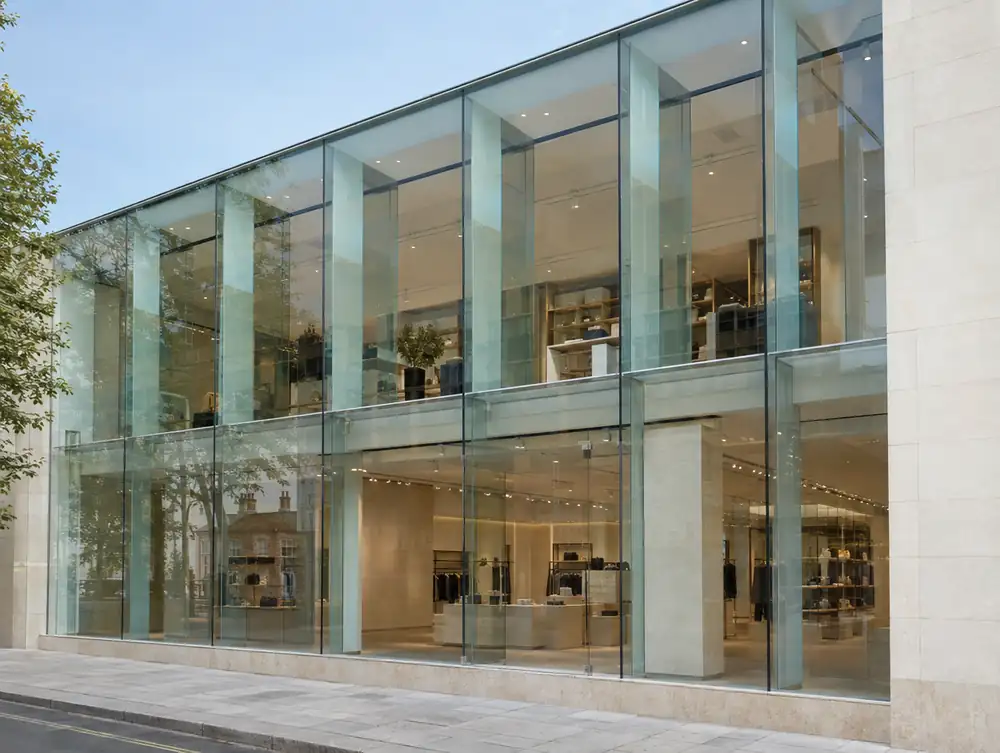
What should you settle before committing to structural glazing in Tyne and Wear?
Deflection matters as much as strength if your frontage in Tyne and Wear sits beneath a steel or timber head. We check how that head behaves before glass goes under it, since a pane with no frame cannot absorb movement.
A flagship entrance often has a fixed opening date. Where a new unit in Tyne and Wear is working to one, we plan back from it and leave room for a windy lifting day or a damaged pane.
What consents apply to structural glazing in Tyne and Wear?
For structural glazing at premises in the Tyne and Wear area, the deciding question in England is whether the building work materially affects the external appearance. If it does, planning permission is needed, while a true like-for-like replacement usually needs none. The council confirms the position for each site.
How much does structural glazing cost in Tyne and Wear?
We would budget £950 to £1,850 plus VAT per m². Scope sets most of the figure, so a clear brief at the start does more for the budget than any later change of detail.
| Area | Tyne and Wear |
|---|---|
| Nation | England |
| Towns covered | 20 |
| Main town | Newcastle upon Tyne |
| Planning regime | England: TCPA 1990 and the 2007 Advertisement Regulations |
| Building approval | Building Regulations (Approved Documents) |
| Survey | Free for new work, from our Great Barr base |
Does Newcastle City Council publish shopfront guidance?
Yes, Shopfronts in the historic environment (2011). It tells applicants what the council expects from new and altered shopfronts. A few of the things it asks for:
- Fascias should generally take up no more than 20% of the shopfront height, with lettering no more than two-thirds of the fascia height.
- Solid external roller shutters are treated as harmful to appearance, with internal lattice grilles offered as a good alternative.
- No shopfront sign should be internally lit, and whole plastic fascias are not acceptable.
Questions about structural glazing in Tyne and Wear
Can I get a price for premises in Tyne and Wear from photographs?
No, every price comes from a measure-up. Structural glazing depends on the exact opening, floor and head, so a figure from a photograph would mislead you.
Can large glass reach premises on a narrow street in Tyne and Wear?
Often, yes, though pane size may need to change. We measure the street, the kerb and any overhead obstructions at survey, then size the glass around what a lifter can reach.
Can structural glazing be fitted while a business around Newcastle upon Tyne stays open?
Often, with a carefully agreed sequence. Lifts usually happen when the street is quiet, and closed-day or out-of-hours installation can be arranged. A temporary screen keeps the interior secure and dry until the glass is in.
Do I need planning permission to change a shopfront in the Tyne and Wear area?
Usually yes, if the work materially affects the building's external appearance. England's shop permitted development rights exclude creating, altering or replacing a shopfront, so there is no shortcut. A true like-for-like replacement usually needs no application, and the council confirms the position.
Does a new shopfront in the Tyne and Wear area need Building Regulations approval?
Assume yes until building control says otherwise. England has no like-for-like exemption, though registered installers can self-certify replacement windows and doors in non-dwellings. That route doesn't cover structural glass, curtain walling or revolving doors.