From Newcastle upon Tyne to the furthest corner of Tyne and Wear, the sequence for accessible entrances stays the same: survey, drawings, written price, then work on site. We travel from Great Barr in Birmingham and use vetted teams working under S&K Glazing.
Finishes behave differently at full size. Any sample we show you for accessible entrances is better judged at the premises in daylight, since a colour that looks quiet on a desk can read much louder across a whole elevation.
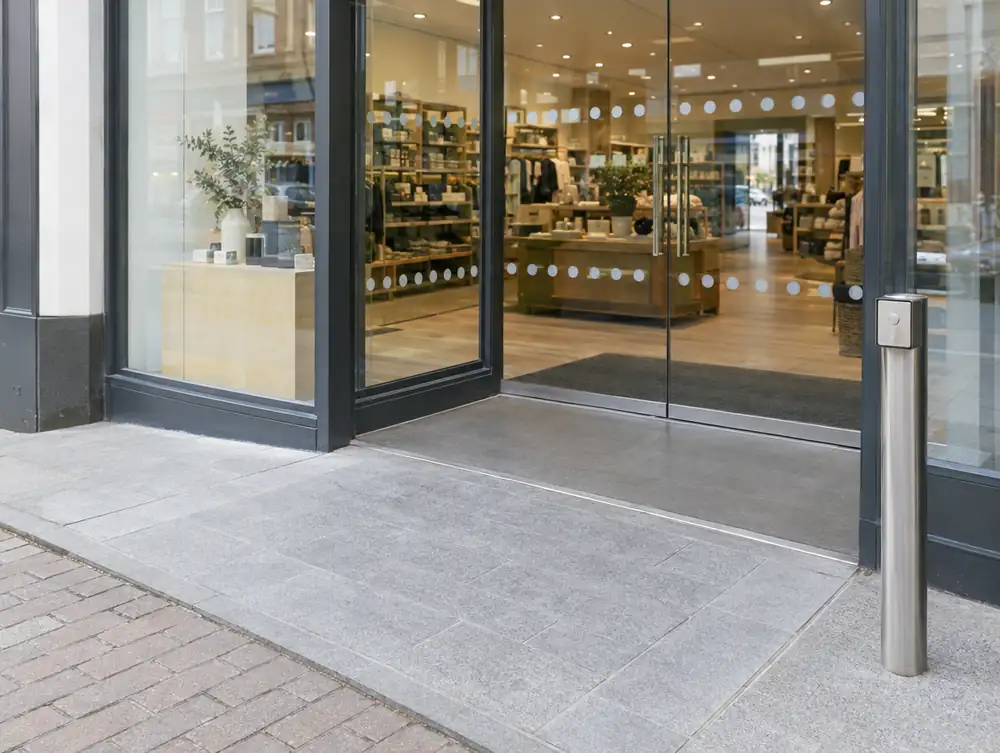
How should you approach accessible entrances in Tyne and Wear?
A stone step or old threshold can be worth keeping for its character. If your premises in Tyne and Wear have one, we look at ways of working around it, such as a slim ramp within the recess or a second entrance to one side.
A better entrance helps everyone who uses it, including staff wheeling stock and parents with pushchairs. For premises in Tyne and Wear, we look at deliveries and daily use as well, so the new door works for the whole business.
What consents apply to accessible entrances in Tyne and Wear?
A true like-for-like replacement usually needs no planning permission in England, because the external appearance isn't materially affected. New materials, a different glass line or altered proportions usually do count as material, so for accessible entrances at premises in the Tyne and Wear area, an application is then likely. The council confirms which side of that line a job falls on.
How much do accessible entrances cost in Tyne and Wear?
A sensible starting budget is £995 to £6,995 plus VAT depending on the work. What shifts the figure is whatever can't be seen yet, such as the condition behind the old frontage or the services running through it.
| Area | Tyne and Wear |
|---|---|
| Nation | England |
| Towns covered | 20 |
| Main town | Newcastle upon Tyne |
| Planning regime | England: TCPA 1990 and the 2007 Advertisement Regulations |
| Building approval | Building Regulations (Approved Documents) |
| Survey | Free for new work, from our Great Barr base |
Does Newcastle City Council publish shopfront guidance?
Yes, Shopfronts in the historic environment (2011). It tells applicants what the council expects from new and altered shopfronts. A few of the things it asks for:
- Fascias should generally take up no more than 20% of the shopfront height, with lettering no more than two-thirds of the fascia height.
- Solid external roller shutters are treated as harmful to appearance, with internal lattice grilles offered as a good alternative.
- No shopfront sign should be internally lit, and whole plastic fascias are not acceptable.
Questions about accessible entrances in Tyne and Wear
Can you improve shop entrances across Tyne and Wear?
Yes. We travel from Great Barr to survey the entrance, take levels and draw the options, and vetted teams carry out the work.
Can I make a small change first at my Tyne and Wear premises?
Yes. Start with what helps most for the least work, such as a lighter closer, better handles or clearer glass markings, and plan the bigger work for your next refit.
Can work on my Tyne and Wear entrance be done around trading?
Usually. Most threshold and door work can happen out of hours, and we'd keep one route into the shop open wherever we can.
Does the Equality Act apply to a shop entrance in the Tyne and Wear area?
Yes. The Equality Act 2010 applies in England, as across Great Britain, and it requires reasonable steps to remove, alter or avoid physical features that disadvantage disabled people. The duty is anticipatory, so it looks at disabled people generally, and a new Services Code replaced the 2011 Code on 5 August 2026.
Does a shop sign in the Tyne and Wear area need advertisement consent?
Not always. In England, an unlit sign within Class 5 of the 2007 Advertisement Regulations generally needs no application, and neither does a lit sign within Class 4B. Anything outside those classes needs consent, and Class 4B isn't available in conservation areas, so check before ordering.