From Newcastle upon Tyne to the furthest corner of Tyne and Wear, the sequence for curved glass shopfronts stays the same: survey, drawings, written price, then work on site. We travel from Great Barr in Birmingham and use vetted teams working under S&K Glazing.
Access gets as much attention as appearance at survey. Where a vehicle can stop, how long sections reach the opening and how the pavement stays safe for the public all shape the programme for curved glass shopfronts in Tyne and Wear.
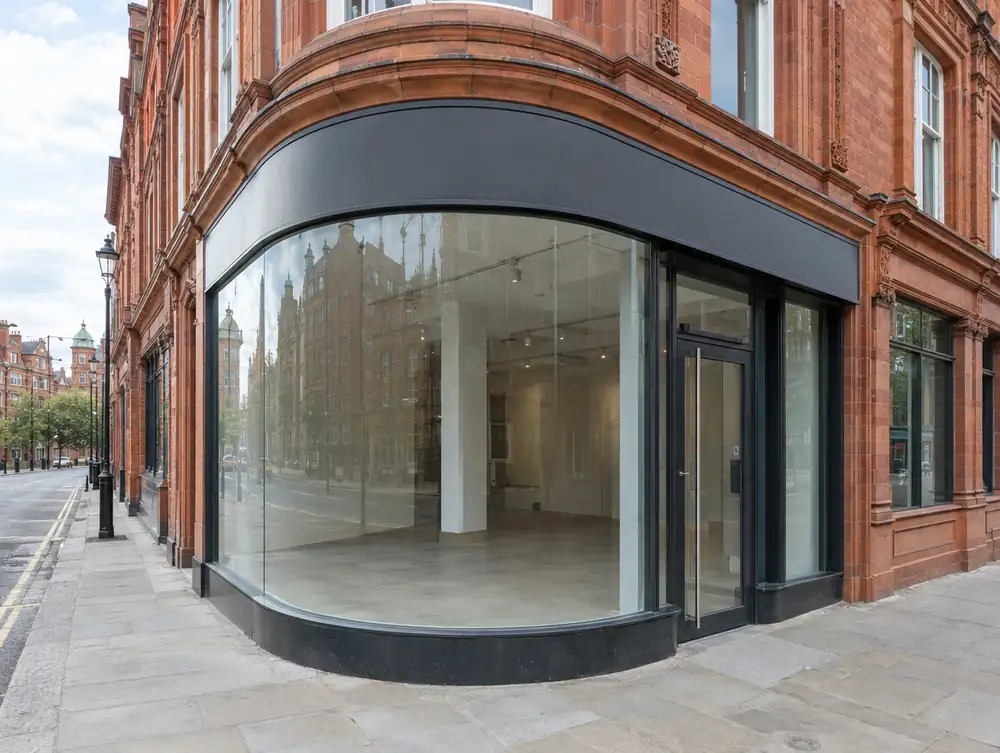
What should you look for from curved glass shopfronts in Tyne and Wear?
Curves change how a corner reads after dark. For a unit in Newcastle upon Tyne or anywhere in Tyne and Wear, we'd run lighting with the arc, because a single bright spot on curved glass pulls the eye to the reflection instead of the display.
If your building in Tyne and Wear already has an old curved pane, we'd look at keeping it first. Older bent glass is hard to replicate, and a careful repair of the frame may save the piece that gives the front its character.
What consents apply to curved glass shopfronts in Tyne and Wear?
A true like-for-like replacement usually needs no planning permission in England, because the external appearance isn't materially affected. New materials, a different glass line or altered proportions usually do count as material, so for curved glass shopfronts at premises in the Tyne and Wear area, an application is then likely. The council confirms which side of that line a job falls on.
How much do curved glass shopfronts cost in Tyne and Wear?
A sensible starting budget is £6,995 to £19,995 plus VAT for a typical frontage. What shifts the figure is whatever can't be seen yet, such as the condition behind the old frontage or the services running through it.
| Area | Tyne and Wear |
|---|---|
| Nation | England |
| Towns covered | 20 |
| Main town | Newcastle upon Tyne |
| Planning regime | England: TCPA 1990 and the 2007 Advertisement Regulations |
| Building approval | Building Regulations (Approved Documents) |
| Survey | Free for new work, from our Great Barr base |
Does Newcastle City Council publish shopfront guidance?
Yes, Shopfronts in the historic environment (2011). It tells applicants what the council expects from new and altered shopfronts. A few of the things it asks for:
- Fascias should generally take up no more than 20% of the shopfront height, with lettering no more than two-thirds of the fascia height.
- Solid external roller shutters are treated as harmful to appearance, with internal lattice grilles offered as a good alternative.
- No shopfront sign should be internally lit, and whole plastic fascias are not acceptable.
Questions about curved glass shopfronts in Tyne and Wear
Can the old curved pane at my Tyne and Wear premises be reused?
Sometimes, if it is sound and can be taken out safely. We'd examine it at survey and tell you honestly whether repairing around it is the safer choice.
How do you measure a curve at premises in Newcastle upon Tyne?
At three heights, using a plywood template or a laser survey. That shows whether the corner is a true arc, and tells us where any difference has to be taken up.
What if my corner in Tyne and Wear is not a true curve?
Most aren't. We set the glass to the closest arc and absorb the rest in the head and floor channels, or build out the surround where the building drifts too far.
Do I need planning permission to change a shopfront in the Tyne and Wear area?
Usually yes, if the work materially affects the building's external appearance. England's shop permitted development rights exclude creating, altering or replacing a shopfront, so there is no shortcut. A true like-for-like replacement usually needs no application, and the council confirms the position.
Does the Equality Act apply to a shop entrance in the Tyne and Wear area?
Yes. The Equality Act 2010 applies in England, as across Great Britain, and it requires reasonable steps to remove, alter or avoid physical features that disadvantage disabled people. The duty is anticipatory, so it looks at disabled people generally, and a new Services Code replaced the 2011 Code on 5 August 2026.