Seen a frontage you admire? Bring the picture to our first talk about projecting signs in Tyne and Wear, and we will work out what makes it succeed, from fascia depth to glass line, and what that means for your building.
Daylight is only half the brief for projecting signs, because a frontage keeps working after dark. Think about how the glass, the sign and the view inside will read to someone walking past at six o'clock on a winter evening.
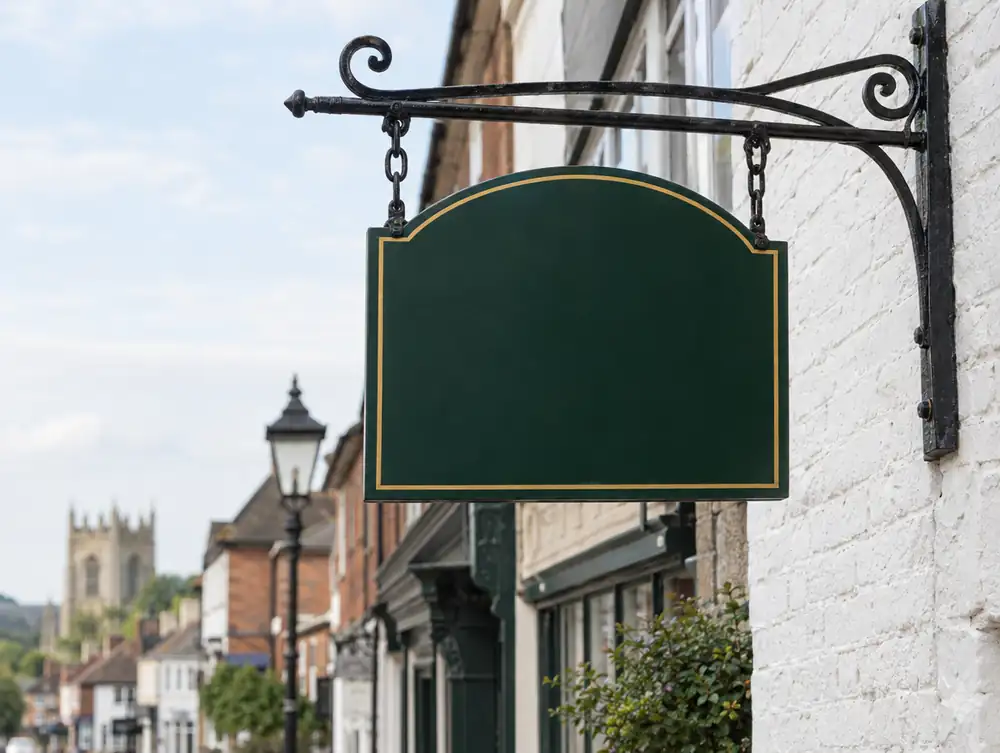
Where do you start with projecting signs in Tyne and Wear?
A symbol can do what a name cannot. For premises near Newcastle upon Tyne with a long business name, we would look at a logo or simple shape that reads in a second from an angle.
Sightlines along the street decide the position. On premises across Tyne and Wear we walk the pavement from both directions at survey, because a lamp post, tree or neighbouring sign can hide a sign from the side people arrive.
What consents apply to projecting signs in Tyne and Wear?
Security grilles and shutters are named in England's rules: installing or replacing one on a shopfront sits outside the shop permitted development rights. The frontage itself is treated the same way, so for projecting signs at premises in the Tyne and Wear area, building work that materially affects the appearance needs planning permission. Confirm the position with the council before anything is ordered.
Class 4B, England's class for lit signs, isn't available in conservation areas, Areas of Outstanding Natural Beauty, National Parks or the Broads, so a lit sign there normally needs advertisement consent. In an area of special control it is unavailable too, and Class 5 drops to a 3.6m top height, 0.3m letters and one-tenth of the building face up to 3.6m. Ask the council which designations cover premises in the Tyne and Wear area.
How much do projecting signs cost in Tyne and Wear?
Until the survey is done, plan on £395 to £1,295 plus VAT per sign. Unusual sizes, fine detail and phased working push the figure up, while a simple brief and clear access keep it toward the lower end.
| Area | Tyne and Wear |
|---|---|
| Nation | England |
| Towns covered | 20 |
| Main town | Newcastle upon Tyne |
| Planning regime | England: TCPA 1990 and the 2007 Advertisement Regulations |
| Building approval | Building Regulations (Approved Documents) |
| Survey | Free for new work, from our Great Barr base |
Does Newcastle City Council publish shopfront guidance?
Yes, Shopfronts in the historic environment (2011). It tells applicants what the council expects from new and altered shopfronts. A few of the things it asks for:
- Fascias should generally take up no more than 20% of the shopfront height, with lettering no more than two-thirds of the fascia height.
- Solid external roller shutters are treated as harmful to appearance, with internal lattice grilles offered as a good alternative.
- No shopfront sign should be internally lit, and whole plastic fascias are not acceptable.
Questions about projecting signs in Tyne and Wear
Can a new panel go on my existing bracket in Tyne and Wear?
Often, yes, once we have checked the bracket and fixings. Old ironwork can be stripped and repainted, and the panel can be made to fit it. A loose or corroded bracket has to come down first.
How long does fitting take on premises in Tyne and Wear?
Usually about half a day from a ladder or tower, with a little longer if a cable has to be run for lighting. The shop can normally stay open while we work.
What artwork works on a small hanging sign around Newcastle upon Tyne?
Bold, simple artwork works, with a logo or a short name. Fine lettering and long strap lines get lost at an angle, so we test the design at full size.
Does a new shopfront in the Tyne and Wear area need Building Regulations approval?
Assume yes until building control says otherwise. England has no like-for-like exemption, though registered installers can self-certify replacement windows and doors in non-dwellings. That route doesn't cover structural glass, curtain walling or revolving doors.
Do I need planning permission to change a shopfront in the Tyne and Wear area?
Usually yes, if the work materially affects the building's external appearance. England's shop permitted development rights exclude creating, altering or replacing a shopfront, so there is no shortcut. A true like-for-like replacement usually needs no application, and the council confirms the position.