Few businesses can shut for a week, so any time on site for automatic sliding doors in Lincolnshire is planned around the hours you trade. Closed-day or out-of-hours installation can be arranged.
What sits behind the existing fascia often decides the job. Old beams, abandoned cable runs and earlier frames are common finds, which is why our visit to Lincolnshire premises looks past the surface before anything is drawn or priced for automatic sliding doors.
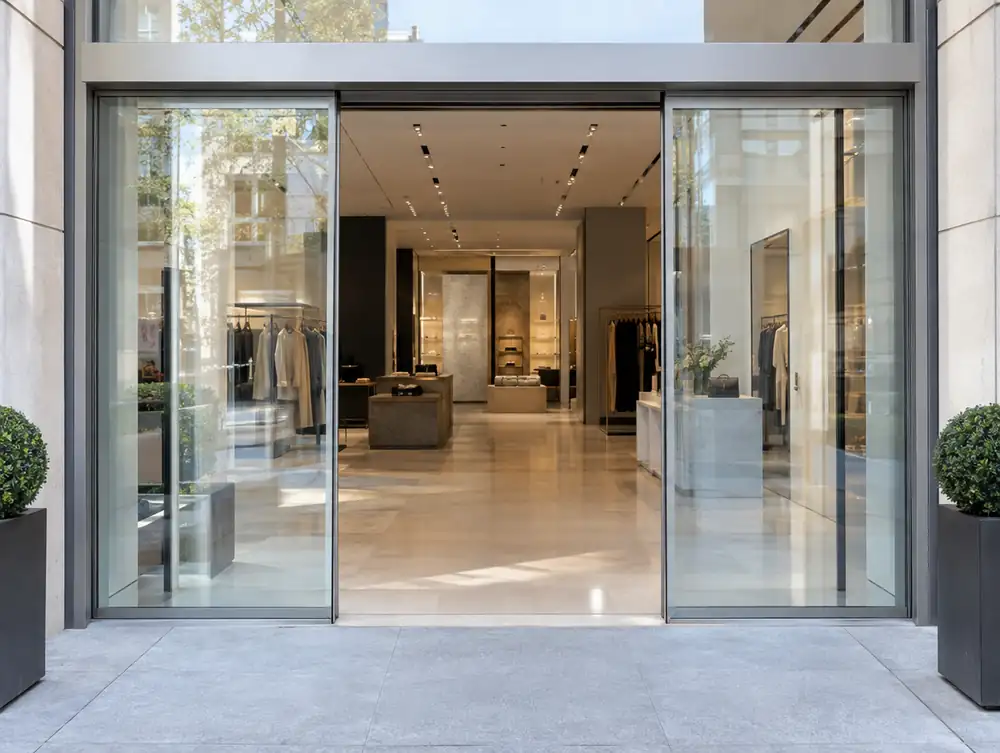
What should you settle before committing to automatic sliding doors in Lincolnshire?
Exposure shapes the door. If your entrance in Lincolnshire faces the prevailing wind, we'd look at a lobby, a stronger drive or a deeper recess, so that tall leaves don't fight the weather.
Narrow fronts are the hard part. Across Lincolnshire, we check first whether the parked leaves fit, then whether a telescopic set would give a wider opening on the same width.
What consents apply to automatic sliding doors in Lincolnshire?
For automatic sliding doors at premises in the Lincolnshire area, the deciding question in England is whether the building work materially affects the external appearance. If it does, planning permission is needed, while a true like-for-like replacement usually needs none. The council confirms the position for each site.
How much do automatic sliding doors cost in Lincolnshire?
We would budget £3,895 to £11,995 plus VAT per entrance. Scope sets most of the figure, so a clear brief at the start does more for the budget than any later change of detail.
| Area | Lincolnshire |
|---|---|
| Nation | England |
| Towns covered | 17 |
| Main town | Lincoln |
| Planning regime | England: TCPA 1990 and the 2007 Advertisement Regulations |
| Building approval | Building Regulations (Approved Documents) |
| Survey | Free for new work, from our Great Barr base |
Does South Kesteven District Council publish shopfront guidance?
Yes, South Kesteven Shopfront Design Guide (2024). It tells applicants what the council expects from new and altered shopfronts. A few of the things it asks for:
- Retractable shutters should sit inside the building hidden behind the fascia, and external roller shutters are not acceptable on listed buildings.
- Fascias that are boxed in or project excessively are unsuitable, and signs should not be built out on an extra box or board.
- External illumination is the only acceptable option for traditional shopfronts, using static single-colour LED where lighting is accepted.
Questions about automatic sliding doors in Lincolnshire
Can a door in Lincolnshire be set up to ignore people walking past?
Yes, in most cases. The sensor field can be narrowed and angled so it reads direction, which cuts false openings on a street-facing door.
Can premises in Lincoln keep trading during installation?
Often, yes. A side entrance or a closed period outside trading hours usually covers the main stage, and the door can be set up soon after.
Do you fit automatic sliding doors across Lincolnshire?
Yes. We travel from Great Barr to survey the entrance, then fit and set up the door with a vetted team.
Do I need listed building consent for a shopfront in the Lincolnshire area?
Usually yes, if the building is listed. In England the local planning authority decides, and Historic England is notified of Grade I and II* works and specified Grade II works. Like-for-like repair may not need consent, so ask the council before work starts.
Does a new shopfront in the Lincolnshire area need Building Regulations approval?
Assume yes until building control says otherwise. England has no like-for-like exemption, though registered installers can self-certify replacement windows and doors in non-dwellings. That route doesn't cover structural glass, curtain walling or revolving doors.