A slim framed slider can sit inside an existing Bourne frontage with little change to the outside. The drive hides behind the fascia, and the leaves line up with the screens either side.
A survey in Bourne usually starts outside, looking at the whole elevation before any tape comes out, because the frontage has to answer the building above it.
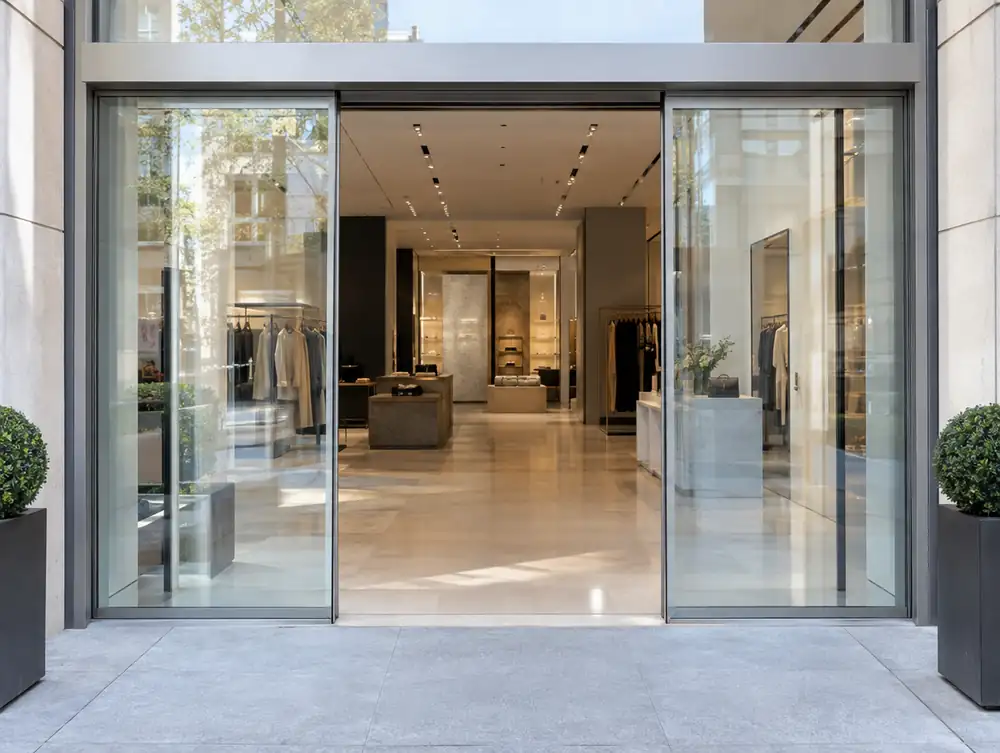
What makes automatic sliding doors work well on Bourne premises?
If your Bourne entrance catches low sun, infrared sensors can misread the light on the floor. We'd favour radar with a presence sensor set for those conditions, and consider solar control glass in the leaves.
In a parade in Bourne with a narrow pavement, the sensor set-up is the first job. We'd angle the radar so people walking past don't trigger the door, and keep the leaves in line with the neighbouring frontage.
Where the building has good brick or stone around the opening, set the frame back in the reveal so the masonry can be seen. On Bourne premises with a flat elevation, that deep reveal throws a shadow line that adds real depth in low sun.
How much should you set aside for automatic sliding doors in Bourne?
Allow £3,895 to £11,995 plus VAT per entrance. Size and specification set most of that figure for automatic sliding doors, and the rest depends on what the survey finds on site.
Could automatic sliding doors in Bourne need planning permission?
England has no permitted development route for changing a shopfront. Part 7 Class A of the General Permitted Development Order 2015 excludes creating, altering or replacing one, and it allows no alterations at all on article 2(3) land. That leaves two outcomes for automatic sliding doors at premises in the Bourne area: a planning application, or work that doesn't materially affect the external appearance.
Expect planning and advert applications here to go to South Kesteven District Council in the normal way. We check what that means for your building when we survey it in Bourne.
| Town | Bourne |
|---|---|
| Area | Lincolnshire |
| Postcode districts | PE10 |
| Planning authority | South Kesteven District Council |
| Building approval | Building Regulations (Approved Documents) |
| Distance from Great Barr | About 66 miles |
| Survey | Free for new work |
Does South Kesteven District Council publish shopfront guidance?
Yes, South Kesteven Shopfront Design Guide (2024). It tells applicants what the council expects from new and altered shopfronts. A few of the things it asks for:
- Retractable shutters should sit inside the building hidden behind the fascia, and external roller shutters are not acceptable on listed buildings.
- Fascias that are boxed in or project excessively are unsuitable, and signs should not be built out on an extra box or board.
- External illumination is the only acceptable option for traditional shopfronts, using static single-colour LED where lighting is accepted.
Questions about automatic sliding doors in Bourne
Can an automatic door work with my Bourne shop's alarm and locks?
Yes. The door can lock at closing, and it can link to your alarm or access control where the systems allow, with a manual key position as a fallback.
What will people on the street see at my Bourne entrance?
Ideally, very little. The drive sits behind the fascia, the leaves line up with the screens beside them, and the frame colour matches the rest of your front.
How noisy would an automatic door be at my Bourne shop?
A healthy door is very quiet, and you'd normally hear only a soft hum. Noise usually means worn rollers or grit in the guide, which a service will put right.
Does a shop sign in the Bourne area need advertisement consent?
Not always. In England, an unlit sign within Class 5 of the 2007 Advertisement Regulations generally needs no application, and neither does a lit sign within Class 4B. Anything outside those classes needs consent, and Class 4B isn't available in conservation areas, so check before ordering.
Does a new shopfront in the Bourne area need Building Regulations approval?
Assume yes until building control says otherwise. England has no like-for-like exemption, though registered installers can self-certify replacement windows and doors in non-dwellings. That route doesn't cover structural glass, curtain walling or revolving doors.