For a boutique, salon, office or restaurant in Bourne, the ideal door almost disappears. Toughened glass gets close, provided the floor and head are detailed properly.
Measuring the opening is the easy part of a survey in Bourne. We also look at the beam above, the pavement fall and any meters or drains nearby.
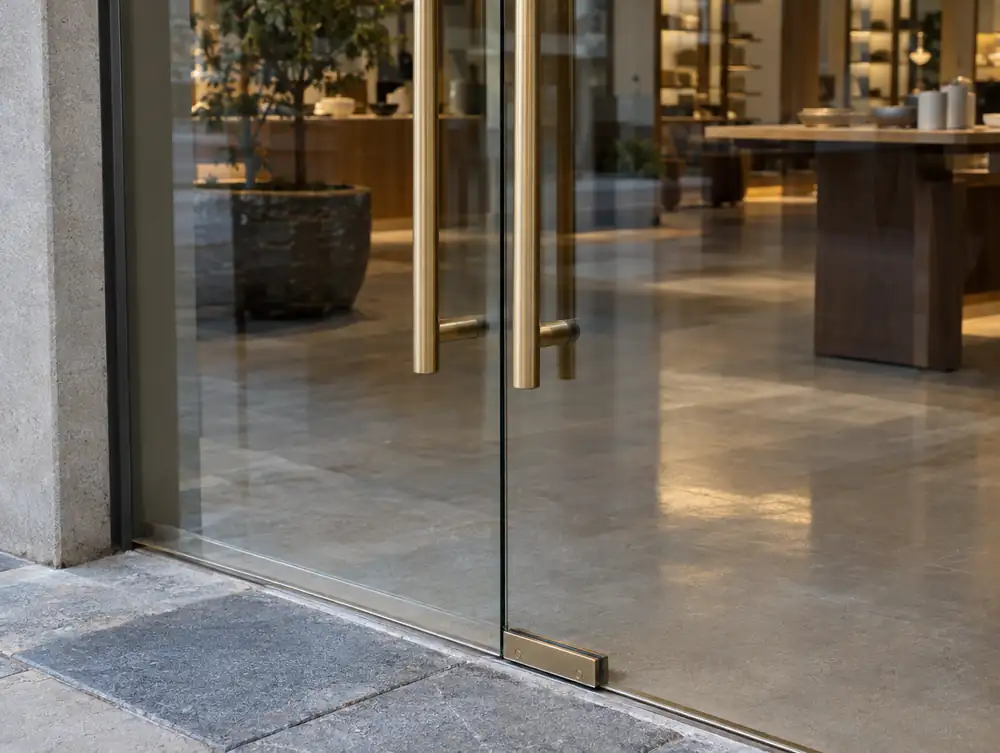
What goes into getting frameless glass doors right in Bourne?
On a sunny Bourne frontage, dark door handles can get uncomfortably hot and fingermarks on the glass show up more. We'd favour brushed finishes, and a full-height handle keeps hands on the metal and off the pane.
A narrow Bourne unit benefits from a door that takes up no visual width. We'd use a single glass leaf hung beside one clear pane, so the entrance and the display read as one view into the shop.
If the pavement falls across your frontage, let the stallriser take up the slope and keep the glass line dead level. The eye reads the long horizontal, so Bourne premises on a slope look settled once that line is true.
Which applications might frameless glass doors in Bourne involve?
For frameless glass doors at premises in the Bourne area, the deciding question in England is whether the building work materially affects the external appearance. If it does, planning permission is needed, while a true like-for-like replacement usually needs none. The council confirms the position for each site.
Bourne applications for planning permission or advertisement consent are normally handled by South Kesteven District Council. Our survey includes a check of the position for your address.
How much could frameless glass doors in Bourne cost you?
Our guide band is £1,495 to £4,495 plus VAT per door set. Scope is the biggest lever, so a tighter brief for frameless glass doors brings the figure down faster than any change of detail.
| Town | Bourne |
|---|---|
| Area | Lincolnshire |
| Postcode districts | PE10 |
| Planning authority | South Kesteven District Council |
| Building approval | Building Regulations (Approved Documents) |
| Distance from Great Barr | About 66 miles |
| Survey | Free for new work |
Does South Kesteven District Council publish shopfront guidance?
Yes, South Kesteven Shopfront Design Guide (2024). It tells applicants what the council expects from new and altered shopfronts. A few of the things it asks for:
- Retractable shutters should sit inside the building hidden behind the fascia, and external roller shutters are not acceptable on listed buildings.
- Fascias that are boxed in or project excessively are unsuitable, and signs should not be built out on an extra box or board.
- External illumination is the only acceptable option for traditional shopfronts, using static single-colour LED where lighting is accepted.
Questions about frameless glass doors in Bourne
Will a glass door be safe with children around in my Bourne shop?
Toughened glass is strong and breaks into small pieces, so it is a good choice for a family-facing shop. The main risks are finger traps at the hinge side, which careful spring settings and guards can reduce.
How long will my Bourne entrance be out of use?
Usually only a few hours, if the floor needs no work. Doors are often fitted outside trading hours, so you can open as normal.
Can you reuse my existing floor spring in Bourne?
Sometimes, if it is sound and suits the new leaf. We'd test it at survey, because an old spring under a heavier door tends to fail early.
What rules apply to a fire exit door through a shopfront in the Bourne area?
It must open in the direction of escape and can't be locked against immediate use, and a dedicated fire exit can't be a sliding or revolving door. In England that comes from article 14(2) of the Regulatory Reform (Fire Safety) Order 2005, and the duty sits with the responsible person, normally the employer or whoever controls the premises for a business, otherwise the owner. An outward door can clash with section 153 of the Highways Act 1980 where it opens onto the footway, so raise it early.
Do I need listed building consent for a shopfront in the Bourne area?
Usually yes, if the building is listed. In England the local planning authority decides, and Historic England is notified of Grade I and II* works and specified Grade II works. Like-for-like repair may not need consent, so ask the council before work starts.