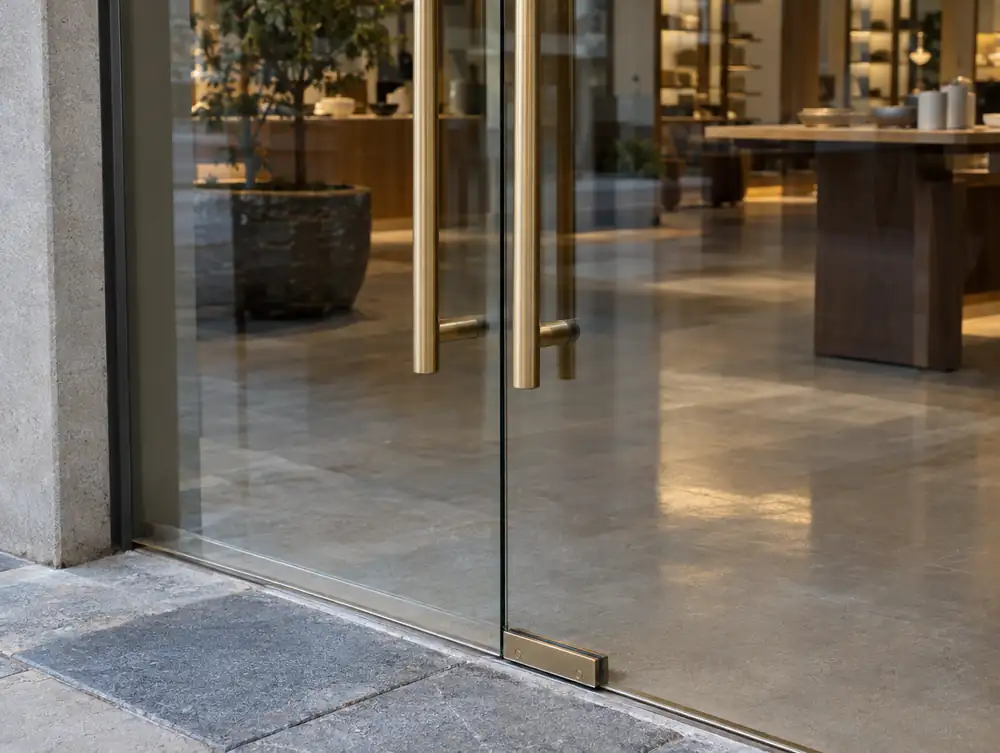
Heavy glass should still feel light to open. We set the spring on site at your Market Deeping premises, so the door closes softly, latches cleanly and stays easy for every customer.
A survey in Market Deeping usually starts outside, looking at the whole elevation before any tape comes out, because the frontage has to answer the building above it.
What makes frameless glass doors work well on Market Deeping premises?
A narrow Market Deeping unit benefits from a door that takes up no visual width. We'd use a single glass leaf hung beside one clear pane, so the entrance and the display read as one view into the shop.
If a landlord in Market Deeping controls the frontage, a glass door is often an easy approval because so little changes visually. We'd supply a drawing showing the door, the fittings and any markings on the glass.
A corner unit has two fronts to think about, and the return elevation often does as much selling as the main one. If that is your layout in Market Deeping, carry the fascia and glass line round the corner and treat both faces as one composition.
Could frameless glass doors in Market Deeping need planning permission?
Security grilles and shutters are named in England's rules: installing or replacing one on a shopfront sits outside the shop permitted development rights. The frontage itself is treated the same way, so for frameless glass doors at premises in the Market Deeping area, building work that materially affects the appearance needs planning permission. Confirm the position with the council before anything is ordered.
For Market Deeping, the usual route for planning and advert applications is through South Kesteven District Council, and we confirm that when we visit.
How much should you set aside for frameless glass doors in Market Deeping?
A sensible starting budget is £1,495 to £4,495 plus VAT per door set. What shifts the figure is whatever can't be seen yet, such as the condition behind the old frontage or the services running through it.
| Town | Market Deeping |
|---|---|
| Area | Lincolnshire |
| Postcode districts | PE6 |
| Planning authority | South Kesteven District Council |
| Building approval | Building Regulations (Approved Documents) |
| Distance from Great Barr | About 68 miles |
| Survey | Free for new work |
Does South Kesteven District Council publish shopfront guidance?
Yes, South Kesteven Shopfront Design Guide (2024). It tells applicants what the council expects from new and altered shopfronts. A few of the things it asks for:
- Retractable shutters should sit inside the building hidden behind the fascia, and external roller shutters are not acceptable on listed buildings.
- Fascias that are boxed in or project excessively are unsuitable, and signs should not be built out on an extra box or board.
- External illumination is the only acceptable option for traditional shopfronts, using static single-colour LED where lighting is accepted.
Questions about frameless glass doors in Market Deeping
What upkeep does a frameless door need in Market Deeping?
A yearly check of the spring and fittings keeps it right, plus regular cleaning. Ask staff to tell you if the door starts to drift, as small adjustments stop bigger problems later.
Can my Market Deeping premises take a frameless glass door?
Most can, once the floor and opening have been checked. The survey shows whether a floor spring will fit, and if not, a concealed closer in a transom does the same job.
How long will my Market Deeping entrance be out of use?
Usually only a few hours, if the floor needs no work. Doors are often fitted outside trading hours, so you can open as normal.
Do I need listed building consent for a shopfront in the Market Deeping area?
Usually yes, if the building is listed. In England the local planning authority decides, and Historic England is notified of Grade I and II* works and specified Grade II works. Like-for-like repair may not need consent, so ask the council before work starts.
Do I need planning permission to change a shopfront in the Market Deeping area?
Usually yes, if the work materially affects the building's external appearance. England's shop permitted development rights exclude creating, altering or replacing a shopfront, so there is no shortcut. A true like-for-like replacement usually needs no application, and the council confirms the position.