Does your Cardiff shop need a hands-free entrance? A well-set sliding door gives customers, pushchairs and wheelchairs a clear way in, without anything swinging into the street.
Bring whatever you have to the survey in Cardiff: brand guidelines, lease plans, old drawings or a photo of a frontage you admire.
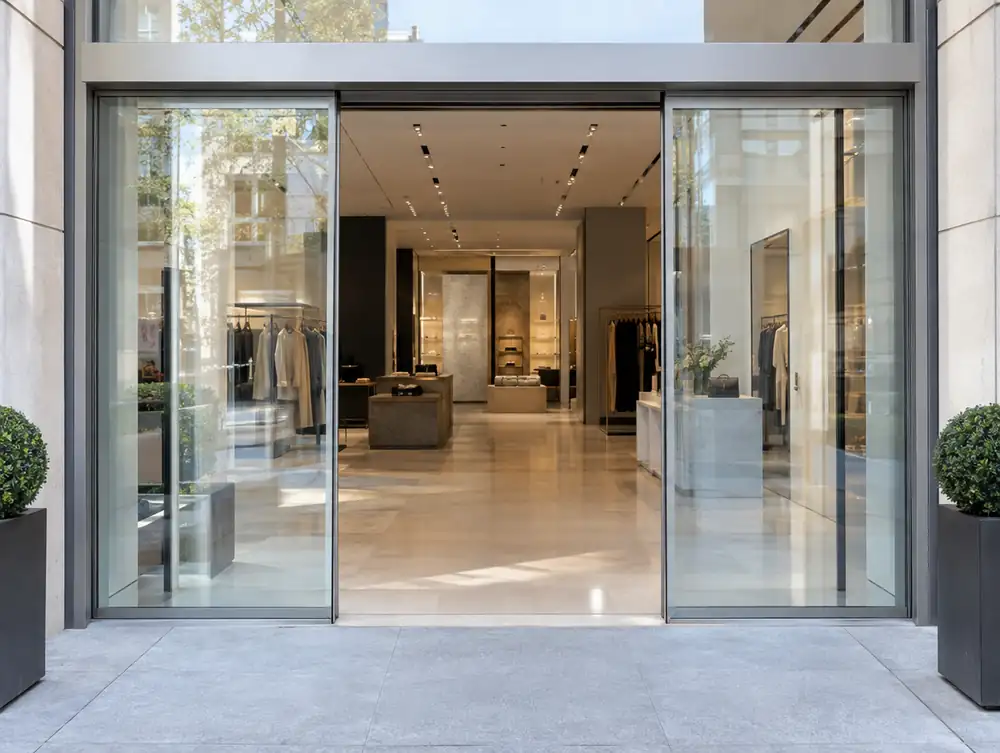
What makes automatic sliding doors work well on Cardiff premises?
A corner unit in Cardiff can often move its entrance to the angle, where two directions of footfall meet. We'd look at a curved or canted door set, and check the wind on both streets before fixing the position.
A deep recess is a gift for an automatic door. At Cardiff premises with one, we'd set the door back from the street so the sensors see less of the pavement and the leaves get some shelter from the wind.
If you trade after dark in Cardiff, the view in matters more than the sign. A warm, evenly lit interior with light on the back wall will usually do more than a brighter fascia, because it gives the eye somewhere to go.
How much should you set aside for automatic sliding doors in Cardiff?
Our guide band is £3,895 to £11,995 plus VAT per entrance. Scope is the biggest lever, so a tighter brief for automatic sliding doors brings the figure down faster than any change of detail.
Could automatic sliding doors in Cardiff need planning permission?
Section 55 of the Town and Country Planning Act 1990 sets the test in Wales: work that doesn't materially affect the external appearance isn't development. Anything that does needs planning permission, and that goes for automatic sliding doors at premises in the Cardiff area as much as for a full new frontage. The council confirms how the test applies to your site.
At survey we check how things stand for your building, although applications for planning permission or advertisement consent here normally go to City of Cardiff Council.
| Town | Cardiff |
|---|---|
| Area | South Glamorgan |
| Postcode districts | CF10, CF11, CF24, CF5 |
| Planning authority | City of Cardiff Council |
| Building approval | Building Regulations (Approved Documents for Wales) |
| Distance from Great Barr | About 91 miles |
| Survey | Free for new work |
Does Cardiff Council publish shopfront guidance?
Yes, Shopfront Design and Signage SPG (2019). It tells applicants what the council expects from new and altered shopfronts. A few of the things it asks for:
- A fascia should typically be no deeper than one-fifth of the shopfront's height.
- Solid or perforated roller shutters are not supported, and external shutters are unacceptable in the city centre, Cardiff Bay, conservation areas and on listed buildings.
- Where external shutters are allowed in exceptional cases in district or local centres, considerations include at least 50% transparency and a colour coating matching the shopfront.
Questions about automatic sliding doors in Cardiff
Who installs automatic doors in Cardiff?
Vetted door teams working under S&K Glazing handle the fit and set-up, travelling from Great Barr. Your agreement is with S&K Glazing Limited, and one person stays your point of call.
Will the door keep opening for passers-by in Cardiff?
Not if it is set up properly. We narrow the sensor field on site and test it against real footfall, so only people heading for the door trigger it.
What will people on the street see at my Cardiff entrance?
Ideally, very little. The drive sits behind the fascia, the leaves line up with the screens beside them, and the frame colour matches the rest of your front.
When does a shop sign in the Cardiff area need advertisement consent?
A sign needs advertisement consent when it falls outside Class 5 or Class 4B of the 1992 Advertisement Regulations, which still apply in Wales. Within Class 5, an unlit sign sits on a wall containing a shop window and tops out at 4.6m or the first-floor sill if lower. A lit sign in a conservation area needs consent, because Class 4B isn't available there.
Is planning permission needed for a new shopfront in the Cardiff area?
Usually yes, if the work materially affects the external appearance, because Wales has no permitted development route for changing a shopfront. Most of the Planning (Wales) Act 2026 hasn't been commenced yet, so the existing rules apply. A true like-for-like replacement usually avoids an application, and the council confirms the position.