Shopfront refurbishment gives Cardiff premises a better frontage without starting from scratch. We survey what is sound, note what has failed and price the difference.
We measure your Cardiff opening in person, at a time agreed with you first, so the visit fits around your trading.
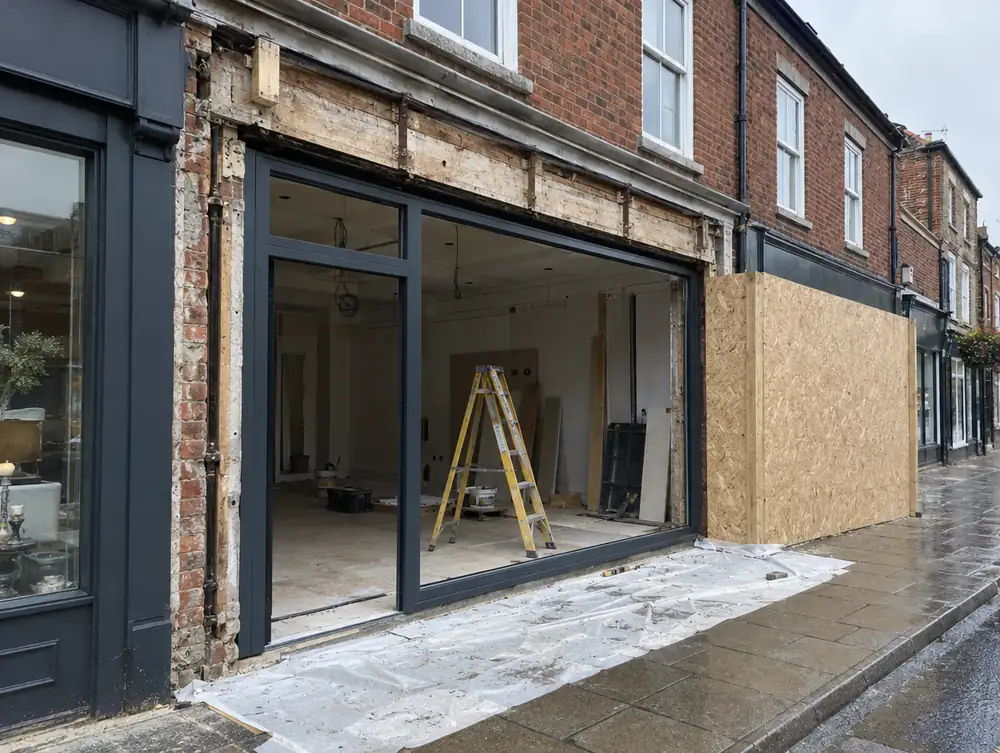
What goes into getting shopfront refurbishment right in Cardiff?
If your Cardiff shopfront is aluminium and the frame is sound, a recoat can change the whole look. We check for corrosion and old sealant first, because paint will not hide either for long.
Where the sign is the first thing that looks tired, we would start there and work down. A slimmer fascia and better letters can carry a modest frame very well.
Where a fascia has crept down over the years, lifting it back to its original line can add real height to the glass. Check what sits behind it first at Cardiff premises, since a shutter box or old beam may set the limit.
How much could shopfront refurbishment in Cardiff cost you?
We would budget £1,995 to £8,995 plus VAT depending on what is kept. Scope sets most of the figure, so a clear brief at the start does more for the budget than any later change of detail.
Which applications might shopfront refurbishment in Cardiff involve?
The existing rules still apply in Wales, because most of the Planning (Wales) Act 2026 is waiting for a commencement order. For shopfront refurbishment at premises in the Cardiff area, building work that materially affects the external appearance needs planning permission, while a true like-for-like replacement usually doesn't. The council confirms the current position.
For Cardiff, the usual route for planning and advert applications is through City of Cardiff Council, and we confirm that when we visit.
| Town | Cardiff |
|---|---|
| Area | South Glamorgan |
| Postcode districts | CF10, CF11, CF24, CF5 |
| Planning authority | City of Cardiff Council |
| Building approval | Building Regulations (Approved Documents for Wales) |
| Distance from Great Barr | About 91 miles |
| Survey | Free for new work |
Does Cardiff Council publish shopfront guidance?
Yes, Shopfront Design and Signage SPG (2019). It tells applicants what the council expects from new and altered shopfronts. A few of the things it asks for:
- A fascia should typically be no deeper than one-fifth of the shopfront's height.
- Solid or perforated roller shutters are not supported, and external shutters are unacceptable in the city centre, Cardiff Bay, conservation areas and on listed buildings.
- Where external shutters are allowed in exceptional cases in district or local centres, considerations include at least 50% transparency and a colour coating matching the shopfront.
Questions about shopfront refurbishment in Cardiff
Can you refurbish just the sign and door on my Cardiff frontage?
Yes. A new sign and door gear can make a big difference on their own. We would look at how they sit with the frame and suggest a colour to tie them together.
Can my Cardiff shopfront be refurbished without closing?
Usually, yes. Work is split into stages around your trading hours, and closed-day or out-of-hours work can be arranged for anything that affects the door.
Is it worth refurbishing an old aluminium shopfront in Cardiff?
Often, yes, if the frame is straight and the corners are tight. Recoating, new gaskets and better glass can add years of life. If the frame is corroded or the door has worn out its fixings, replacement may make more sense.
When does a shop sign in the Cardiff area need advertisement consent?
A sign needs advertisement consent when it falls outside Class 5 or Class 4B of the 1992 Advertisement Regulations, which still apply in Wales. Within Class 5, an unlit sign sits on a wall containing a shop window and tops out at 4.6m or the first-floor sill if lower. A lit sign in a conservation area needs consent, because Class 4B isn't available there.
What access duty applies to a shop in the Cardiff area?
The Equality Act 2010 applies, in Wales as across Great Britain, and it requires reasonable steps to remove, alter or avoid physical features that disadvantage disabled people. The duty is anticipatory, so it covers disabled people generally. A feature that meets a design standard is generally protected for 10 years.