A double-height entrance in Cardiff deserves more than a stretched shopfront. Deeper aluminium sections carry the span, with sightlines kept as slim as the wind load allows.
A survey in Cardiff usually starts outside, looking at the whole elevation before any tape comes out, because the frontage has to answer the building above it.
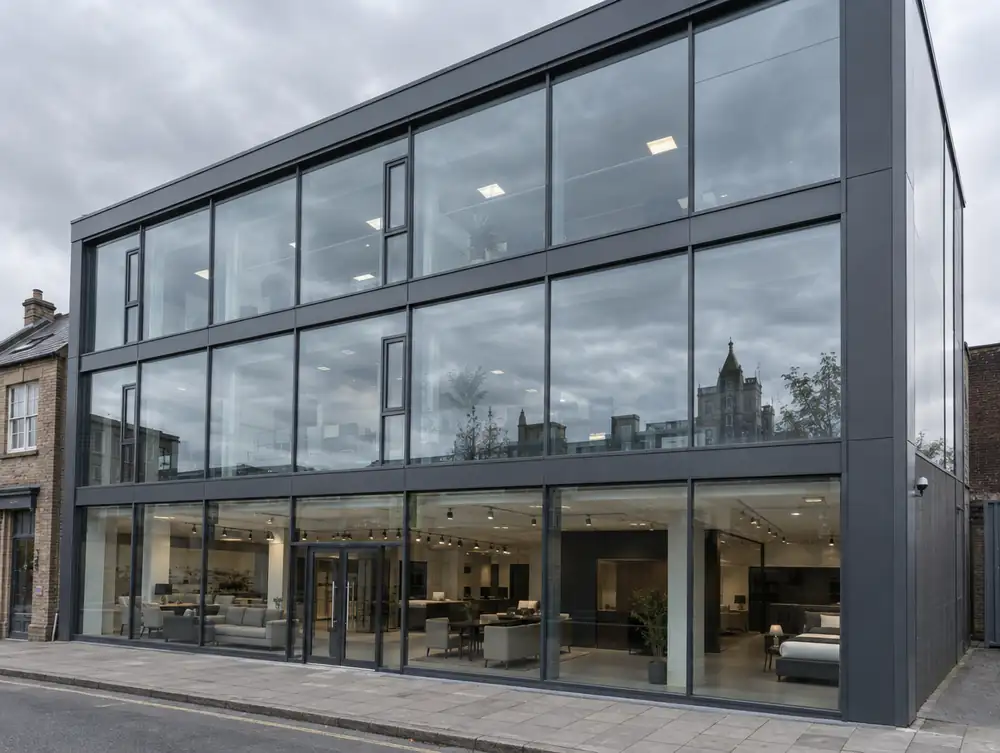
What makes curtain walling work well on Cardiff premises?
Should the floors above stay occupied, the work can be phased bay by bay, with temporary weathering at the end of each shift. Tenants keep their rooms dry and the old elevation comes out in an order that suits the building.
Unloading is worth thinking through early on any Cardiff site with restricted access. Mullions can run to 6m or more, so we look at lifting routes, storage and where a delivery can stop.
Where the building has good brick or stone around the opening, set the frame back in the reveal so the masonry can be seen. On Cardiff premises with a flat elevation, that deep reveal throws a shadow line that adds real depth in low sun.
How much should you set aside for curtain walling in Cardiff?
Allow £550 to £1,250 plus VAT per m². Size and specification set most of that figure for curtain walling, and the rest depends on what the survey finds on site.
Could curtain walling in Cardiff need planning permission?
Section 55 of the Town and Country Planning Act 1990 sets the test in Wales: work that doesn't materially affect the external appearance isn't development. Anything that does needs planning permission, and that goes for curtain walling at premises in the Cardiff area as much as for a full new frontage. The council confirms how the test applies to your site.
For Cardiff, the usual route for planning and advert applications is through City of Cardiff Council, and we confirm that when we visit.
| Town | Cardiff |
|---|---|
| Area | South Glamorgan |
| Postcode districts | CF10, CF11, CF24, CF5 |
| Planning authority | City of Cardiff Council |
| Building approval | Building Regulations (Approved Documents for Wales) |
| Distance from Great Barr | About 91 miles |
| Survey | Free for new work |
Does Cardiff Council publish shopfront guidance?
Yes, Shopfront Design and Signage SPG (2019). It tells applicants what the council expects from new and altered shopfronts. A few of the things it asks for:
- A fascia should typically be no deeper than one-fifth of the shopfront's height.
- Solid or perforated roller shutters are not supported, and external shutters are unacceptable in the city centre, Cardiff Bay, conservation areas and on listed buildings.
- Where external shutters are allowed in exceptional cases in district or local centres, considerations include at least 50% transparency and a colour coating matching the shopfront.
Questions about curtain walling in Cardiff
Who do I deal with during a curtain walling job in Cardiff?
You have one named contact from survey to handover. The contract is with S&K Glazing Limited, and vetted teams working under S&K Glazing carry out the work.
How disruptive is curtain walling for neighbours in Cardiff?
Most disruption comes from access equipment and deliveries, not from noisy work. We plan unloading and any scaffold around nearby premises, and we keep the working area screened and tidy at the end of each shift.
What should I send before a survey of my Cardiff premises?
The address, a few photographs and any existing drawings are enough to start. Tell us how the building is used and which floors stay occupied, because that shapes the access plan.
What access duty applies to a shop in the Cardiff area?
The Equality Act 2010 applies, in Wales as across Great Britain, and it requires reasonable steps to remove, alter or avoid physical features that disadvantage disabled people. The duty is anticipatory, so it covers disabled people generally. A feature that meets a design standard is generally protected for 10 years.
Is planning permission needed for a new shopfront in the Cardiff area?
Usually yes, if the work materially affects the external appearance, because Wales has no permitted development route for changing a shopfront. Most of the Planning (Wales) Act 2026 hasn't been commenced yet, so the existing rules apply. A true like-for-like replacement usually avoids an application, and the council confirms the position.