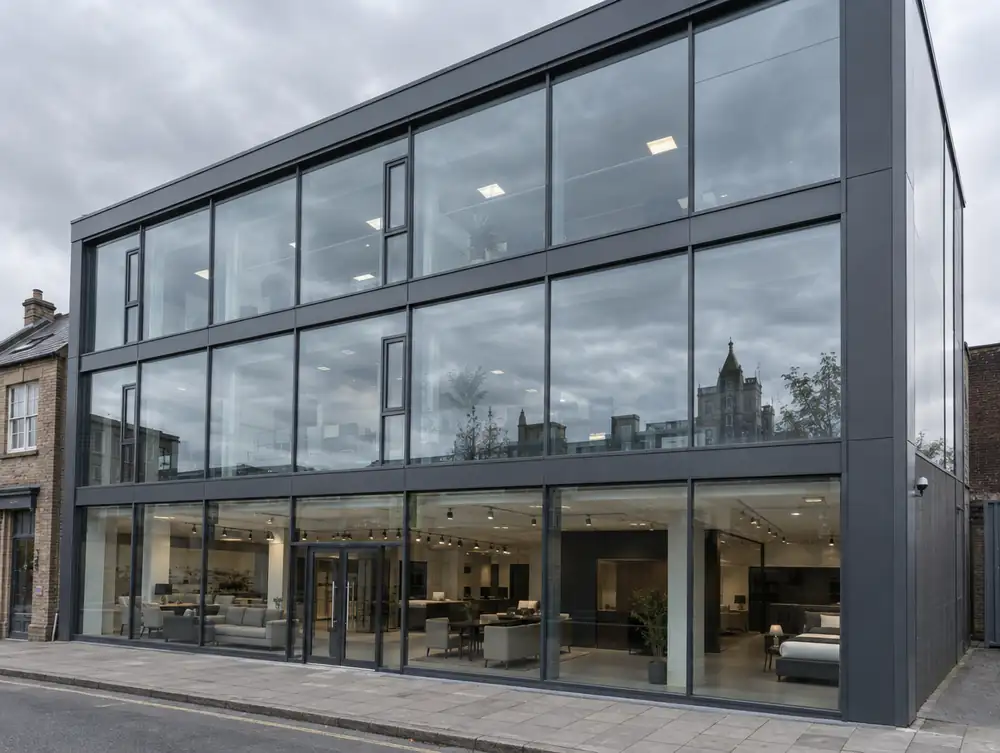
A double-height entrance in Barry deserves more than a stretched shopfront. Deeper aluminium sections carry the span, with sightlines kept as slim as the wind load allows.
Your survey is where the price gets real, because widths, heights, levels and access are all taken on site in Barry.
Where should you begin with curtain walling in Barry?
Unloading is worth thinking through early on any Barry site with restricted access. Mullions can run to 6m or more, so we look at lifting routes, storage and where a delivery can stop.
If your Barry premises have a concrete frame, we open up a sample of slab edges at survey and plan brackets around what is really there. Steel frames and older masonry piers each need a different fixing, so nothing is priced from assumptions.
If there are storeys above the shop, the frontage should feel like the base of the building and not a sign stuck on it. Lining up mullions with the windows overhead is a small move that settles the whole elevation at Barry premises.
What price should you expect for curtain walling in Barry?
Our guide band is £550 to £1,250 plus VAT per m². Scope is the biggest lever, so a tighter brief for curtain walling brings the figure down faster than any change of detail.
What sign-off might you need for curtain walling in Barry?
Section 55 of the Town and Country Planning Act 1990 sets the test in Wales: work that doesn't materially affect the external appearance isn't development. Anything that does needs planning permission, and that goes for curtain walling at premises in the Barry area as much as for a full new frontage. The council confirms how the test applies to your site.
Barry applications for planning permission or advertisement consent are normally handled by Vale of Glamorgan Council. Our survey includes a check of the position for your address.
| Town | Barry |
|---|---|
| Area | South Glamorgan |
| Postcode districts | CF62, CF63 |
| Planning authority | Vale of Glamorgan Council |
| Building approval | Building Regulations (Approved Documents for Wales) |
| Distance from Great Barr | About 99 miles |
| Survey | Free for new work |
Does Vale of Glamorgan Council publish shopfront guidance?
Yes, Shop Fronts, Frontages and Advertisements Good Practice Guidelines. It tells applicants what the council expects from new and altered shopfronts. A few of the things it asks for:
- Fascias should sit within the shop front frame and typically measure about one quarter of the shop front's height.
- Solid or perforated shutters are not acceptable, and open-weave blinds powder-coated in a complementary colour are advised.
- There is a strong presumption against external shutter boxes and blinds in conservation areas.
Questions about curtain walling in Barry
Can you match the frames already on my Barry building?
Usually, yes. Colour can be matched to a RAL reference or a sample, and cap profiles can be chosen to sit close to what is there. An exact match on an old system may not be possible, in which case we would suggest a deliberate change at a natural break.
Can you replace failing curtain walling on premises in Barry?
Yes. We survey the frame, brackets and seals first, because some elevations only need new glass and gaskets. If the frame itself has failed, we draw a replacement that can be phased around the building's use.
Who do I deal with during a curtain walling job in Barry?
You have one named contact from survey to handover. The contract is with S&K Glazing Limited, and vetted teams working under S&K Glazing carry out the work.
What access duty applies to a shop in the Barry area?
The Equality Act 2010 applies, in Wales as across Great Britain, and it requires reasonable steps to remove, alter or avoid physical features that disadvantage disabled people. The duty is anticipatory, so it covers disabled people generally. A feature that meets a design standard is generally protected for 10 years.
Can a shop fire exit in the Barry area use a sliding door?
No, a dedicated fire exit can't be a sliding or revolving door. In Wales, article 14(2) of the Regulatory Reform (Fire Safety) Order 2005 also says fire exit doors must open in the direction of escape and can't be locked against immediate use. The responsible person holds that duty, normally the employer or whoever controls the premises for a business, otherwise the owner.