Drawn well, a frontage in Cardiff can be priced accurately and built without guesswork. The design pack covers elevation, section and specification.
Your survey is where the price gets real, because widths, heights, levels and access are all taken on site in Cardiff.
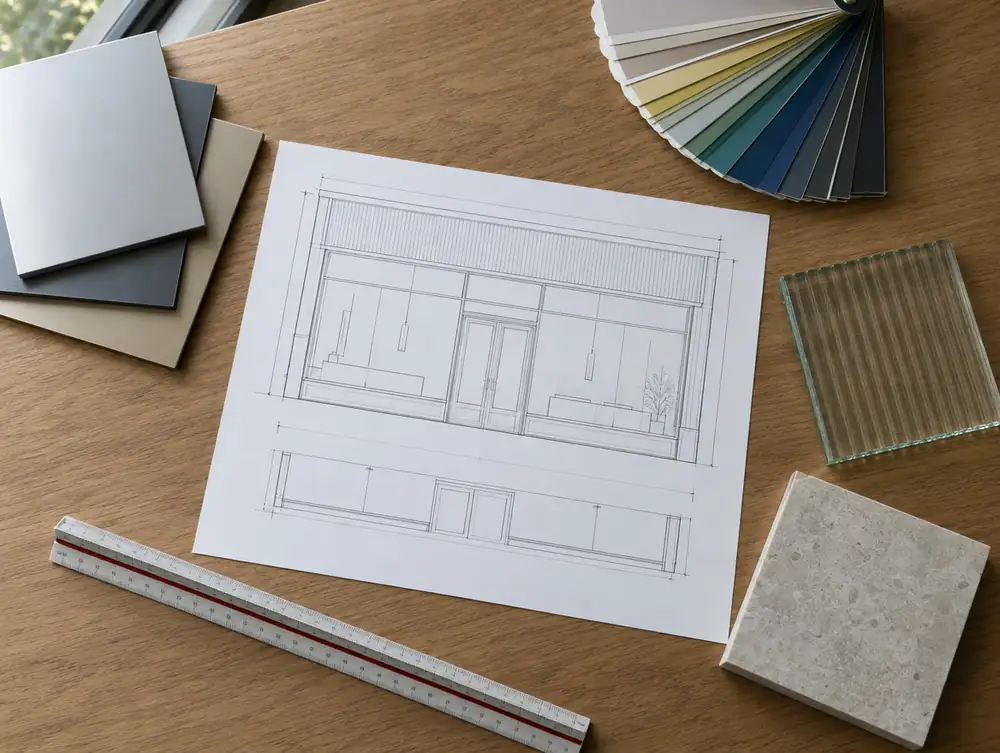
What goes into getting shopfront design right in Cardiff?
If your Cardiff unit sits in a terrace, we draw the neighbouring frontages on the elevation too. Your design then has to work in context, which is how people will actually see it.
Should several trades be involved in your fit-out, we coordinate the frontage with the shopfitter's drawings. Ceiling lines, display depths and shutter boxes then agree with each other before work starts.
On a north-facing frontage the glass stays free of glare, but the interior can look dim from the street, so lighting needs to sit closer to the window. If your Cardiff premises face south, the problem flips to reflections by day and fading stock.
How much could shopfront design in Cardiff cost you?
Our guide band is £495 to £2,495 plus VAT per frontage. Scope is the biggest lever, so a tighter brief for shopfront design brings the figure down faster than any change of detail.
Which applications might shopfront design in Cardiff involve?
The existing rules still apply in Wales, because most of the Planning (Wales) Act 2026 is waiting for a commencement order. For shopfront work at premises in the Cardiff area, building work that materially affects the external appearance needs planning permission, while a true like-for-like replacement usually doesn't. The council confirms the current position.
At survey we check how things stand for your building, although applications for planning permission or advertisement consent here normally go to City of Cardiff Council.
| Town | Cardiff |
|---|---|
| Area | South Glamorgan |
| Postcode districts | CF10, CF11, CF24, CF5 |
| Planning authority | City of Cardiff Council |
| Building approval | Building Regulations (Approved Documents for Wales) |
| Distance from Great Barr | About 91 miles |
| Survey | Free for new work |
Does Cardiff Council publish shopfront guidance?
Yes, Shopfront Design and Signage SPG (2019). It tells applicants what the council expects from new and altered shopfronts. A few of the things it asks for:
- A fascia should typically be no deeper than one-fifth of the shopfront's height.
- Solid or perforated roller shutters are not supported, and external shutters are unacceptable in the city centre, Cardiff Bay, conservation areas and on listed buildings.
- Where external shutters are allowed in exceptional cases in district or local centres, considerations include at least 50% transparency and a colour coating matching the shopfront.
Questions about shopfront design in Cardiff
Can a design for Cardiff premises follow my brand guidelines?
Yes. Send them over with your logo files, and we apply them to your elevation. Where a rule does not fit the building, we explain why and suggest an adjustment.
Can you show the design to my landlord in South Glamorgan?
Yes. The drawings and visuals are prepared so a landlord or agent can review them easily. We can answer their questions directly if that helps.
Do I need a design service for a simple Cardiff shopfront?
Not always. Every job gets a measured survey and scale drawings anyway. The design service adds options, visuals and a full specification, which pay off when the look matters most.
Can a roller shutter go on a shop in the Cardiff area without planning permission?
Usually not in Wales. Part 42 of the 1995 Order, as inserted in 2014, excludes installing or replacing a security grill or shutter on a shopfront, so the rights for shops don't help. The only way to avoid an application is work that doesn't materially affect the appearance, and the council confirms that.
Can a shop fire exit in the Cardiff area use a sliding door?
No, a dedicated fire exit can't be a sliding or revolving door. In Wales, article 14(2) of the Regulatory Reform (Fire Safety) Order 2005 also says fire exit doors must open in the direction of escape and can't be locked against immediate use. The responsible person holds that duty, normally the employer or whoever controls the premises for a business, otherwise the owner.