If your Cardiff unit needs a sharper face on the street, aluminium is usually the simplest route. Fabrication typically takes 2 to 4 weeks and fitting 1 to 5 days, arranged around your trading hours where needed.
It helps if you can be there when we visit Cardiff, since five minutes walking the frontage together answers more than a long email.
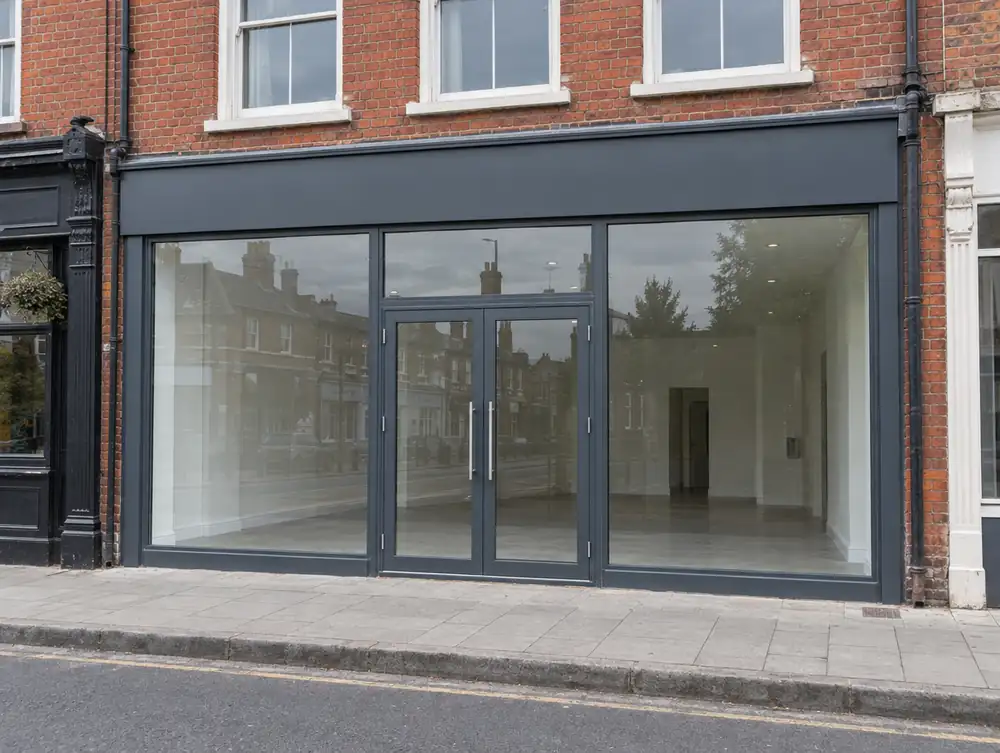
What makes aluminium shopfronts work well on Cardiff premises?
If your Cardiff branch is one stop in a wider rollout, we'd adapt your standard details to this opening instead of forcing the opening to fit them. Section, colour and fixings stay the same as the rest of the estate, while mullion spacing and fascia depth answer to the building.
Where a unit in Cardiff can't afford a closed day, a night fit is worth pricing. Strip-out and frame go in over consecutive nights, with temporary boarding between shifts, so the shop opens each morning weathertight and secure.
Where the building has good brick or stone around the opening, set the frame back in the reveal so the masonry can be seen. On Cardiff premises with a flat elevation, that deep reveal throws a shadow line that adds real depth in low sun.
How much should you set aside for aluminium shopfronts in Cardiff?
As a working budget, use £2,495 to £11,995 plus VAT for a typical 3 to 7 m frontage. Your place inside that range for aluminium shopfronts depends mostly on how much of the existing frontage can stay and how much has to be put right first.
Could aluminium shopfronts in Cardiff need planning permission?
Section 55 of the Town and Country Planning Act 1990 sets the test in Wales: work that doesn't materially affect the external appearance isn't development. Anything that does needs planning permission, and that goes for aluminium shopfronts at premises in the Cardiff area as much as for a full new frontage. The council confirms how the test applies to your site.
For Cardiff, the usual route for planning and advert applications is through City of Cardiff Council, and we confirm that when we visit.
| Town | Cardiff |
|---|---|
| Area | South Glamorgan |
| Postcode districts | CF10, CF11, CF24, CF5 |
| Planning authority | City of Cardiff Council |
| Building approval | Building Regulations (Approved Documents for Wales) |
| Distance from Great Barr | About 91 miles |
| Survey | Free for new work |
Does Cardiff Council publish shopfront guidance?
Yes, Shopfront Design and Signage SPG (2019). It tells applicants what the council expects from new and altered shopfronts. A few of the things it asks for:
- A fascia should typically be no deeper than one-fifth of the shopfront's height.
- Solid or perforated roller shutters are not supported, and external shutters are unacceptable in the city centre, Cardiff Bay, conservation areas and on listed buildings.
- Where external shutters are allowed in exceptional cases in district or local centres, considerations include at least 50% transparency and a colour coating matching the shopfront.
Questions about aluminium shopfronts in Cardiff
Will an aluminium front make my Cardiff shop warmer?
It can, though the glass matters more than the frame. A thermally broken section with double-glazed units loses less heat than single glazing, and a well-sealed door is often the change you notice most on a cold day.
Can I keep trading while my Cardiff shopfront is replaced?
Often, yes. The front can usually be replaced a section at a time, with temporary screens keeping the shop secure, and a closed-day or out-of-hours fit can be arranged if that suits you better.
What do you need before surveying a unit in Cardiff?
An address, a few photos and a rough idea of what you have in mind are enough to book the survey. If you have a lease, a landlord's specification or brand guidelines, send those too, because they shape the drawing.
Does a replacement shopfront in the Cardiff area need Building Regulations approval?
Assume yes until building control says otherwise, because Wales has no like-for-like exemption. Glazing is judged against Approved Document N, as Wales keeps Part N. A registered installer can self-certify replacement windows and doors in non-dwellings, but not structural glass, curtain walling or revolving doors.
When does a shop sign in the Cardiff area need advertisement consent?
A sign needs advertisement consent when it falls outside Class 5 or Class 4B of the 1992 Advertisement Regulations, which still apply in Wales. Within Class 5, an unlit sign sits on a wall containing a shop window and tops out at 4.6m or the first-floor sill if lower. A lit sign in a conservation area needs consent, because Class 4B isn't available there.