The brief for a bi-fold is simple: an open front in summer and a warm room in winter. For Cardiff premises in South Glamorgan, that comes down to panel count, thermal section and a threshold that drains properly.
Please have keys to any meter cupboards and shutter housings to hand when we survey in Cardiff, because what sits behind them can change the drawing.
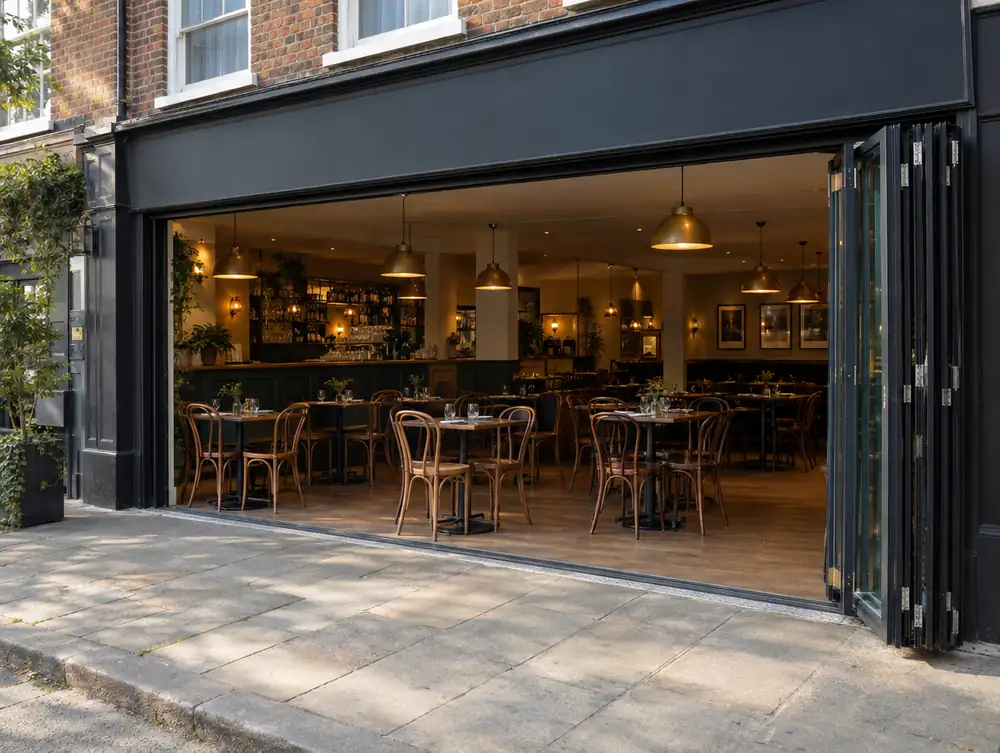
What makes bi-folding shopfronts work well on Cardiff premises?
In a parade in Cardiff, a bi-fold has to sit politely when closed. We'd match the fascia line and keep a short fixed return at one end, so the set reads as part of the row instead of a gap in it.
If your Cardiff frontage faces the sun, a bi-fold doubles as ventilation. We'd pair it with an awning so the room stays usable at midday, and look at solar control glass for the days the set stays closed.
Where the footway outside your Cardiff premises is narrow, a recessed entrance earns its keep. It gives people a dry place to pause out of the walkway, and it adds a longer run of display glass either side of the door.
Could bi-folding shopfronts in Cardiff need planning permission?
Section 55 of the Town and Country Planning Act 1990 sets the test in Wales: work that doesn't materially affect the external appearance isn't development. Anything that does needs planning permission, and that goes for bi-folding shopfronts at premises in the Cardiff area as much as for a full new frontage. The council confirms how the test applies to your site.
Planning and advert applications for Cardiff premises normally go to City of Cardiff Council. We check the position for your address at survey.
How much should you set aside for bi-folding shopfronts in Cardiff?
We would budget £5,195 to £13,995 plus VAT for a typical opening. Scope sets most of the figure, so a clear brief at the start does more for the budget than any later change of detail.
| Town | Cardiff |
|---|---|
| Area | South Glamorgan |
| Postcode districts | CF10, CF11, CF24, CF5 |
| Planning authority | City of Cardiff Council |
| Building approval | Building Regulations (Approved Documents for Wales) |
| Distance from Great Barr | About 91 miles |
| Survey | Free for new work |
Does Cardiff Council publish shopfront guidance?
Yes, Shopfront Design and Signage SPG (2019). It tells applicants what the council expects from new and altered shopfronts. A few of the things it asks for:
- A fascia should typically be no deeper than one-fifth of the shopfront's height.
- Solid or perforated roller shutters are not supported, and external shutters are unacceptable in the city centre, Cardiff Bay, conservation areas and on listed buildings.
- Where external shutters are allowed in exceptional cases in district or local centres, considerations include at least 50% transparency and a colour coating matching the shopfront.
Questions about bi-folding shopfronts in Cardiff
Can my Cardiff bi-fold be fitted around service?
Yes. Closed-day or out-of-hours fitting can be arranged to avoid your busiest sittings, and the job typically takes 2 to 4 days on site.
Who do I speak to about a bi-fold in Cardiff?
Your named contact stays the same from the first visit to the final adjustment. Fitting is carried out by vetted teams working under S&K Glazing, travelling from Great Barr.
Can I have a timber bi-fold on my Cardiff frontage?
Yes. Painted hardwood sets suit older premises across South Glamorgan, though the panels are heavier and need a stiffer head than aluminium.
Who decides listed building consent for a shopfront in the Cardiff area?
Planning authorities and Welsh Ministers share control of listed building consent in Wales, under the Historic Environment (Wales) Act 2023. Cadw is the national body, and the 1990 Act no longer applies. Ask the council where an application should start.
What access duty applies to a shop in the Cardiff area?
The Equality Act 2010 applies, in Wales as across Great Britain, and it requires reasonable steps to remove, alter or avoid physical features that disadvantage disabled people. The duty is anticipatory, so it covers disabled people generally. A feature that meets a design standard is generally protected for 10 years.