On a warm evening, an open front does more for a cafe or bar in Llantrisant than any sign. We design the folding set around your seating, so the panels park where they don't cost you a table.
We measure your Llantrisant opening in person, at a time agreed with you first, so the visit fits around your trading.
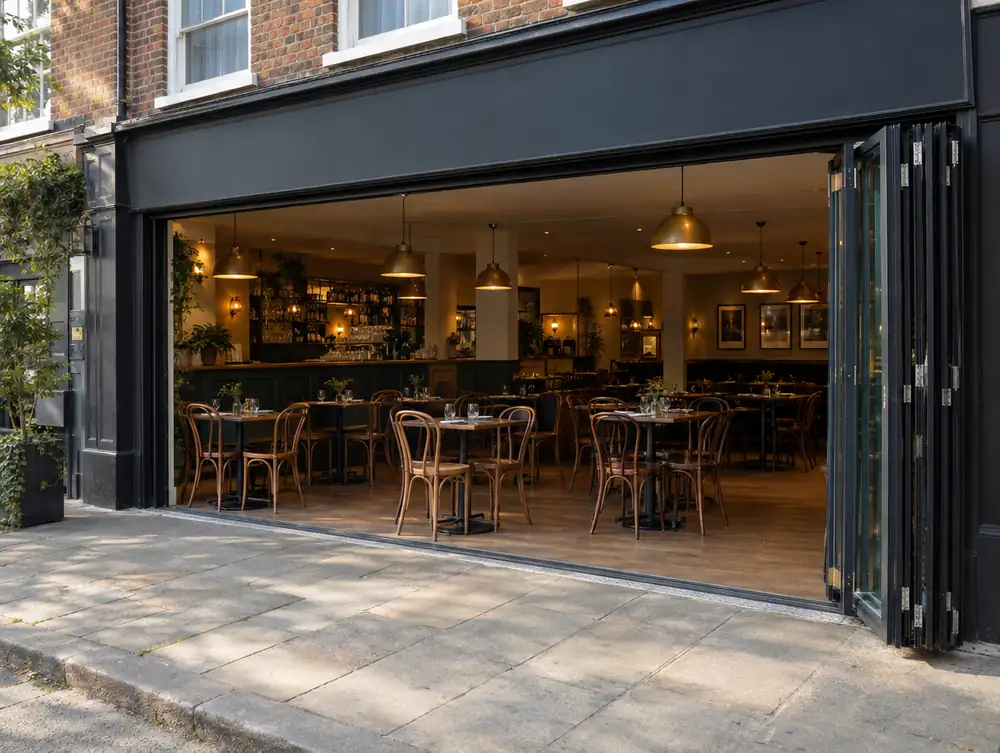
What makes bi-folding shopfronts work well on Llantrisant premises?
For a restaurant group opening in Llantrisant, a bi-fold can carry the brand's look from site to site. We'd standardise the panel section, colour and hardware, then vary the panel count and stack side to suit each opening.
Bi-folds suit a two-stage fit at Llantrisant premises that trade late. We'd take the old front out and fix the frame during closed hours, then hang and adjust the panels the following night, with temporary boarding in between.
Where the footway outside your Llantrisant premises is narrow, a recessed entrance earns its keep. It gives people a dry place to pause out of the walkway, and it adds a longer run of display glass either side of the door.
How much should you set aside for bi-folding shopfronts in Llantrisant?
Allow £5,195 to £13,995 plus VAT for a typical opening. Size and specification set most of that figure for bi-folding shopfronts, and the rest depends on what the survey finds on site.
Could bi-folding shopfronts in Llantrisant need planning permission?
Section 55 of the Town and Country Planning Act 1990 sets the test in Wales: work that doesn't materially affect the external appearance isn't development. Anything that does needs planning permission, and that goes for bi-folding shopfronts at premises in the Llantrisant area as much as for a full new frontage. The council confirms how the test applies to your site.
Planning and advert applications for Llantrisant premises normally go to Rhondda Cynon Taf County Borough Council. We check the position for your address at survey.
| Town | Llantrisant |
|---|---|
| Area | Mid Glamorgan |
| Postcode districts | CF38, CF72 |
| Planning authority | Rhondda Cynon Taf County Borough Council |
| Building approval | Building Regulations (Approved Documents for Wales) |
| Distance from Great Barr | About 93 miles |
| Survey | Free for new work |
Does Rhondda Cynon Taf County Borough Council publish shopfront guidance?
Yes, Shopfront Design. It tells applicants what the council expects from new and altered shopfronts. A few of the things it asks for:
- External roller shutters are a last resort after other security options are shown to be unsuitable.
- Solid metal shutters are unlikely to be acceptable, while lattice or brick-bond grille shutters may be considered.
- Individual shutters covering only the glazing are one option, and powder coating is generally preferred to paint.
Questions about bi-folding shopfronts in Llantrisant
Can my Llantrisant bi-fold be fitted around service?
Yes. Closed-day or out-of-hours fitting can be arranged to avoid your busiest sittings, and the job typically takes 2 to 4 days on site.
Will I lose a table to the stack in my Llantrisant restaurant?
Possibly one, but careful layout usually avoids it. We draw the folded panels on your floor plan, then look at moving the stack to a quieter corner or splitting the set in two.
How many panels would my Llantrisant opening need?
It depends on the width and how you want the set to open. Most openings divide into leaves under 1m wide, and an odd number gives you a daily door, so we draw the options after the measure-up.
Who decides listed building consent for a shopfront in the Llantrisant area?
Planning authorities and Welsh Ministers share control of listed building consent in Wales, under the Historic Environment (Wales) Act 2023. Cadw is the national body, and the 1990 Act no longer applies. Ask the council where an application should start.
What access duty applies to a shop in the Llantrisant area?
The Equality Act 2010 applies, in Wales as across Great Britain, and it requires reasonable steps to remove, alter or avoid physical features that disadvantage disabled people. The duty is anticipatory, so it covers disabled people generally. A feature that meets a design standard is generally protected for 10 years.