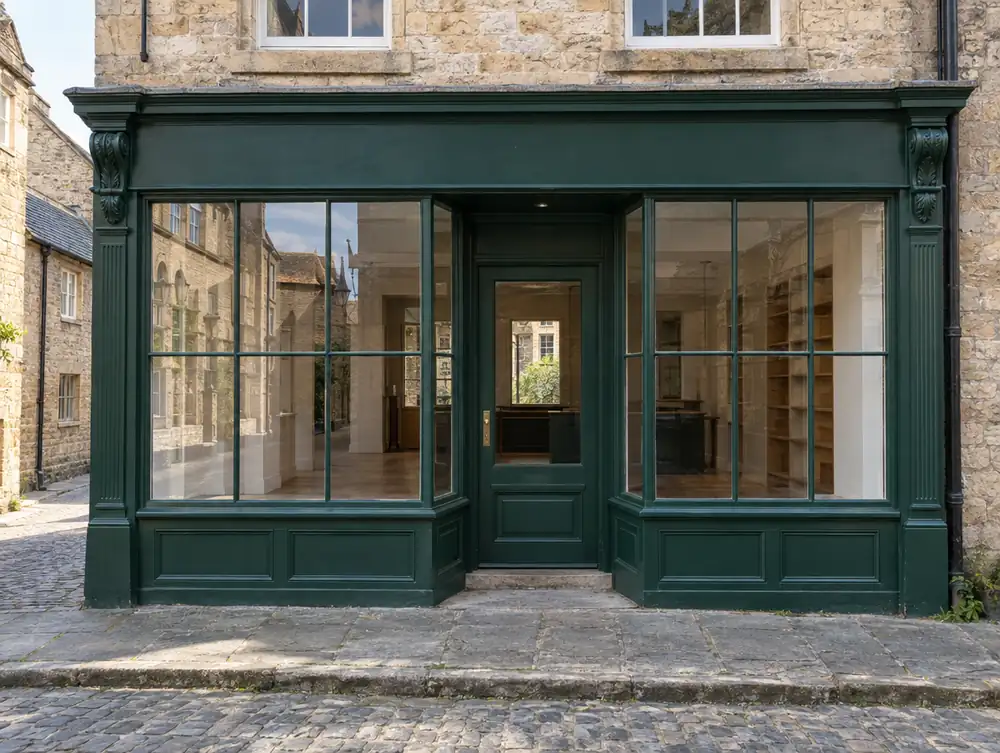
Across Mid Glamorgan, timber is the material we suggest when a building has proportions worth respecting. For Llantrisant premises, we set the stallriser, pilasters and fascia from the elevation above, then detail the joinery to match.
We measure your Llantrisant opening in person, at a time agreed with you first, so the visit fits around your trading.
What makes timber shopfronts work well on Llantrisant premises?
In a parade of mixed fronts in Llantrisant, painted timber can lift a unit without shouting. We'd take the height of the neighbouring cills and fascias, then let the depth of the mouldings and a considered colour do the talking.
A corner plot gives a timber front two faces and one chance to get the turn right. For Llantrisant premises on a corner, we'd use a pilaster or a canted bay at the angle, so the cornice wraps round without a clumsy mitre.
If there are storeys above the shop, the frontage should feel like the base of the building and not a sign stuck on it. Lining up mullions with the windows overhead is a small move that settles the whole elevation at Llantrisant premises.
Could timber shopfronts in Llantrisant need planning permission?
Section 55 of the Town and Country Planning Act 1990 sets the test in Wales: work that doesn't materially affect the external appearance isn't development. Anything that does needs planning permission, and that goes for timber shopfronts at premises in the Llantrisant area as much as for a full new frontage. The council confirms how the test applies to your site.
For Llantrisant, the usual route for planning and advert applications is through Rhondda Cynon Taf County Borough Council, and we confirm that when we visit.
How much should you set aside for timber shopfronts in Llantrisant?
A sensible starting budget is £3,995 to £13,995 plus VAT for a typical frontage. What shifts the figure is whatever can't be seen yet, such as the condition behind the old frontage or the services running through it.
| Town | Llantrisant |
|---|---|
| Area | Mid Glamorgan |
| Postcode districts | CF38, CF72 |
| Planning authority | Rhondda Cynon Taf County Borough Council |
| Building approval | Building Regulations (Approved Documents for Wales) |
| Distance from Great Barr | About 93 miles |
| Survey | Free for new work |
Does Rhondda Cynon Taf County Borough Council publish shopfront guidance?
Yes, Shopfront Design. It tells applicants what the council expects from new and altered shopfronts. A few of the things it asks for:
- External roller shutters are a last resort after other security options are shown to be unsuitable.
- Solid metal shutters are unlikely to be acceptable, while lattice or brick-bond grille shutters may be considered.
- Individual shutters covering only the glazing are one option, and powder coating is generally preferred to paint.
Questions about timber shopfronts in Llantrisant
Will timber suffer on my Llantrisant frontage if it gets a lot of rain?
Not if the details are right. Sloped cills, sealed end grain and plinth blocks keep water moving, and the paint system then only has to deal with the weather, not trapped damp.
How much disruption will a timber front cause in my Llantrisant shop?
Expect more time on site than an aluminium front, typically 3 to 7 days with the painting. Closed-day or out-of-hours fitting can be arranged, and the opening stays boarded and secure between stages.
Can a timber front take a modern sign in Llantrisant?
Yes. Hand-painted letters suit a timber fascia well, and raised letters or a concealed trough light work too. We draw the sign and the joinery together, so the fixings don't cut through a moulding.
Who decides listed building consent for a shopfront in the Llantrisant area?
Planning authorities and Welsh Ministers share control of listed building consent in Wales, under the Historic Environment (Wales) Act 2023. Cadw is the national body, and the 1990 Act no longer applies. Ask the council where an application should start.
Does a replacement shopfront in the Llantrisant area need Building Regulations approval?
Assume yes until building control says otherwise, because Wales has no like-for-like exemption. Glazing is judged against Approved Document N, as Wales keeps Part N. A registered installer can self-certify replacement windows and doors in non-dwellings, but not structural glass, curtain walling or revolving doors.