Seeing the frontage before it is built changes the conversation. You get scale drawings and a rendered view of your Llantrisant premises, so you can judge it properly before committing.
Expect us to measure the opening, photograph the existing front and check how materials will reach it on the day, at a time you have agreed.
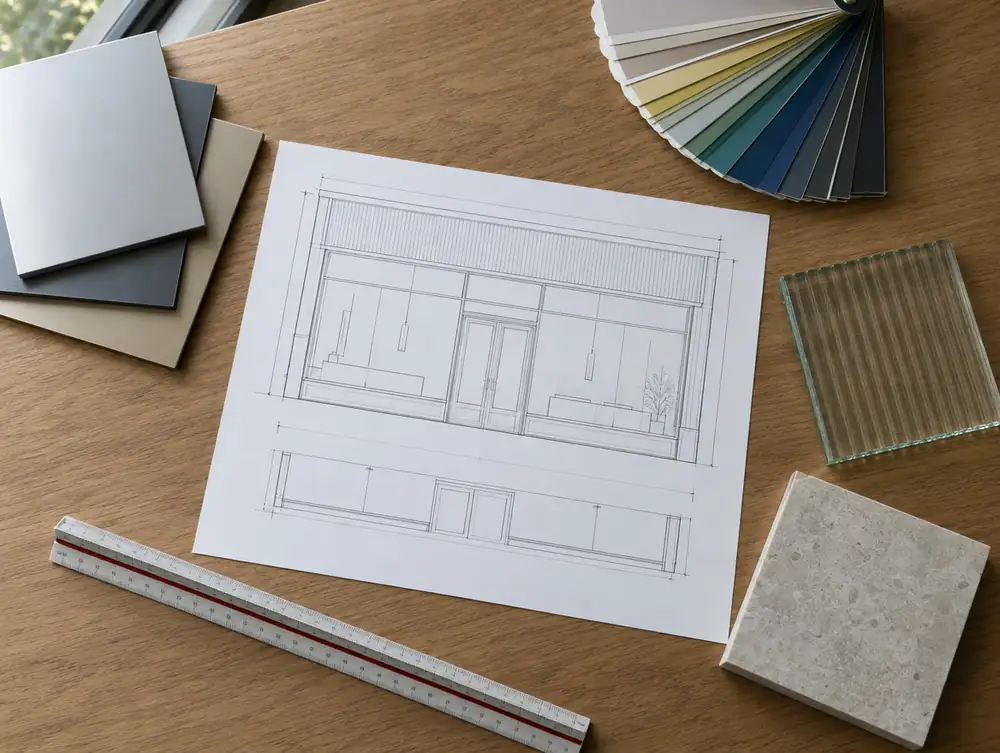
What makes shopfront design work well on Llantrisant premises?
If the pavement falls along your frontage, we survey the levels before drawing a line. Door threshold, stallriser and sill are then set from the real ground, which is where designs drawn from photographs tend to fail.
For a corner unit in Llantrisant, we design both elevations as one. The return, the door position and the sign all depend on which street brings your customers.
Where the building has good brick or stone around the opening, set the frame back in the reveal so the masonry can be seen. On Llantrisant premises with a flat elevation, that deep reveal throws a shadow line that adds real depth in low sun.
How much should you set aside for shopfront design in Llantrisant?
A sensible starting budget is £495 to £2,495 plus VAT per frontage. What shifts the figure is whatever can't be seen yet, such as the condition behind the old frontage or the services running through it.
Could shopfront design in Llantrisant need planning permission?
Like-for-like replacement usually needs no planning permission in Wales, because the external appearance isn't materially affected. Matching the existing materials, proportions and glass line is what keeps a job in that position. For shopfront work at premises in the Llantrisant area, changing any of those usually means an application, which the council can confirm.
Expect planning and advert applications here to go to Rhondda Cynon Taf County Borough Council in the normal way. We check what that means for your building when we survey it in Llantrisant.
| Town | Llantrisant |
|---|---|
| Area | Mid Glamorgan |
| Postcode districts | CF38, CF72 |
| Planning authority | Rhondda Cynon Taf County Borough Council |
| Building approval | Building Regulations (Approved Documents for Wales) |
| Distance from Great Barr | About 93 miles |
| Survey | Free for new work |
Does Rhondda Cynon Taf County Borough Council publish shopfront guidance?
Yes, Shopfront Design. It tells applicants what the council expects from new and altered shopfronts. A few of the things it asks for:
- External roller shutters are a last resort after other security options are shown to be unsuitable.
- Solid metal shutters are unlikely to be acceptable, while lattice or brick-bond grille shutters may be considered.
- Individual shutters covering only the glazing are one option, and powder coating is generally preferred to paint.
Questions about shopfront design in Llantrisant
Do I need a design service for a simple Llantrisant shopfront?
Not always. Every job gets a measured survey and scale drawings anyway. The design service adds options, visuals and a full specification, which pay off when the look matters most.
How many options will I see for my Llantrisant premises?
Usually two or three directions at concept stage, then one developed design. If you already know what you want, we can go straight to the developed drawings.
Can you design a frontage for Llantrisant premises I have not taken on yet?
Yes. A survey and concept drawing can show what the unit could become and what it might cost. That can be useful before you sign anything.
What access duty applies to a shop in the Llantrisant area?
The Equality Act 2010 applies, in Wales as across Great Britain, and it requires reasonable steps to remove, alter or avoid physical features that disadvantage disabled people. The duty is anticipatory, so it covers disabled people generally. A feature that meets a design standard is generally protected for 10 years.
Can a shop fire exit in the Llantrisant area use a sliding door?
No, a dedicated fire exit can't be a sliding or revolving door. In Wales, article 14(2) of the Regulatory Reform (Fire Safety) Order 2005 also says fire exit doors must open in the direction of escape and can't be locked against immediate use. The responsible person holds that duty, normally the employer or whoever controls the premises for a business, otherwise the owner.