Thinking about opening up your Pontypridd frontage? Start with where the stack will sit, because that one decision shapes the panel count, the track and the seating plan behind it.
A survey in Pontypridd usually starts outside, looking at the whole elevation before any tape comes out, because the frontage has to answer the building above it.
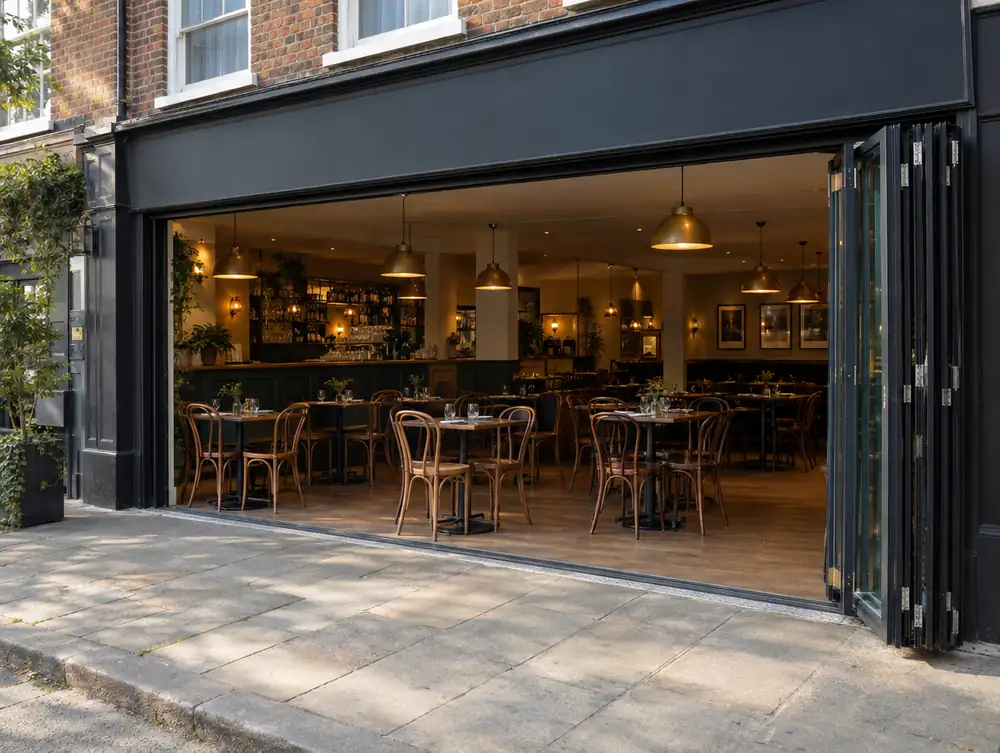
How do you design around the building when planning bi-folding shopfronts in Pontypridd?
On a narrow Pontypridd unit, the stack can swallow the opening. We'd limit the set to three panels, or look at a single sliding leaf, so the opening you gain outweighs the width lost to parked frames.
If your Pontypridd frontage faces the sun, a bi-fold doubles as ventilation. We'd pair it with an awning so the room stays usable at midday, and look at solar control glass for the days the set stays closed.
Where the building has good brick or stone around the opening, set the frame back in the reveal so the masonry can be seen. On Pontypridd premises with a flat elevation, that deep reveal throws a shadow line that adds real depth in low sun.
What permissions should you check for bi-folding shopfronts in Pontypridd?
Like-for-like replacement usually needs no planning permission in Wales, because the external appearance isn't materially affected. Matching the existing materials, proportions and glass line is what keeps a job in that position. For bi-folding shopfronts at premises in the Pontypridd area, changing any of those usually means an application, which the council can confirm.
For Pontypridd, the usual route for planning and advert applications is through Rhondda Cynon Taf County Borough Council, and we confirm that when we visit.
What might bi-folding shopfronts cost in Pontypridd?
A sensible starting budget is £5,195 to £13,995 plus VAT for a typical opening. What shifts the figure is whatever can't be seen yet, such as the condition behind the old frontage or the services running through it.
| Town | Pontypridd |
|---|---|
| Area | Mid Glamorgan |
| Postcode districts | CF37 |
| Planning authority | Rhondda Cynon Taf County Borough Council |
| Building approval | Building Regulations (Approved Documents for Wales) |
| Distance from Great Barr | About 89 miles |
| Survey | Free for new work |
Does Rhondda Cynon Taf County Borough Council publish shopfront guidance?
Yes, Shopfront Design. It tells applicants what the council expects from new and altered shopfronts. A few of the things it asks for:
- External roller shutters are a last resort after other security options are shown to be unsuitable.
- Solid metal shutters are unlikely to be acceptable, while lattice or brick-bond grille shutters may be considered.
- Individual shutters covering only the glazing are one option, and powder coating is generally preferred to paint.
Questions about bi-folding shopfronts in Pontypridd
Which way should the panels fold at my Pontypridd premises?
Inward is the usual answer, since panels folded into the room stay clear of people on the pavement. We'd draw the options where the room allows, and you choose against your seating plan.
Can my Pontypridd bi-fold be fitted around service?
Yes. Closed-day or out-of-hours fitting can be arranged to avoid your busiest sittings, and the job typically takes 2 to 4 days on site.
Can I have a timber bi-fold on my Pontypridd frontage?
Yes. Painted hardwood sets suit older premises across Mid Glamorgan, though the panels are heavier and need a stiffer head than aluminium.
When does a shop sign in the Pontypridd area need advertisement consent?
A sign needs advertisement consent when it falls outside Class 5 or Class 4B of the 1992 Advertisement Regulations, which still apply in Wales. Within Class 5, an unlit sign sits on a wall containing a shop window and tops out at 4.6m or the first-floor sill if lower. A lit sign in a conservation area needs consent, because Class 4B isn't available there.
What access duty applies to a shop in the Pontypridd area?
The Equality Act 2010 applies, in Wales as across Great Britain, and it requires reasonable steps to remove, alter or avoid physical features that disadvantage disabled people. The duty is anticipatory, so it covers disabled people generally. A feature that meets a design standard is generally protected for 10 years.