We travel from Great Barr to design and fit frameless glass shopfronts for Pontypridd premises. One named contact runs the job from first measure to final clean.
Bring whatever you have to the survey in Pontypridd: brand guidelines, lease plans, old drawings or a photo of a frontage you admire.
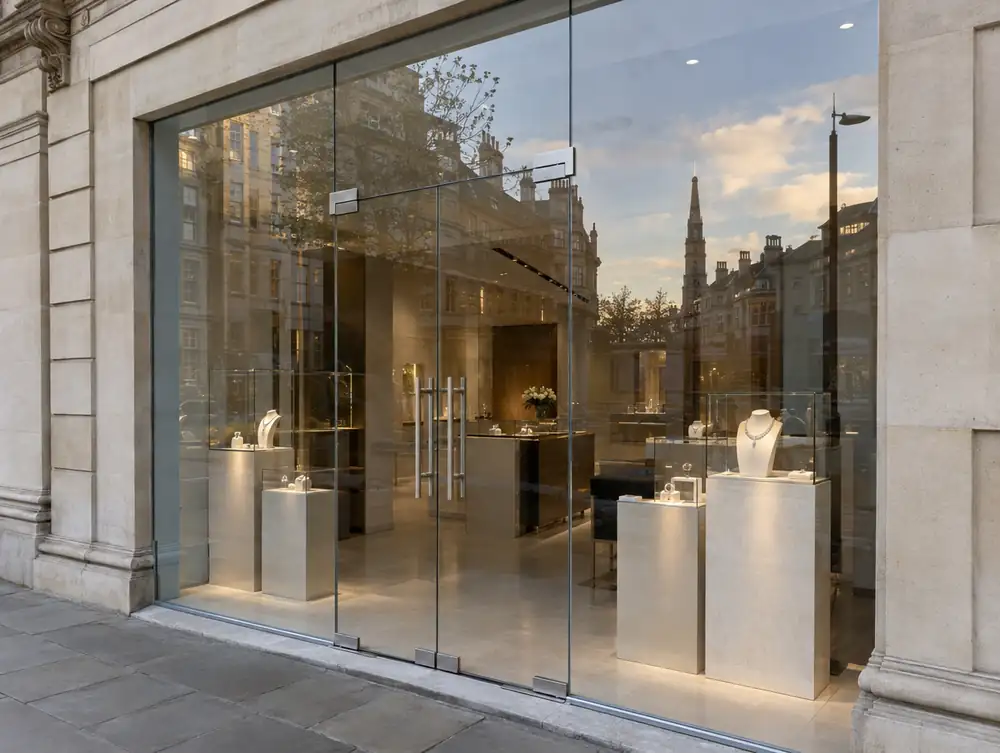
What goes into getting frameless glass shopfronts right in Pontypridd?
A recessed entrance gives frameless glass somewhere to perform. At Pontypridd premises with a deep lobby, we'd carry glass back along the returns, light the soffit and run one floor finish from the pavement line into the shop.
In a narrow Pontypridd unit every millimetre of frame counts, so frameless glass helps. We'd run one clear pane beside a single glass door with both sharing the same head line, and let the full depth of the shop draw people in.
Where the footway outside your Pontypridd premises is narrow, a recessed entrance earns its keep. It gives people a dry place to pause out of the walkway, and it adds a longer run of display glass either side of the door.
Which applications might frameless glass shopfronts in Pontypridd involve?
The existing rules still apply in Wales, because most of the Planning (Wales) Act 2026 is waiting for a commencement order. For frameless glass shopfronts at premises in the Pontypridd area, building work that materially affects the external appearance needs planning permission, while a true like-for-like replacement usually doesn't. The council confirms the current position.
Pontypridd applications for planning permission or advertisement consent are normally handled by Rhondda Cynon Taf County Borough Council. Our survey includes a check of the position for your address.
How much could frameless glass shopfronts in Pontypridd cost you?
Guide price: £4,995 to £15,995 plus VAT for a typical frontage. Materials, finish and the amount of drawing and coordination involved all move it, and your itemised quotation shows where the money goes on frameless glass shopfronts.
| Town | Pontypridd |
|---|---|
| Area | Mid Glamorgan |
| Postcode districts | CF37 |
| Planning authority | Rhondda Cynon Taf County Borough Council |
| Building approval | Building Regulations (Approved Documents for Wales) |
| Distance from Great Barr | About 89 miles |
| Survey | Free for new work |
Does Rhondda Cynon Taf County Borough Council publish shopfront guidance?
Yes, Shopfront Design. It tells applicants what the council expects from new and altered shopfronts. A few of the things it asks for:
- External roller shutters are a last resort after other security options are shown to be unsuitable.
- Solid metal shutters are unlikely to be acceptable, while lattice or brick-bond grille shutters may be considered.
- Individual shutters covering only the glazing are one option, and powder coating is generally preferred to paint.
Questions about frameless glass shopfronts in Pontypridd
Who fits frameless glass in Pontypridd?
Glazing crews vetted by us and working under S&K Glazing handle the panes. They travel to Pontypridd from Great Barr, and you keep one named contact throughout.
How do you stop people walking into the glass at my Pontypridd shop?
Markings on the glass are designed as part of the front. We can turn them into a pattern, logo or frosted band that suits your brand, placed where the eye naturally catches them.
How much of my Pontypridd shop will people see from the pavement?
All of it, which is both the point and the risk. Shelving backs, till positions and ceiling services become part of the front once the frames have gone, so we'd plan that view with you.
Can a roller shutter go on a shop in the Pontypridd area without planning permission?
Usually not in Wales. Part 42 of the 1995 Order, as inserted in 2014, excludes installing or replacing a security grill or shutter on a shopfront, so the rights for shops don't help. The only way to avoid an application is work that doesn't materially affect the appearance, and the council confirms that.
What access duty applies to a shop in the Pontypridd area?
The Equality Act 2010 applies, in Wales as across Great Britain, and it requires reasonable steps to remove, alter or avoid physical features that disadvantage disabled people. The duty is anticipatory, so it covers disabled people generally. A feature that meets a design standard is generally protected for 10 years.