Panels that fold away should still look right when closed, since that is how a front in Penarth spends most of the year. We keep the widths even, the rails aligned and the frames slim, so the set reads as a shopfront.
Nothing gets ordered off the back of a survey in Penarth, because its job is to give us the numbers to draw and price from.
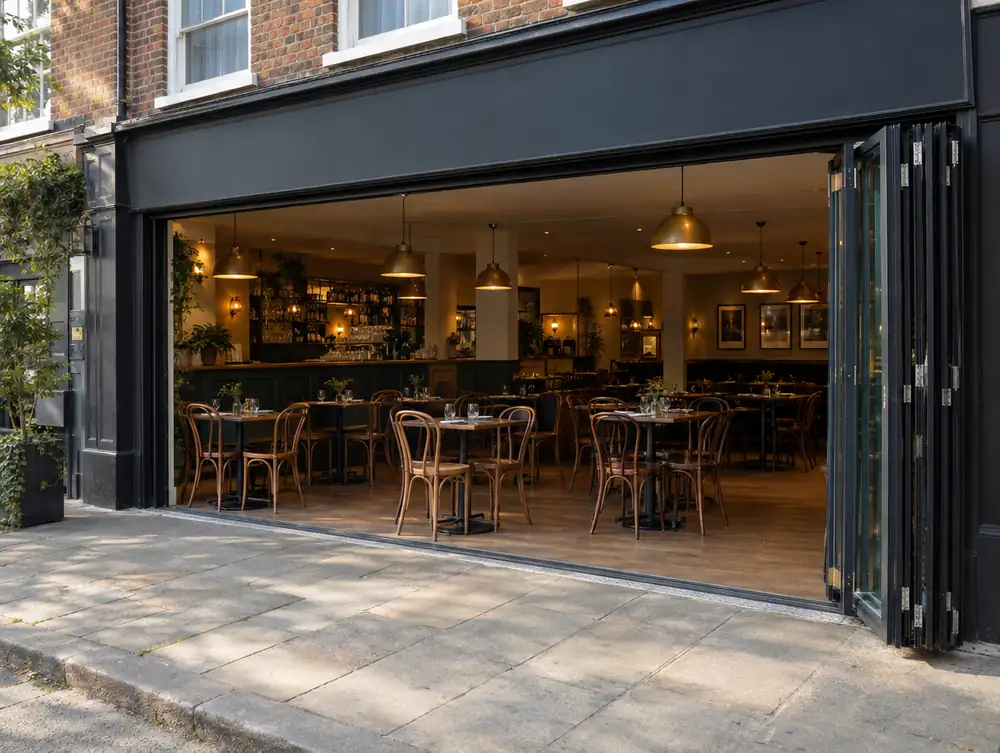
What goes into getting bi-folding shopfronts right in Penarth?
A deep recess can host a bi-fold set back from the street, which keeps the panels clear of passers-by and creates a sheltered pocket by the door. At Penarth premises with that depth, it's often the neatest layout.
In a parade in Penarth, a bi-fold has to sit politely when closed. We'd match the fascia line and keep a short fixed return at one end, so the set reads as part of the row instead of a gap in it.
If your Penarth unit is narrow, a central door can split a small window into two weak ones. Moving the door to one side gives you a single confident pane, provided the layout inside still works.
Which applications might bi-folding shopfronts in Penarth involve?
Going by Part 42 of the 1995 Order as inserted in 2014, Wales has no permitted development route for changing a shopfront. The right covers A1 and A2 premises, but it excludes creating, altering or replacing a shopfront, or fitting or replacing a security grill or shutter on one, and it doesn't apply on Article 1(5) land. For bi-folding shopfronts at premises in the Penarth area, that leaves a planning application, or work that leaves the appearance materially unchanged.
Penarth applications for planning permission or advertisement consent are normally handled by Vale of Glamorgan Council. Our survey includes a check of the position for your address.
How much could bi-folding shopfronts in Penarth cost you?
Until the survey is done, plan on £5,195 to £13,995 plus VAT for a typical opening. Unusual sizes, fine detail and phased working push the figure up, while a simple brief and clear access keep it toward the lower end.
| Town | Penarth |
|---|---|
| Area | South Glamorgan |
| Postcode districts | CF64 |
| Planning authority | Vale of Glamorgan Council |
| Building approval | Building Regulations (Approved Documents for Wales) |
| Distance from Great Barr | About 94 miles |
| Survey | Free for new work |
Does Vale of Glamorgan Council publish shopfront guidance?
Yes, Shop Fronts, Frontages and Advertisements Good Practice Guidelines. It tells applicants what the council expects from new and altered shopfronts. A few of the things it asks for:
- Fascias should sit within the shop front frame and typically measure about one quarter of the shop front's height.
- Solid or perforated shutters are not acceptable, and open-weave blinds powder-coated in a complementary colour are advised.
- There is a strong presumption against external shutter boxes and blinds in conservation areas.
Questions about bi-folding shopfronts in Penarth
Can my Penarth bi-fold be fitted around service?
Yes. Closed-day or out-of-hours fitting can be arranged to avoid your busiest sittings, and the job typically takes 2 to 4 days on site.
Will I lose a table to the stack in my Penarth restaurant?
Possibly one, but careful layout usually avoids it. We draw the folded panels on your floor plan, then look at moving the stack to a quieter corner or splitting the set in two.
How many panels would my Penarth opening need?
It depends on the width and how you want the set to open. Most openings divide into leaves under 1m wide, and an odd number gives you a daily door, so we draw the options after the measure-up.
What access duty applies to a shop in the Penarth area?
The Equality Act 2010 applies, in Wales as across Great Britain, and it requires reasonable steps to remove, alter or avoid physical features that disadvantage disabled people. The duty is anticipatory, so it covers disabled people generally. A feature that meets a design standard is generally protected for 10 years.
When does a shop sign in the Penarth area need advertisement consent?
A sign needs advertisement consent when it falls outside Class 5 or Class 4B of the 1992 Advertisement Regulations, which still apply in Wales. Within Class 5, an unlit sign sits on a wall containing a shop window and tops out at 4.6m or the first-floor sill if lower. A lit sign in a conservation area needs consent, because Class 4B isn't available there.