From Cardiff to the furthest corner of South Glamorgan, the sequence for bi-folding shopfronts stays the same: survey, drawings, written price, then work on site. We travel from Great Barr in Birmingham and use vetted teams working under S&K Glazing.
Your frontage is read alongside its neighbours, so we note the fascia line, stallriser height and pilasters on either side before drawing bi-folding shopfronts for South Glamorgan premises. Matching those lines or breaking them on purpose can both work, whereas doing it by accident never does.
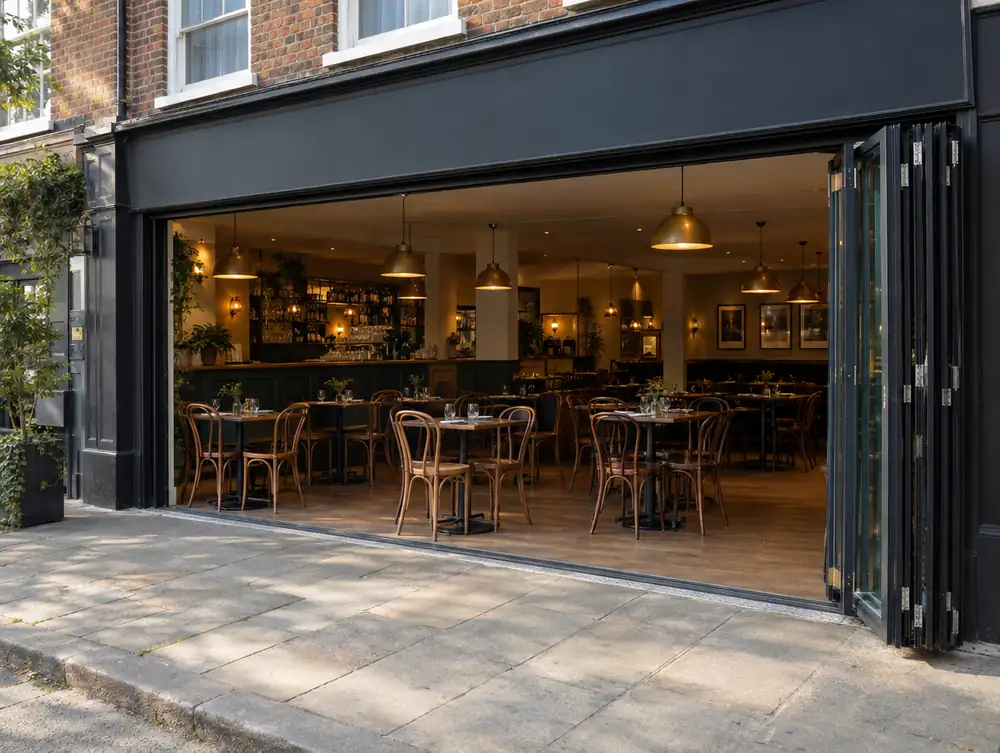
What should you look for from bi-folding shopfronts in South Glamorgan?
Floors vary more than people expect. If your premises in South Glamorgan are older, a level track can mean cutting into a slab, a stone threshold or a cellar head, so we find out what's under the floor before deciding between top-hung and bottom-rolling.
Neighbours matter too. Where premises in South Glamorgan share a wall with flats or offices, we'd talk through sound before fixing the layout, because an open front carries music and conversation further than most owners expect.
What consents apply to bi-folding shopfronts in South Glamorgan?
Going by Part 42 of the 1995 Order as inserted in 2014, Wales has no permitted development route for changing a shopfront. The right covers A1 and A2 premises, but it excludes creating, altering or replacing a shopfront, or fitting or replacing a security grill or shutter on one, and it doesn't apply on Article 1(5) land. For bi-folding shopfronts at premises in the South Glamorgan area, that leaves a planning application, or work that leaves the appearance materially unchanged.
How much do bi-folding shopfronts cost in South Glamorgan?
A sensible starting budget is £5,195 to £13,995 plus VAT for a typical opening. What shifts the figure is whatever can't be seen yet, such as the condition behind the old frontage or the services running through it.
| Area | South Glamorgan |
|---|---|
| Nation | Wales |
| Towns covered | 6 |
| Main town | Cardiff |
| Planning regime | Wales: TCPA 1990 and the 1992 Advertisement Regulations |
| Building approval | Building Regulations (Approved Documents for Wales) |
| Survey | Free for new work, from our Great Barr base |
Does Cardiff Council publish shopfront guidance?
Yes, Shopfront Design and Signage SPG (2019). It tells applicants what the council expects from new and altered shopfronts. A few of the things it asks for:
- A fascia should typically be no deeper than one-fifth of the shopfront's height.
- Solid or perforated roller shutters are not supported, and external shutters are unacceptable in the city centre, Cardiff Bay, conservation areas and on listed buildings.
- Where external shutters are allowed in exceptional cases in district or local centres, considerations include at least 50% transparency and a colour coating matching the shopfront.
Questions about bi-folding shopfronts in South Glamorgan
Do bi-folds suit the weather in South Glamorgan?
Yes, as long as the threshold, seals and panel sizes match the exposure. Sheltered streets get more open days, but closed performance is what counts through winter.
Do you install bi-folding shopfronts in South Glamorgan?
Yes. We travel from Great Barr to survey the opening, check the head and floor, and fit the set with a vetted team.
Will a bi-fold work on a sloping street in South Glamorgan?
Usually, with the right threshold. We take levels across the opening, then step the track, add a low upstand or set the frame back so water stays outside.
Is planning permission needed for a new shopfront in the South Glamorgan area?
Usually yes, if the work materially affects the external appearance, because Wales has no permitted development route for changing a shopfront. Most of the Planning (Wales) Act 2026 hasn't been commenced yet, so the existing rules apply. A true like-for-like replacement usually avoids an application, and the council confirms the position.
When does a shop sign in the South Glamorgan area need advertisement consent?
A sign needs advertisement consent when it falls outside Class 5 or Class 4B of the 1992 Advertisement Regulations, which still apply in Wales. Within Class 5, an unlit sign sits on a wall containing a shop window and tops out at 4.6m or the first-floor sill if lower. A lit sign in a conservation area needs consent, because Class 4B isn't available there.