Refurbishment is a design job as much as a repair job. Small changes to colour, fascia depth and lighting can lift frontages in Rhiwbina far more than their cost suggests.
A survey in Rhiwbina usually starts outside, looking at the whole elevation before any tape comes out, because the frontage has to answer the building above it.
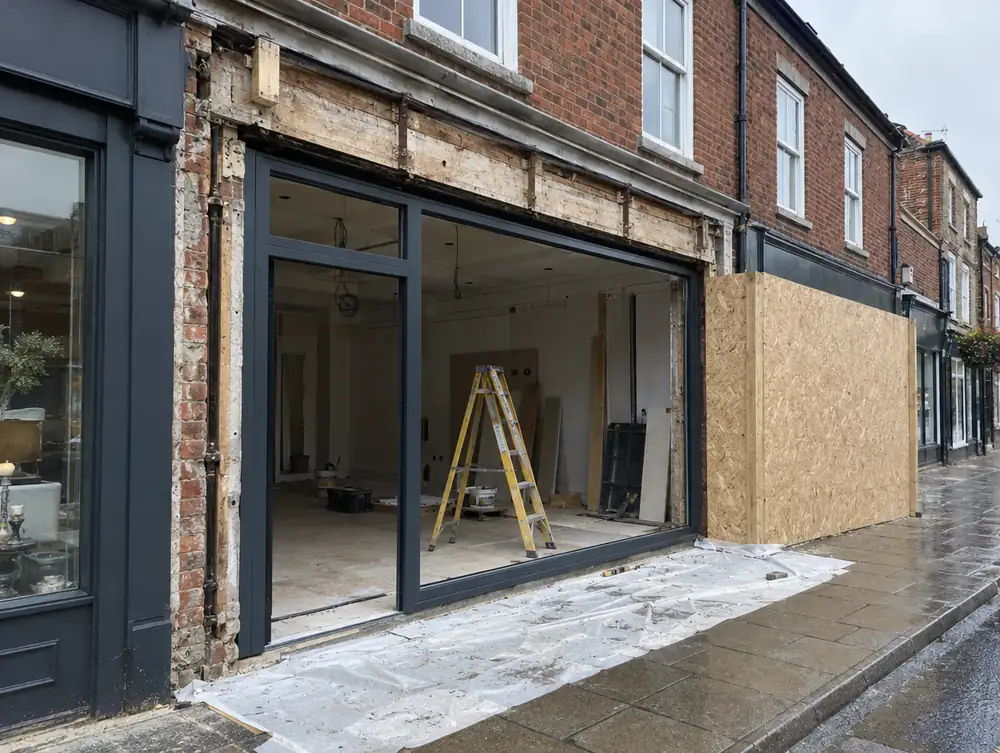
Where should you begin with shopfront refurbishment in Rhiwbina?
If your Rhiwbina shopfront is aluminium and the frame is sound, a recoat can change the whole look. We check for corrosion and old sealant first, because paint will not hide either for long.
Where the sign is the first thing that looks tired, we would start there and work down. A slimmer fascia and better letters can carry a modest frame very well.
If your Rhiwbina unit is narrow, a central door can split a small window into two weak ones. Moving the door to one side gives you a single confident pane, provided the layout inside still works.
What sign-off might you need for shopfront refurbishment in Rhiwbina?
Section 55 of the Town and Country Planning Act 1990 sets the test in Wales: work that doesn't materially affect the external appearance isn't development. Anything that does needs planning permission, and that goes for shopfront refurbishment at premises in the Rhiwbina area as much as for a full new frontage. The council confirms how the test applies to your site.
For Rhiwbina, the usual route for planning and advert applications is through City of Cardiff Council, and we confirm that when we visit.
What price should you expect for shopfront refurbishment in Rhiwbina?
We would budget £1,995 to £8,995 plus VAT depending on what is kept. Scope sets most of the figure, so a clear brief at the start does more for the budget than any later change of detail.
| Town | Rhiwbina |
|---|---|
| Area | South Glamorgan |
| Postcode districts | CF14 |
| Planning authority | City of Cardiff Council |
| Building approval | Building Regulations (Approved Documents for Wales) |
| Distance from Great Barr | About 90 miles |
| Survey | Free for new work |
Does Cardiff Council publish shopfront guidance?
Yes, Shopfront Design and Signage SPG (2019). It tells applicants what the council expects from new and altered shopfronts. A few of the things it asks for:
- A fascia should typically be no deeper than one-fifth of the shopfront's height.
- Solid or perforated roller shutters are not supported, and external shutters are unacceptable in the city centre, Cardiff Bay, conservation areas and on listed buildings.
- Where external shutters are allowed in exceptional cases in district or local centres, considerations include at least 50% transparency and a colour coating matching the shopfront.
Questions about shopfront refurbishment in Rhiwbina
Is it worth refurbishing an old aluminium shopfront in Rhiwbina?
Often, yes, if the frame is straight and the corners are tight. Recoating, new gaskets and better glass can add years of life. If the frame is corroded or the door has worn out its fixings, replacement may make more sense.
Can a refurbishment make my Rhiwbina premises easier to enter?
Often, yes. Lighter door closers, better handles and a lower threshold can all be added without replacing the frontage. We check the door width and the step at survey.
What if you find more damage on my Rhiwbina premises?
We stop, photograph it and show you the cost before going further. Nothing extra goes ahead without your agreement.
Can a shop fire exit in the Rhiwbina area use a sliding door?
No, a dedicated fire exit can't be a sliding or revolving door. In Wales, article 14(2) of the Regulatory Reform (Fire Safety) Order 2005 also says fire exit doors must open in the direction of escape and can't be locked against immediate use. The responsible person holds that duty, normally the employer or whoever controls the premises for a business, otherwise the owner.
Does a replacement shopfront in the Rhiwbina area need Building Regulations approval?
Assume yes until building control says otherwise, because Wales has no like-for-like exemption. Glazing is judged against Approved Document N, as Wales keeps Part N. A registered installer can self-certify replacement windows and doors in non-dwellings, but not structural glass, curtain walling or revolving doors.