A shopfront door used as a fire exit must not be locked against immediate use, and a door kept only for escape should open in the direction of travel and can't be sliding or revolving. The duty sits with the responsible person in England and Wales and with dutyholders in Scotland and Northern Ireland. Outward-opening doors can clash with highway law, so check both early.
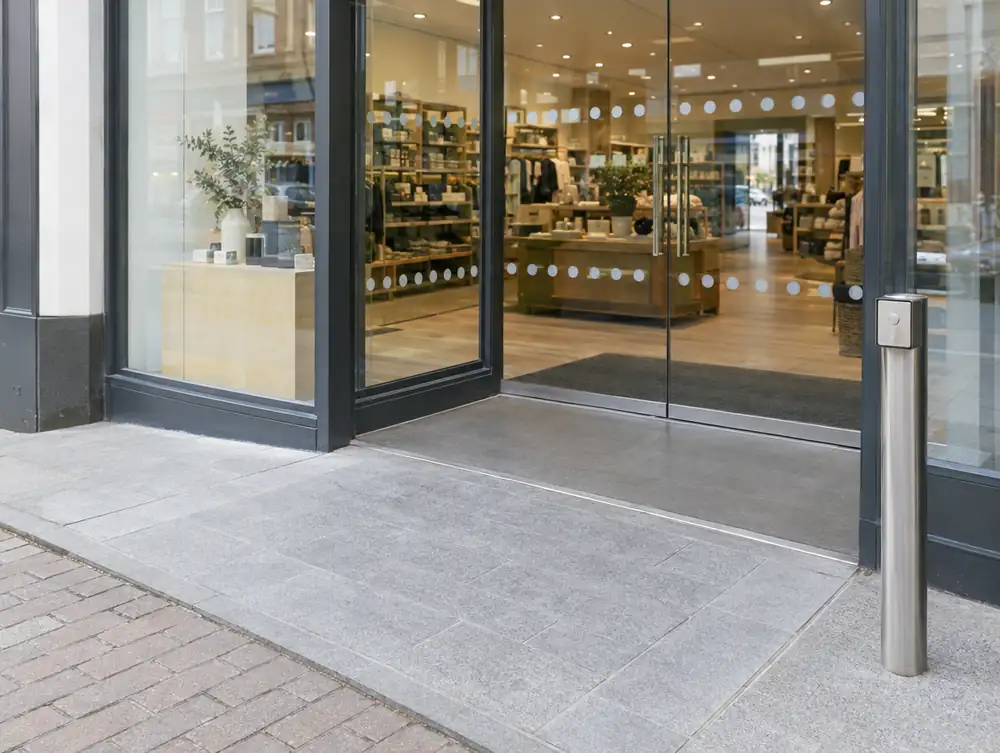
What are the rules for fire exits through a shopfront?
Fire exit doors must open easily and immediately, and they must not be locked against use while people are inside. Doors serving as exits open in the direction of escape, and a door kept only as a fire exit may not be sliding or revolving. The same core rule appears in all four nations, in different legislation.
Whoever runs or controls the premises holds the duty, and the words differ. England and Wales say responsible person, which means the employer, or the person controlling the premises for a business, or failing that the owner. Scotland's guidance says dutyholders, and in Northern Ireland the duty sits with the employer and the person in control, whom fire service guidance calls the appropriate person.
Your shopfitter or door installer doesn't take that duty from you. This guide describes what generally applies, so your fire risk assessment and your fire authority or building control remain the place to confirm the detail.
| Nation | Law | Duty sits with | Door rule |
|---|---|---|---|
| England and Wales | Regulatory Reform (Fire Safety) Order 2005 | Responsible person | Art 14(2) |
| Scotland | Fire (Scotland) Act 2005 Pt 3 | Dutyholders | 2006 Regs reg 13(2) |
| Northern Ireland | 2006 Order Arts 25-26 | Employer and person with control | Fire Safety Regulations (NI) 2010 reg 13(2) |
Which way must a shop fire exit door open?
A fire exit door should open in the direction of escape, which for a shopfront means outward. Scotland's guidance states the exception most plainly: doors open with escape unless occupancy is 60 or fewer. Many small shops rely on a main door that opens inward, and whether that is acceptable depends on your numbers and your fire risk assessment.
Check this before fixing the door design. People like a door that swings in, because it stays clear of the pavement and pulls customers into the shop, and a new frontage is the moment to get that decision right. A double-action door on a floor spring can swing both ways, and it suits some entrances, although a closer setting that is heavy enough to hold against wind can be a problem for access.
Keep the route clear to the door as well. Display stands, tills and queue rails drift towards the entrance over time, and a clear exit on the drawing can be a cluttered one a year later.
Can an outward door open over the pavement?
Not freely, and this is where fire law and highway law can collide. In England and Wales, s.153 of the Highways Act 1980 bars doors opening outwards over a highway, with public buildings able to do so by consent. Northern Ireland's Art 56 needs Department consent, and Scotland's s.67 appears to address the same subject, so ask the roads authority.
On our reading, an outward escape door can therefore clash with either provision. The usual way out is a recess. Set the door back far enough that the open leaf stays within your own threshold, with the depth at least equal to the leaf width, and the clash goes away. Allow for the 1500 x 1500mm landing while you are at it.
Where a recess isn't possible, raise it with the council and the highway authority before ordering. Setting the whole frame back into the shop may cost you a small amount of floor area, and that can be a sensible price for avoiding the problem.
Can an automatic or sliding door be a fire exit?
Not on a dedicated fire exit, because sliding and revolving doors are ruled out there in all four nations. A main entrance used by customers every day is a different case, although it needs checking if it forms part of the escape route. Many designs pair a sliding door with a hinged leaf beside it, so that an ordinary door is always available.
On an escape route, Scottish guidance calls for BS 7036 design and fail-safe conditions on revolving and automatic doors. England's guidance is that a powered door must open if the power fails and must never trap anyone. Break-out sliding leaves exist for this purpose, so ask for the product's test evidence and let the fire risk assessment decide whether it is acceptable.
What locks and exit hardware can a shopfront door use?
Use hardware that opens in one movement without a key whenever people are inside. BS EN 1125 covers horizontal-bar panic exit devices, usually chosen where members of the public use the exit. Lever or push-pad devices fall under BS EN 179, more often used where staff know the door.
Security is the usual conflict. Bolts, deadlocks and hook locks that make a front door strong are fine after everyone has left, but they must not be in use while staff are cashing up inside. Thumb-turn cylinders and a clear closing routine go a long way. A magnetic lock needs to release on alarm and on power failure, so involve your alarm engineer in that design.
Roller shutters and internal grilles over an exit need the same thought. It must be fully open whenever anyone is on the premises, and a key-operated shutter that a junior member of staff can't open is a real risk.
Do I need to update the fire risk assessment after a new shopfront?
Yes, you should review it, because a new door, screen or layout changes the means of escape. Building regulations can apply too. In England and Wales, regulation 3 treats work as a material alteration where it leaves a building worse against Part A, B1, B3, B4, B5 or M.
England's Approved Document B Volume 2 places shops in purpose group 4, and Wales has its own edition, amended from 20 December 2025. Scotland uses Standard 2.9, and Northern Ireland uses Technical Booklet E, changed by AMD 9 from 6 May 2025. Mention the door to flats above the shop if there is one, as that door often forms part of a separate escape route and must work throughout the job.
Common questions
Who holds the fire duty in a rented shop?
Usually the employer running the shop, though a landlord who controls shared areas can hold duties too. More than one party can be involved, so agree in writing who does what.
Can I lock the fire exit when the shop is closed?
Yes, once nobody is inside. Locks should come off as soon as anyone is back on the premises.
Can a bi-folding shopfront be my fire exit?
Don't rely on the folding panels, as they are slow and awkward to open under pressure. A hinged traffic door within the set is the usual exit, and your fire risk assessment should confirm it.
Does my fire exit need a sign?
Fire safety signs are a matter for your fire risk assessment, so ask whoever carries it out. Allow a position for them in the design, as they can clash with manifestation and brand graphics.